


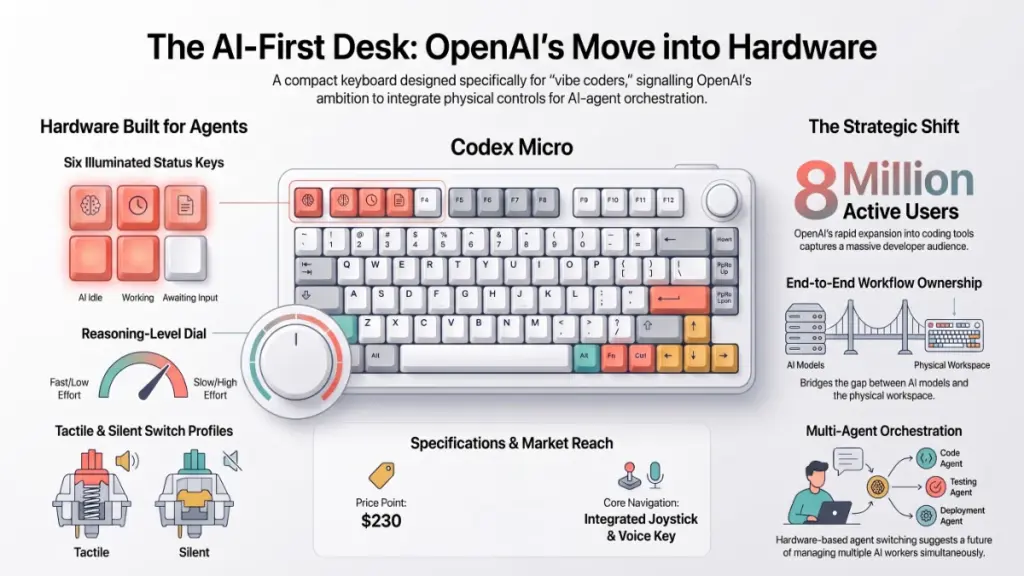
OpenAI has introduced the Codex Micro, a $230 mechanical keyboard built specifically for Codex AI coding workflows. Featuring AI agent controls, a reasoning dial, voice input, and multi-agent switching, it marks OpenAI’s first hardware product. The launch highlights the company’s growing focus on AI-assisted software development and signals that dedicated AI hardware could become an important part of future developer workflows.
OpenAI has stepped into hardware for the first time. Its new product is the Codex Micro, a compact $230 keyboard built for developers who work daily inside Codex, OpenAI’s AI coding assistant. The device was co-engineered with keyboard maker Work Louder, and it went on sale this week. As a result, it signals just how central AI-assisted coding has become to OpenAI’s roadmap.
This isn’t the long-rumored Jony Ive collaboration. That project, according to OpenAI’s CFO, won’t surface until later this year. Instead, the Codex Micro is a narrower, more practical release. Specifically, it’s aimed at “vibe coders,” the growing group of developers who lean on AI agents to write, debug, and orchestrate software in real time.
What’s Inside the Codex Micro
The Codex Micro isn’t just a rebranded mechanical keyboard. Rather, it’s built around one specific job: managing AI coding agents. To do that, it includes hardware controls that map directly onto Codex’s interface.
Key features include:
- Six illuminated agent-status keys that show whether an AI agent is idle, working, or waiting on input
- Instant agent switching, useful for developers running multiple agents in parallel
- A reasoning-level dial, which lets users tune how much computational effort an agent applies to a task
- A navigation joystick for moving through code and agent outputs without touching a mouse
- Programmable shortcut keys for frequent Codex actions, including a dedicated voice-recorder key for audio prompts
True to Work Louder’s mechanical-keyboard roots, the Codex Micro also ships in two switch profiles. One is a tactile “clicky” version, while the other is a quieter “silent” version. Because of this choice, the keyboard can fit into open-plan offices just as easily as home setups.
Why OpenAI Is Betting Big on Codex
This launch doesn’t happen in a vacuum. Over the past several months, OpenAI has poured resources into Codex. For instance, it has run aggressive advertising pushes and offered free usage incentives to pull developers away from rival AI coding tools.
So far, that push seems to be paying off. According to Codex engineering lead Thibault Sottiaux, Codex and the related ChatGPT Work product have already reached 8 million active users combined. Additionally, OpenAI recently merged Codex directly into the ChatGPT desktop app. As a result, agentic coding is becoming a default, always-on experience rather than a separate tool developers have to seek out.
Seen in that light, the Codex Micro isn’t just a novelty gadget. Instead, it’s a physical extension of OpenAI’s broader strategy: owning the AI coding workflow end to end, from the model, to the interface, and now, to the desk itself.
Why It Matters for Developers and Remote Teams
Developers, engineering managers, and remote-first teams are increasingly relying on AI pair-programming tools. For that reason, this release carries a few concrete implications:
- Multi-agent orchestration is becoming mainstream. Because OpenAI built dedicated hardware just for switching between agents, it clearly expects developers to juggle several agents at once, not just one chatbot window.
- Reasoning-level control is moving into everyday workflows. A physical dial for adjusting agent reasoning depth suggests a future where trading speed for accuracy becomes as routine as adjusting volume.
- Voice-driven prompting is gaining ground. The built-in voice recorder points to rising demand for hands-free, spoken interaction with AI coding assistants. This matters for accessibility, and also for developers who work across multiple screens.
- Competitive pressure is intensifying. Codex’s user base is already in the millions. Consequently, rival AI coding platforms will likely face pressure to differentiate on workflow ergonomics, not just model quality.
For digital marketers and automation specialists, the Codex Micro is a useful signal too. It shows that the “frontier AI stack” is expanding beyond software. Increasingly, hardware accessories, voice interfaces, and physical controls are becoming part of how vendors compete for developer mindshare and daily engagement.
The Bigger Picture
The Codex Micro is a small product, but it sends a big signal. OpenAI clearly sees AI-assisted coding not as a mere feature, but as a platform worth building dedicated hardware around. As agentic coding tools mature, more vendors will likely follow suit. From established SaaS players to AI startups, expect experimentation with purpose-built accessories, voice interfaces, and workflow-specific controls.
Ultimately, the Codex Micro’s success will depend on adoption. Specifically, it hinges on how deeply multi-agent, voice-driven coding workflows take hold over the next year. For now, though, it’s a clear marker of where OpenAI is placing its chips. It also offers an early preview of what “AI automation” hardware might look like across the industry.