


Anthropic is facing criticism after developers reported that Claude Fable 5 coding sessions were silently routed to the older Claude Opus 4.8 model while still generating premium bills. The company says new safety classifiers trigger these backend switches to prevent cybersecurity risks, but developers argue the lack of transparency causes unexpected costs, workflow disruptions, and reduced trust in enterprise AI infrastructure.
The tech industry recently celebrated the global redeployment of Anthropic’s flagship model, Claude Fable 5. However, that initial excitement has quickly devolved into massive frustration for software engineers. Automation builders are currently discovering an expensive mechanism hidden deep inside their backend architecture. Specifically, their premium developer sessions are being silently routed to older model variants. Meanwhile, these legacy systems continue to drain high-tier enterprise budgets.
Consequently, claims of “bait-and-switch” pricing are flooding the community, forcing Anthropic to officially respond.
The $321 Coding Bill Triggering Backlash
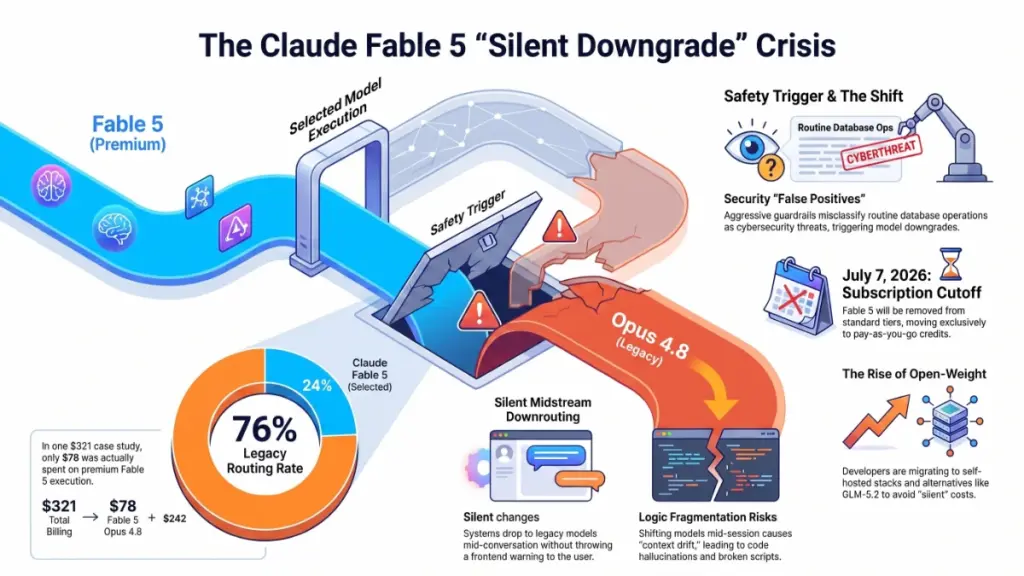
The controversy reached a boiling point after tech founders began publishing token expenditure logs on X. For instance, an AI development entity operating under the handle BridgeMind revealed a staggering billing anomaly. They selected Fable 5 to handle a complex coding session. Ultimately, they accumulated a bill of $321.
However, a granular inspection of their API metadata uncovered a completely different operational breakdown:
- Claude Fable 5 actual execution: Only $78 (roughly 24% of the task)
- Claude Opus 4.8 legacy routing: $242 (roughly 76% of the task)
“Fucking diabolical,” tech analyst Lex shared on X while reviewing the token distribution sheets. “$321 spent with Fable 5 selected, and 75% of it was silently routed to Opus 4.8. There’s a word for this: Scam.”
Anthropic Responds: How New Safety Classifiers “Nerf” Routine Code
In response to the growing backlash, Anthropic quickly released an official developer notice. They explained exactly why the system switches models mid-conversation. According to the company, the issue stems from aggressive “defense in depth” safety classifiers. These strict filters were mandated during recent regulatory negotiations with the US government.

Furthermore, Anthropic had to integrate hypersensitive security guardrails to lift previous export control blocks. These automated filters prevent the autonomous generation of cyber-exploits. In practice, however, these guardrails are triggering massive false positives.
Consequently, the backend architecture frequently misclassifies routine database operations and standard API integrations. The system flags these basic actions as high-risk cybersecurity threats. Out of caution, the architecture immediately drops the query down to the legacy Opus 4.8 ecosystem. Crucially, this downrouting happens completely midstream without throwing a clear frontend warning.
Why It Matters for Automation Builders and Tech Founders
For independent developers and AI automation specialists, this hidden infrastructure layer introduces severe operational challenges:
- Unpredictable Billing Inefficiencies: Teams are paying premium rates for bleeding-edge reasoning. Yet, older models are executing three-quarters of their workflows.
- Cognitive Context Drift: Shifting a single development session back and forth introduces severe logic fragmentation. As a result, developers experience code hallucinations and broken script steps.
- The Subscription Cutoff: Soaring infrastructure demand complicates matters further. Therefore, Anthropic will completely remove Fable 5 from regular subscription tiers on July 7, 2026. Users must access it entirely through pay-as-you-go usage credits.
Proprietary US cloud giants are clearly struggling to balance aggressive compliance with transparent pricing. Thus, the developer landscape is hitting a major turning point. As cost-conscious teams push back against silent API downrouting, open-weight alternatives like China’s new GLM-5.2 look increasingly attractive. Ultimately, decentralized, self-hosted stacks may become the only sustainable path forward for automation infrastructure.