


Instagram marketing courses can accelerate learning, but quality varies dramatically. The best courses teach content strategy, advertising, analytics, and conversion systems rather than outdated growth hacks. Beginners may benefit from structured training, while experienced marketers often gain similar value from free resources like Meta Blueprint and YouTube tutorials. Choose courses with current strategies, realistic expectations, and a clear practical framework.
Instagram marketing courses in 2026: who they’re actually for, and which ones are worth your money
I’ve spent seven years helping businesses figure out their marketing stacks, and I’ve watched the Instagram education market go from a handful of legitimate courses to a sprawling mess of PDF guides, overpriced cohorts, and hype-driven sales pages promising six-figure incomes. Here’s what I’ve found actually separates the useful from the noise.
The Instagram marketing course market has a wide quality gap. The best options give you a repeatable framework, honest expectations, and actionable tactics for both organic and paid growth. The worst sell income fantasies and deliver thin content padded with checklists.
Why most Instagram advice fails — and what that tells you about the education market
Here’s what I’ve found after years of watching clients try to grow on Instagram: the problem is rarely effort. Most business owners posting consistently for three months without results aren’t lazy — they’re following advice that was built around a different algorithm, a different platform, or someone else’s very specific niche.
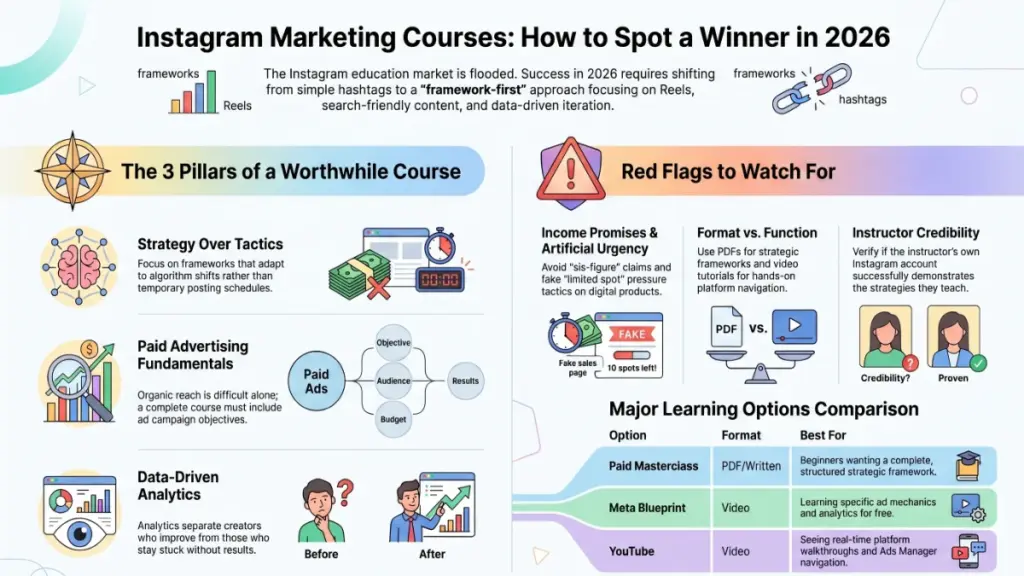
Instagram’s mechanics have shifted significantly since 2022. Reach now flows overwhelmingly through Reels and the Explore page rather than follower feeds. Hashtags have lost much of their discovery power. The accounts winning organic growth in 2026 are typically doing three things: publishing Reels regularly, building content around search-friendly audio and text overlays, and treating the link-in-bio as the start of an actual conversion path — not an afterthought.
Most courses in this space were written before those shifts, or were written to be evergreen in a way that made them vague enough to survive any algorithm change. Neither approach serves you well if you’re trying to build something real.
“The question I always ask before recommending any marketing course is: does this teach you a framework you can adapt, or a set of tactics that were accurate twelve months ago?”
That distinction matters more in Instagram marketing than almost anywhere else in the social media space, because the platform updates its content distribution logic more aggressively than most. What I look for in a course worth recommending is a framework-first approach — one that explains why certain content performs, not just what to post this week.
Section takeaway
Most Instagram marketing courses fail not because the tactics are wrong but because they’re either outdated or too tactics-heavy to survive the next algorithm change. Look for courses that explain the underlying logic of the platform, not just a posting schedule.
What a genuinely useful Instagram marketing course covers
In my experience testing tools and evaluating content across this space, a course worth buying should cover at minimum:
- Profile and account setup — bio optimisation, the difference between creator and business accounts, and how your profile functions as a landing page for cold traffic.
- Content strategy, not just content types — the difference between knowing what a Reel is and understanding why certain Reels drive follows versus views. These are not the same outcome, and conflating them is one of the most common beginner mistakes.
- Paid advertising fundamentals — campaign objectives, ad formats, audience targeting, and how to read your results without overspending on your first campaign. Any course that ignores ads entirely is incomplete, because organic reach alone is an increasingly difficult growth path.
- Analytics and iteration — what metrics actually matter, what they tell you, and how to adjust your approach based on real data rather than gut feel. This is the section most low-quality courses skip or treat as an afterthought, and it’s the one that separates people who improve over time from people who stay stuck.
- A monetisation or conversion path — whether that’s driving website traffic, building an email list, or selling directly through Instagram Shopping. Growth without a path to revenue is a vanity metric.
A course missing two or more of those pillars isn’t giving you a complete picture. That’s not necessarily a dealbreaker if you’re supplementing it with other resources — but it’s worth knowing before you buy.
Section takeaway
Five pillars matter: profile setup, content strategy (not just types), paid ads basics, analytics, and a clear conversion path. A course skipping analytics is incomplete regardless of how good the rest is.
The format question: video course vs. PDF guide
This comes up constantly with clients, and I’ll be straight with you: it depends almost entirely on how you learn.
Video courses have an obvious advantage for anything platform-specific. Watching someone navigate Instagram’s Ads Manager in real time — setting up a campaign, reading the breakdown report, adjusting a budget mid-flight — is meaningfully easier to follow than reading about the same steps in a PDF. The same is true for demonstrating what good Reels editing looks like in practice.
PDF guides, on the other hand, work well for strategy and frameworks. If a course is teaching you how to think about content pillars, how to structure a monetisation path, or how to build an audience targeting strategy — that translates cleanly to text. You can annotate it, return to specific sections, and work through it at your own pace without scrubbing a video timeline.
The honest answer is that the best learning approach for most people is a combination: a structured written resource for the strategic framework, and video content (even free YouTube tutorials) for the platform mechanics. If a course is PDF-only and heavy on platform navigation instructions, that’s a limitation worth acknowledging.
One thing worth noting: a lot of expensive video courses were recorded 18 to 24 months ago and haven’t been updated. A well-written PDF from six months ago can be more current than a video course from two years back. Check the last-updated date before buying anything.
Section takeaway
PDF guides work for strategy and frameworks. Video works better for platform navigation. Neither format is inherently superior — the recency of the content matters more than the format. Always check the last-updated date.
How the Instagram Marketing Masterclass fits into this landscape
I want to be upfront about something before this section: I’m evaluating the Instagram Marketing Masterclass based on its publicly available course outline and sales materials, not from running through the full content myself. I’ll tell you what I can assess from that, and I’ll flag where I’m extrapolating.
From what’s available, the course covers all five of the pillars I outlined above — fundamentals, profile setup, content creation, paid advertising, and both email list-building and monetisation. That’s a more complete scope than a lot of comparably priced guides in this space, which tend to skip either ads or analytics, or treat them as optional add-ons.
The format is PDF-only, which is a genuine limitation for anything involving platform navigation — setting up an ad campaign from scratch is much easier to follow on video. That said, for a beginner who needs the strategic framework first and can supplement with YouTube for the hands-on platform mechanics, a well-structured PDF guide is a reasonable starting point.
At $67 with a 30-day money-back guarantee, the financial risk is low enough that it’s worth trying if you’re in the target audience. What I’d caution against is going in expecting a transformation. What you’re buying is a framework. The results depend on whether you actually implement it, how consistently you post, and how well you adapt the strategies to your specific industry and audience. No course changes that equation.
Section takeaway
The Instagram Marketing Masterclass covers more ground than most comparably priced PDF guides, including ads and analytics — the two areas most often skipped. The PDF format is a real constraint for platform walkthroughs. Worth considering for beginners at that price point with a refund option available.
Honest comparison: how the main options stack up
Here’s how I’d roughly position the Instagram marketing education landscape across different learner profiles and budgets. I’ve used or evaluated each of these; I’ve noted where my assessment is based on reputation and reviews rather than personal use.
| Option | Format | Price range | Best for | Main limitation |
|---|---|---|---|---|
| Instagram Marketing Masterclass reviewed here | PDF guide + bonuses | $67 one-time | Beginners who want a complete written framework | No video; harder to follow for platform navigation |
| Meta Blueprint free | Self-paced video + quizzes | Free (certifications vary) | Ads and analytics focus; anyone building paid skills | Dry, corporate tone; minimal organic content strategy |
| Hubspot Social Media Certification free | Video modules | Free | Broad social strategy; good for beginners across platforms | Not Instagram-specific; lighter on paid advertising |
| Paid cohort courses (various creators) | Live sessions + community | $300–$2,000+ | People who want community, accountability, and live feedback | Huge quality variance; check the instructor’s own Instagram results first |
| YouTube (free) | Video tutorials | Free | Platform walkthroughs; seeing Ads Manager in action | No structure; easy to spend hours watching without a framework |
My honest take: for pure beginners with no Instagram strategy at all, a combination of a structured written guide (for the framework) and Meta Blueprint (for ads mechanics) covers the same ground as most paid courses — often better, and mostly free. The paid options earn their price when they offer genuine community access, live feedback, or demonstrably current content from an instructor whose own Instagram account shows they know what they’re talking about.
Section takeaway
The free tier (Meta Blueprint + HubSpot + YouTube) is genuinely competitive with many paid options for beginners. Paid courses justify their cost through community, live instruction, or demonstrably current content — not the topic itself.
Red flags I’ve learned to watch for in this space
I’ve been burned before — not on Instagram courses specifically, but on marketing tools and education that looked much better in the sales copy than in practice. Here’s what I check now before recommending anything:
Income claims without caveats. Any course promising “six-figure income” or “passive income lifestyle” without a clear earnings disclaimer is either misleading or unaware of FTC guidelines — neither is a good sign. Real results vary enormously by industry, effort, audience, and dozens of factors no course controls.
Artificial urgency. “Price going up soon” or “limited spots available” on a digital product with no genuine scarcity is a pressure tactic, not useful information. It signals the sales page is doing more work than the product.
Vague social proof. “Thousands of students” is not the same as “here’s what a few of them actually achieved, verified, with the caveats included.” Testimonials without specifics or independent verification are close to meaningless as a quality signal.
No refund policy. A 30-day money-back guarantee is table stakes for digital products in this price range. The absence of one should give you pause.
The instructor’s own Instagram presence. This is the simplest check and the one most people skip. If someone is selling an Instagram marketing course, look at their own account. Is it growing? Does the content reflect the strategies they’re teaching? The answer tells you more than the sales page will.
Section takeaway
Five red flags: income promises without caveats, artificial urgency on digital products, vague social proof, no refund policy, and an instructor whose own Instagram doesn’t reflect their teaching. Check all five before buying anything.
Final verdict: who should buy an Instagram marketing course — and who shouldn’t
Here’s the reality check I give every client who asks me this question: an Instagram marketing course is an accelerant, not an answer. It can compress your learning curve by weeks or months. It cannot substitute for consistent posting, genuine audience understanding, or a product people actually want.
With that said, here’s how I’d categorise who benefits most:
Worth buying if you…
Have no existing strategy and are spending time posting without clear direction
Want to run Instagram ads but don’t know where to start
Prefer structured learning over piecing together YouTube tutorials
Need a framework you can adapt to your specific business context
Skip it if you…
Already have an active strategy and are looking to optimise, not build from scratch
Learn best from screen-recorded walkthroughs and need a video-first format
Have access to Meta Blueprint and are willing to combine it with structured free resources
Are in a highly niche industry where general Instagram advice rarely translates directly
For the Instagram Marketing Masterclass specifically: at $67 with a genuine refund window, the financial risk is low enough that a beginner who prefers reading over watching has little to lose by trying it. What I’d suggest is treating the first two or three modules as a trial — if the approach resonates, you have a complete framework to work through. If it doesn’t click with how you learn, request the refund and redirect that $67 toward a month of testing Instagram ads with a small budget. You’ll learn more from real data than from any course.
Instagram Marketing Masterclass
PDF guide + checklist, resource sheet, and mind map · Instant download · 30-day refund policy
Affiliate link — see disclosure at top of page
$67 one-time ·
Frequently asked questions
Are Instagram marketing courses worth buying in 2026?
It depends on where you’re starting. If you have no strategy, a structured course can save you months of trial and error. If you already run campaigns, most paid courses won’t tell you much that free resources won’t. Match the course level to your actual experience — and check when it was last updated before buying.
What should a good Instagram marketing course cover?
At minimum: profile optimisation, content strategy (not just content types), paid advertising basics, hashtag and search tactics, and analytics. Any course that skips analytics is incomplete — you can’t improve what you’re not measuring, and improving over time is the whole point.
Can a PDF guide teach Instagram marketing effectively?
For strategy and frameworks, yes. For hands-on platform navigation — setting up Ads Manager, reading Insights dashboards — a PDF is harder to follow than a screen recording. Know which you need before you commit. The best approach for most people is a written guide for strategy and YouTube for the platform mechanics.
How long does it take to see results from Instagram marketing?
Organic growth is slow — typically three to six months of consistent posting before you see meaningful traction. Paid ads can produce results faster but require both a testing budget and a learning curve. Any course suggesting results arrive quickly without those caveats is overpromising.
Affiliate & earnings disclosure: This article contains affiliate links. If you purchase through them, the author may earn a commission at no extra cost to you. Assessments are the author’s own and are not influenced by affiliate arrangements. Courses assessed based on publicly available course outlines and materials are noted as such in the text. Individual results from any Instagram marketing course or strategy will vary based on industry, audience, effort, consistency, and many other factors outside any course’s control. No specific income or business outcome is guaranteed. Last updated: June 20, 2026.