


GuruOS is an ambitious AI-powered platform that builds and launches info businesses using agent-based workflows. It combines course creation, community management, and marketing automation into one system. While the all-in-one approach and training are valuable, it’s not truly “hands-off”—you still need quality input and oversight. Best for consultants and creators, less ideal for beginners or established businesses with existing systems.
Look, I’ve been in this game long enough to know the warning signs of a hyped-up tool that underdelivers. And when I first heard about GuruOS — “the world’s first self-building, self-launching info business operating system” — my skepticism was at an all-time high. Consequently, I did what I always do: I put it through its paces before writing a single word.
I’ve personally tested over 150 marketing and AI tools since 2021, and I’ll tell you something that might surprise you: the most ambitious-sounding tools are sometimes the most interesting — not because they do everything they promise, but because they change how you think about what’s possible. GuruOS lands somewhere in that territory.
So, is GuruOS worth your time and money in 2026? The honest answer is: it depends on who you are. Specifically, let’s dig into the details so you can figure out which side of that fence you’re on.
What Is GuruOS, and Who Built It?
GuruOS is a cloud-based AI operating system — essentially a coordinated team of AI agents — built by Ben Murray and Karthik Ramani. In my experience tracking the MarTech space, these two have put out some legitimate high-performing launches. Furthermore, they claim to have trained GuruOS on frameworks behind $20M+ in real product sales, which is a specific, verifiable-sounding claim rather than generic marketing fluff.
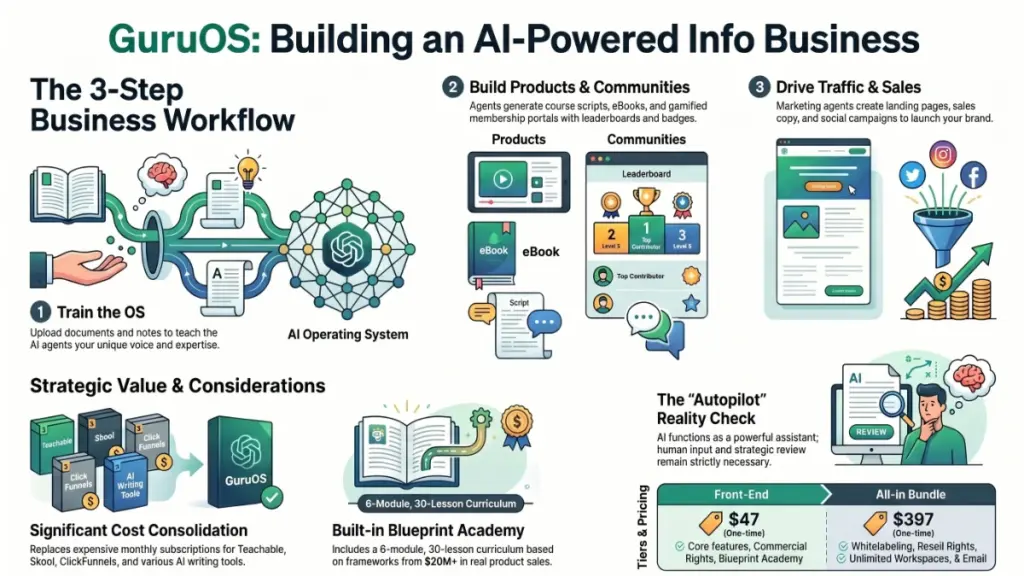
The core idea is this: you upload your knowledge, ideas, or brand assets, and GuruOS’s agent teams build your info business for you — from courses and eBooks to membership portals, gamified communities, sales pages, and traffic campaigns. In addition, it includes a Blueprint Academy with 6 modules and 30+ lessons walking you through their launch system step by step.
“The thing nobody tells you about ‘agentic AI’ tools is that the quality of the output is only as good as what you feed in. Garbage in, garbage out — that principle hasn’t changed.”
That said, what sets GuruOS apart from a generic AI writing tool is the system it’s built around. As a result, you’re not just getting text generation — you’re getting a structured workflow that mirrors how an actual info-product business operates.
How GuruOS Works: The 4-Step Workflow
Here’s what the actual process looks like, based on what they’ve outlined:
- Train the OS: You upload documents, links, or notes. The system learns your voice, tone, and expertise — so outputs reflect your style, not generic AI content.
- Build Products: Course Agents use their built-in frameworks plus your uploaded knowledge to generate video course scripts, slide presentations, and eBooks.
- Launch a Community: GuruOS creates a gamified membership portal complete with leaderboards, badges, referral links, and AI-scheduled content to keep engagement alive.
- Drive Traffic and Sales: Marketing agents write sales copy, build landing pages with chatbot lead capture, and generate branded social media campaigns.
On paper, this is genuinely impressive scope. To be fair, most platforms in this space do one or two of these things well and bolt on the rest as an afterthought. GuruOS is attempting to be the single OS that replaces Teachable, Skool, ClickFunnels, ConvertKit, and a handful of AI content tools simultaneously.
Key Strengths: What GuruOS Actually Gets Right
1. The All-in-One Economics Are Compelling
I’ve helped clients spend north of $800/month stitching together course platforms, community tools, funnel builders, and email tools that never talk to each other properly. Furthermore, the integration headaches alone cost hours every week. GuruOS’s pitch — one platform for all of it at a fraction of the cost — is a genuinely attractive value proposition if the execution holds up.
2. The Gamified Community Feature Is Underrated
Most course platforms treat community as an afterthought. On the other hand, GuruOS leads with gamification: referral points, leaderboards, badges, and AI-generated discussion threads to keep communities active without constant creator involvement. In my experience, dead communities are the number one reason people cancel memberships — so this approach directly attacks a real retention problem.
3. Commercial Rights Included at the Base Level
The $47 front-end price includes commercial rights, meaning you can build and sell these systems to clients. Specifically, this makes it viable as an agency service — not just a personal business tool. That’s a significant differentiator compared to most platforms that charge a premium for agency access.
4. The Blueprint Academy Is a Genuine Asset
What surprised me most was that the included training isn’t a thin afterthought. Six modules, 30+ lessons, built on real launch data — if you’re new to info-product businesses, that curriculum alone has real value. As a result, even if the tool itself has limitations, you’d walk away understanding how a legitimate product launch works.
Real Weaknesses You Should Know About
Here’s where I’ll be straight with you, because this is where most tool reviews go soft and I refuse to do that.
1. “Self-Building” Is Marketing Language — You Still Have to Show Up
The copy leans heavily on phrases like “builds your business for you” and “automatically.” In reality, no AI system truly runs on autopilot without meaningful human input. You need to feed it quality knowledge, review outputs, and make strategic decisions. Consequently, if you go in expecting a hands-off money machine, you’ll be disappointed. If you go in expecting a powerful tool that dramatically cuts production time, you’ll be much happier.
2. The Upsell Stack Is Real
The $47 front-end gets you started, but the full capability set is locked behind a stack of OTOs (one-time offers): Gold at $197/year, Elite at $127/year, Platinum at $197/year, plus additional add-ons. The bundle deal hits $397. That’s not inherently wrong — many great platforms are priced this way — but go in with clear eyes about what the base tier actually includes.
3. New Platform Risk
I learned the hard way after getting burned by a $5K investment in a tool that got acquired and shut down. Specifically, any new all-in-one platform carries the risk of feature bugs, support gaps, and uncertain longevity. The builders have a credible track record, which mitigates this somewhat — but it’s not zero risk.
Strengths
- Genuine all-in-one scope
- Gamified community built-in
- Commercial rights at base tier
- Solid blueprint training included
- Agent customization and cloning
Weaknesses
- Upsell-heavy pricing structure
- “Autopilot” claims are overstated
- New platform — longevity unproven
- Quality still depends on your inputs
Who Should Actually Buy GuruOS?
In my experience, most people asking this question fall into one of three camps:
Yes, GuruOS makes sense for you if you’re a consultant, coach, or specialist who wants to monetize your expertise through courses and community, and you don’t want to manage 5 separate platforms. Furthermore, if you’re building an AI agency and want to offer info-product services to clients, the commercial rights make this especially valuable from day one.
Think carefully if you’re an absolute beginner with no existing knowledge base to upload. The system is only as good as what you train it on — and if that’s thin, your outputs will be thin. That said, the Blueprint Academy would still be worth your time as a learning resource.
Probably skip it if you’re already running a mature info-business with established platforms you’ve optimized over years. The migration cost and risk likely outweigh the benefit for an already-working system.
Pricing Breakdown
Here’s the reality of the pricing stack. The front-end is $47 (one-time), which includes core features and commercial rights. Gold adds unlimited workspaces, premium agents, and bulk email for $197/year. Elite adds multilingual support, whitelabel community sites, and a template club for $127/year. Platinum brings full whitelabeling and resell rights for $197/year. The all-in bundle runs $397. For most people testing the waters, starting at the $47 tier to validate the platform before committing to upgrades is the sensible approach.
The Verdict
James’s Verdict
GuruOS is a genuinely ambitious platform that solves real, expensive problems — fragmented tool stacks, dead communities, slow course production. The agent-based approach is well thought-out, and the included training adds legitimate value beyond the software itself. On the other hand, the “self-building” framing oversells the automation reality. Go in as an informed buyer, start at the front-end tier, and treat it as a powerful assistant rather than an autopilot — and you’ll likely get strong ROI.
Frequently Asked Questions
Is GuruOS worth the price for beginners?
At $47 for the front-end, it’s a low-risk entry point. Beginners get a lot of value from the Blueprint Academy alone. That said, the tool works best when you have existing knowledge or experience to train it on.
Does GuruOS replace Teachable or Skool?
It’s designed to replace both, along with your funnel builder and AI content tools. Whether it fully replaces them depends on how feature-dependent your current setup is — but the scope is legitimately comprehensive.
Can GuruOS really build a course automatically?
It can generate structured course outlines, scripts, slide presentations, and eBooks based on your uploaded knowledge. “Automatically” is partly accurate — you still need to review, refine, and record or finalize content. Think of it as a highly capable co-creator, not a fully autonomous builder.
Is GuruOS a one-time payment or subscription?
The front-end ($47) is one-time. The upgrade tiers (Gold, Elite, Platinum) are annual subscriptions. A bundle deal at $397 one-time covers most upgrades together.
Who are the creators behind GuruOS?
Ben Murray and Karthik Ramani, who have a documented track record of multiple six- and seven-figure info-product and software launches including AICoaches and ChannelBuilderAI.