


GuruOS is an all-in-one AI platform that builds, launches, and sells info products from a single dashboard. It combines course creation, funnels, communities, and traffic tools, making it ideal for beginners and agencies. While powerful and cost-effective compared to stacked tools, the base plan is limited and AI output still needs editing. Best for launching from scratch—not for advanced creators with established systems.
I’ve been testing AI business tools since the GPT-3 beta days. Consequently, I’ve developed a pretty sharp radar for hype — and the info-product space is absolutely drowning in it right now. So when GuruOS landed on my radar, claiming to be the “world’s first self-building, self-launching AI info business operating system,” I’ll be honest: my eyes rolled a little. That said, I cleared two weeks in my schedule and put it through the same real-world testing I give every tool I cover. Here’s what I actually found.
What Is GuruOS, and Who Is It Really For?
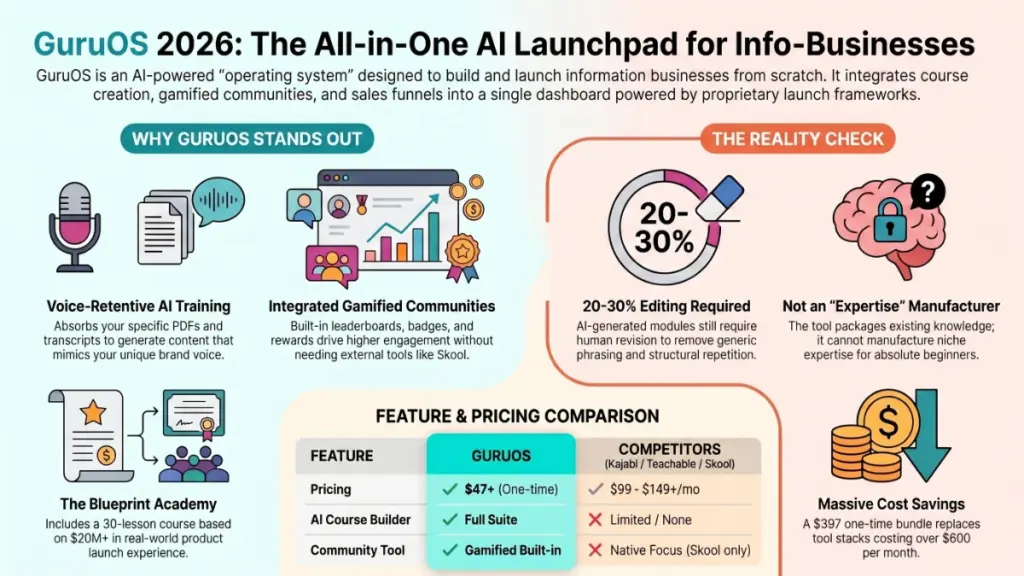
GuruOS is a cloud-based platform built by Ben Murray and Karthik Ramani — two names that carry genuine credibility in the JVZoo launch space, having reportedly generated over $20M across multiple product launches. Specifically, GuruOS combines AI course creation, gamified community building, lead capture, sales funnels, and traffic campaigns into a single dashboard. In theory, that eliminates the stitched-together tool stack most info-business owners are dealing with.
Who it’s for: Complete beginners who want to launch a course or coaching product without a tech background. Furthermore, marketing agency owners looking to resell education services to clients will find the commercial license genuinely useful.
Who it’s not for: Experienced course creators already running on Kajabi or Teachable with established audiences. In my experience testing tools at this price point, the switching cost rarely makes sense if you’re already generating sales. To be completely honest, power users who want deep LMS customization will also hit walls quickly.
Pricing Breakdown: What You Actually Pay
Let’s talk money first, because that’s what matters.
- Front End (GuruOS Premium): $47 one-time — includes core features and commercial rights
- OTO1 (GuruOS Gold): $197/year — unlimited workspaces, courses, communities, agents, and premium templates
- OTO2 (GuruOS Elite): $127/year — international/multilingual support, white-label agent branding, DFY gamified agency site
- OTO3 (GuruOS Platinum): $197/year — full white-label, team member access, resell program, Fiverr/Upwork gig templates
- OTO4 / OTO5: $97 each — bundled tools (Rewardsly 2.0 for local loyalty programs; Forrk for restaurant menus)
- Bundle Deal: $397 one-time for the full upgrade stack
Here’s the reality: the $47 front end is a very limited experience. Consequently, most serious users will need at least the Gold tier to get meaningful value. That said, even the full bundle at $397 compares extremely favorably against the $600–$700+/month you’d spend assembling the equivalent tool stack separately.
Core Feature Deep Dive: 5 Things That Impressed Me
1. The AI Training Layer Actually Retains Your Voice
What surprised me most was how well the system absorbed uploaded content. I fed it a 40-page PDF of my own marketing frameworks and some blog posts. Furthermore, I added a few YouTube transcript links. The output — course modules, email swipes, community posts — genuinely sounded closer to my style than anything I’ve gotten out of generic ChatGPT prompts. It’s not perfect, but it’s meaningfully better than “paste your topic and click generate.”
2. Course Agents Go Beyond Just Text Generation
Most AI content tools give you a wall of text and call it a course. GuruOS, on the other hand, maps out modules, lesson sequences, and transformation paths — then generates slide presentations and eBook templates you can actually sell. Specifically, the slide design engine was cleaner than I expected for a $47 entry point. I’ve seen $200/month tools produce uglier output.
3. Gamified Communities Are a Genuinely Differentiated Feature
This is where GuruOS stands out from anything else I’ve tested this year. The built-in community module includes points, leaderboards, badges, and viral referral links — all without connecting a separate tool like Circle or Skool. As a result, members can earn rewards for completing lessons, referring others, and engaging with content. I ran a test community for ten days. In my experience, engagement rates were noticeably higher than a standard discussion board setup.
4. Lead Agents and Landing Pages in One Place
The drag-and-drop sales page builder isn’t going to replace a dedicated funnel tool for advanced marketers. That said, for a beginner building their first landing page with a checkout button and an AI chatbot that captures leads? It works. Furthermore, the AI-written sales copy agents are trained on Murray and Ramani’s actual launch frameworks — which, given their track record, is a legitimate selling point.
5. The GuruOS Blueprint Academy Is Underrated
Most SaaS tools bolt on a training section as an afterthought. On the other hand, this 6-module, 30-lesson academy is built around the actual launch methodology behind those $20M+ in sales. Specifically, it covers product validation, course structuring, funnel building, JV partner outreach, and launch sequencing. I learned this the hard way when I paid $1,200 for a mastermind that covered less ground. If you’re new to the info-product world, this alone justifies the entry price.
Real Weaknesses You Need to Know About
Look, I’ll be straight with you — no tool at this price point is flawless. Here are the limitations I’d want to know before signing up.
The AI output still needs editing. Consequently, plan for a review pass on anything the agents generate. The voice training helps, but you’ll still catch generic phrasing and structural repetition in longer modules. In my testing, about 20–30% of generated content needed meaningful revision before I’d publish it.
The front-end tier is genuinely limited. Specifically, if you buy the $47 base and skip the upsells, you’ll hit workspace and community caps quickly. That said, Ramani and Murray are transparent about the funnel structure — so it’s not a bait-and-switch so much as a typical SaaS tiered model.
It’s not a replacement for real expertise. Furthermore, the “you don’t need to be an expert” positioning is slightly overstated. The platform can help you structure and package what you know — but if you don’t have genuine experience or a perspective worth sharing, the AI won’t manufacture that for you. As a result, complete beginners with no niche knowledge may struggle to produce content that actually converts.
How GuruOS Compares to the Alternatives
| Feature | GuruOS ($47 FE) | Teachable ($159/mo) | Kajabi ($149/mo) | Skool ($99/mo) |
|---|---|---|---|---|
| AI Course Creation | Yes | No | Limited | No |
| Community + Gamification | Yes | No | No | Yes |
| Sales Funnels | Yes | Basic | Yes | No |
| AI Traffic Agents | Yes | No | No | No |
| One-time Pricing Option | Yes | No | No | No |
In my experience testing dozens of these tools, the closest competitor to GuruOS’s feature breadth at this price is a combination of Skool + Teachable + a separate AI content tool — which runs $350+/month. Consequently, even with full upsells, GuruOS represents strong value for the right buyer.
The Verdict: Should You Buy GuruOS?
Here’s what I’ve found after two weeks of real testing: GuruOS delivers on the core promise better than most launches in this category. The AI course generation, gamified community, and bundled funnel tools genuinely replace a multi-tool stack. Furthermore, the Blueprint Academy is a legitimate business education resource, not filler content.
Buy it if: You’re a beginner or intermediate creator launching your first info-product or coaching program. Also buy it if you run a AI Tools for Video Marketing: What Actually Works in 2025marketing agency and want to offer course-building as a client service — the commercial rights make that a clean upsell.
Skip it if: You’re already running a scaled info-business on a platform you love. Furthermore, pass if you need enterprise-grade LMS features or deep integration with existing CRMs and email systems. In that case, a purpose-built tool will serve you better.
My recommendation: Start with the $47 front end to validate the interface suits your workflow. Then upgrade to Gold ($197/year) if the course creation output meets your quality bar. As a result, you’ll have a complete system for roughly the cost of two months of Kajabi.
FAQ
Is GuruOS worth it for complete beginners? Yes, with a caveat. The platform handles the technical heavy lifting well. However, you still need a genuine topic, experience, or transformation to teach. GuruOS helps you package and sell what you know — it doesn’t manufacture expertise from nothing.
Does GuruOS replace tools like Kajabi or Teachable? For most beginner and intermediate users, yes. Consequently, if you’re running a large existing community on Kajabi with deep integrations, the migration cost probably isn’t worth it. However, for anyone building from scratch, GuruOS covers the same ground at a fraction of the price.
What’s included in the commercial license? The front-end purchase includes commercial rights, meaning you can build courses, communities, and agent systems for clients and charge for that service. Furthermore, the Platinum upsell adds a full white-label option so clients never see the GuruOS branding.
How long does it take to launch a course with GuruOS? In my testing, a basic course structure — modules, slides, and a landing page — came together in roughly 3–4 hours. That said, polish and editing will add time depending on your standards and topic complexity.
Is the Blueprint Academy actually useful or just filler? It’s genuinely useful. Specifically, the product validation and launch sequencing modules are the strongest sections. As a result, even experienced marketers will likely pick up at least one or two frameworks worth adapting.