

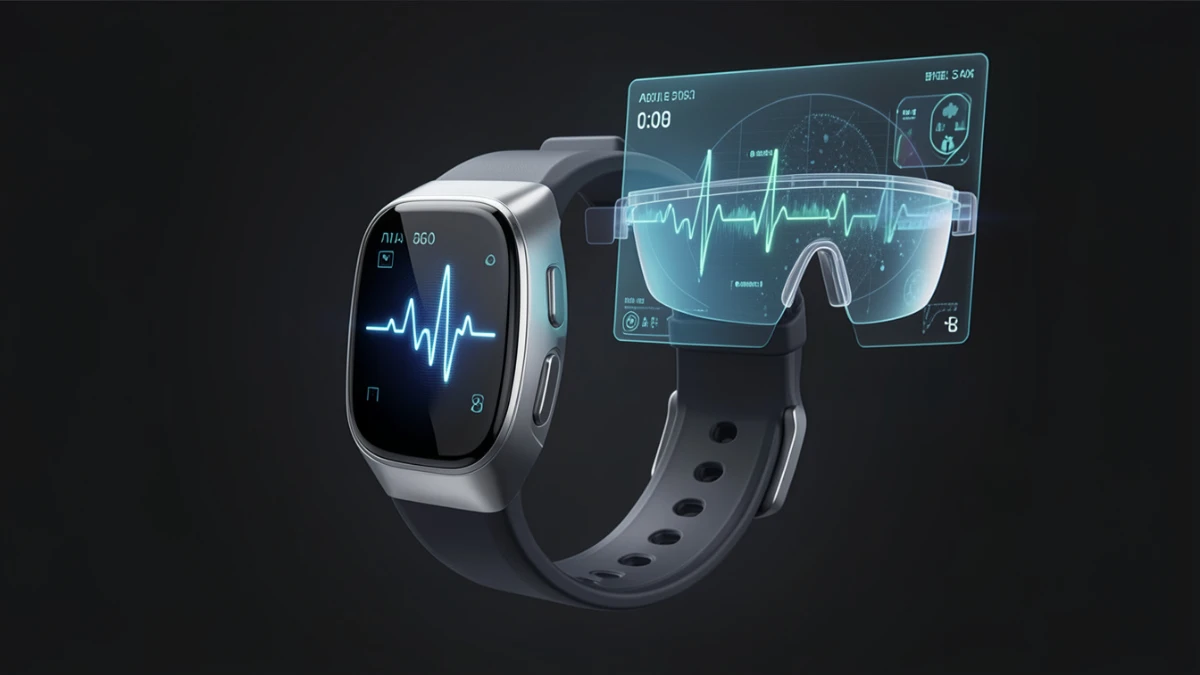
Wearable AI in 2026 delivers genuine value through smartwatches (Apple/Samsung for health), rings (Oura for sleep, Whoop for athletes), and glasses (Meta for hands-free tasks). Choose based on your specific needs, calculate total costs including subscriptions, and commit to 30 days of consistent use. Avoid treating AI health data as medical diagnoses and prioritize devices with strong privacy protections.
Why Wearable AI Technology Matters More Than Ever in 2026
Wearable AI technology has fundamentally shifted from a futuristic curiosity to an essential daily tool for millions of people worldwide. The devices sitting on your wrist, finger, face, or in your ears are no longer simple step counters—they’re sophisticated artificial intelligence systems that process biometric data, predict health outcomes, and deliver personalized coaching in real-time.
The global wearable AI market is projected to exceed $180 billion by 2030, with 2026 marking a critical inflection point where on-device AI processing becomes genuinely useful rather than merely gimmicky. This transformation matters because edge AI chips—processors small enough to fit inside an earbud now enable powerful on-device inference without destroying battery life.
However, here’s the reality most reviews won’t tell you: not all wearable AI devices deserve your money. After nine years testing AI-powered tools across industries, I’ve watched impressive spec sheets translate to disappointing real-world performance far too often. Some devices genuinely transform how you manage health and productivity. Others become expensive drawer decorations within weeks.
This comprehensive guide cuts through the marketing noise. You’ll discover exactly which wearable AI categories deliver measurable value in 2026, how to evaluate devices before purchasing, and the critical mistakes that waste money and compromise your health data privacy.
What Is Wearable AI Technology? Understanding the 2026 Landscape
Wearable AI technology refers to body-worn devices utilizing artificial intelligence to process sensor data, recognize patterns, and deliver contextual insights without requiring constant smartphone connectivity. Unlike first-generation wearables that merely collected data passively, modern AI-powered devices actively analyze your biometric signals, learn your behavioral patterns, and make predictive recommendations.
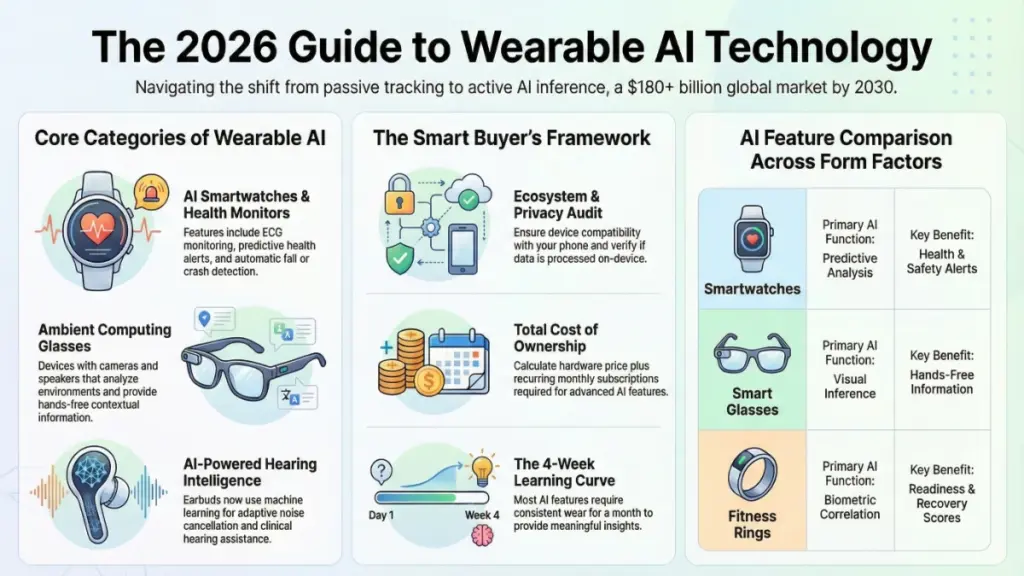
The critical distinction is active inference versus passive tracking. A 2020 fitness band counted your steps. A 2026 AI wearable detects atrial fibrillation before symptoms appear, predicts your cognitive performance based on sleep architecture, adjusts noise cancellation dynamically based on environmental analysis, and transcribes conversations with speaker identification—all processed locally on your device.
This evolution stems from three converging technologies:
- Edge AI Processors: 3-nanometer chips enabling smartphone-level computation within watch-sized batteries
- Advanced Biometric Sensors: Multi-spectral optical sensors measuring blood oxygen, skin temperature, heart rate variability, and even metabolic markers
- Federated Learning: AI models that improve through aggregated data while preserving individual privacy
The result? Wearable AI in 2026 finally delivers on promises that sounded like science fiction just three years ago.
The 5 Wearable AI Categories Dominating 2026 (Ranked by Real-World Utility)
Not all wearable AI serves identical purposes. Understanding these distinct categories prevents purchasing impressive technology that solves problems you don’t actually have.
1. AI Smartwatches: The Health Command Centers
The smartwatch category represents the most mature wearable AI segment, with Apple, Samsung, and Google leading through fundamentally different philosophical approaches.
Apple Watch Series 10 & 11: The Ecosystem Integration Champion
Apple’s 2026 lineup maintains the redesigned Series 10 chassis introduced in 2024—10% thinner than previous generations with enlarged 42mm and 46mm cases and wide-angle OLED displays up to 40% brighter at off-angles. However, the compelling upgrades aren’t cosmetic.
2026 AI Health Features That Matter:
- Hypertension Notifications: Optical sensors detecting blood pressure trends without cuffs (FDA-cleared)
- Sleep Apnea Risk Detection: Machine learning analysis of breathing patterns during sleep
- Satellite Emergency Connectivity: Direct satellite communication when cellular networks fail
- Crash and Fall Detection: AI algorithms distinguishing actual emergencies from daily movements—documented to have triggered life-saving emergency calls when users couldn’t
The Apple Watch’s AI excels through predictive health alerts. Rather than merely displaying heart rate, the device builds personal baselines over weeks, then flags deviations suggesting potential issues. This probabilistic approach requires understanding: these are prompts for medical consultation, not diagnoses.
Critical Limitation: The Apple Watch remains iPhone-dependent. Android users receive significantly degraded functionality, making ecosystem lock-in a genuine consideration.
Samsung Galaxy Watch 7 & Ultra: The Open Ecosystem Alternative
Samsung’s 2026 Galaxy Watch lineup demonstrates how Android-compatible wearables have closed the AI gap. The 3-nanometer processor enables Galaxy AI to process health data on-device with improved battery efficiency.
Standout AI Capabilities:
- BioActive Sensor: Combined optical and electrical sensors tracking heart rate, sleep, blood oxygen, and body composition analysis—a meaningful differentiator for fitness-focused users
- Energy Score: AI-generated readiness metric analyzing sleep quality, heart rate patterns, and activity to recommend daily intensity levels
- Personalized Cycling Metrics: Galaxy AI estimating Functional Threshold Power (FTP) in approximately 10 minutes when paired with compatible power meters
- FDA-Authorized Sleep Apnea Detection: Over-the-counter software detecting moderate to severe obstructive sleep apnea signs
- AGEs Index: Advanced Glycation End-products monitoring—first on Galaxy Watch—analyzing how dietary choices affect metabolic health
Samsung’s advantage lies in cross-platform flexibility. While optimized for Galaxy phones, the watches function meaningfully across the Android ecosystem. The Ultra variant adds dual-frequency GPS for precise location tracking in dense urban environments—critical for serious runners and cyclists.
Key Decision Factor: Apple Watch dominates for users embedded in iOS ecosystems seeking seamless integration. Samsung Galaxy Watch 7 offers superior flexibility for Android users wanting comparable AI health features without platform lock-in.
2. AI Smart Rings: Invisible Health Intelligence
Smart rings represent 2026’s most intriguing wearable AI category – invisible technology providing medical-grade insights without screens, notifications, or social distraction. For sleep tracking specifically, rings outperform wrist-worn devices because they’re comfortable enough to wear 24/7 without consciousness of their presence.
Oura Ring 4: The Design and Comfort Leader
The Oura Ring 4 represents industrial design mastery. The “three bumps” defining previous generations are eliminated—the interior is now 100% titanium with recessed sensors sitting flush at just 0.3mm. This isn’t merely aesthetic; it dramatically improves signal accuracy by maintaining consistent skin contact.
2026 AI Features:
- Smart Sensing Algorithms: Dynamic signal path selection based on your finger’s unique anatomy
- Readiness Score: 0-100 scale incorporating HRV, resting heart rate, body temperature deviation, respiratory rate, and sleep stages
- Cardio Capacity & Cardiovascular Age: Long-term trend analysis estimating biological versus chronological age
- Stress Tracking: Graphing stress patterns against recent activity to identify causation
- 8-Day Battery Life: Sufficient for continuous wear with brief weekly charging
Pricing Reality Check: $349 hardware purchase plus $69.99 annual membership. Over three years, total cost reaches approximately $559—competitive with subscription-heavy alternatives.
Whoop 5.0: The Performance Optimization Engine
Whoop 5.0 takes a radically different approach—membership-first pricing where hardware is included with subscription. The 2026 iteration solves wearable AI’s persistent “charging anxiety” through 14+ day battery life and wireless charging packs enabling on-wrist recharging.
Clinical-Grade 2026 Additions:
- On-Demand ECG: FDA-cleared heart screening directly from the wrist band
- Blood Pressure Insights: Trend analysis without traditional cuff measurements
- Physiological Age & Pace of Aging: Longevity-focused metrics tracking biological aging rates
- Real-Time Stress Monitor: Continuous sympathetic nervous system assessment
Pricing Structure: The “Peak” tier at $239/year includes Whoop 5.0 hardware, wireless battery pack, and full feature access. Over three years, Whoop costs approximately $717—significantly more expensive than Oura for long-term ownership.
The Verdict: Choose Oura Ring 4 if you prioritize sleep tracking accuracy, prefer discreet jewelry-like aesthetics, and want lower long-term costs. Select Whoop 5.0 if you’re a data-motivated athlete requiring strain-based training guidance, ECG functionality, and don’t mind ongoing subscription costs.
3. AI Smart Glasses: Ambient Computing Reality Check
Smart glasses with AI capabilities represent the most volatile wearable category—simultaneously promising ambient computing liberation and facing significant practical constraints.
Meta Ray-Ban Smart Glasses: The Breakthrough Product
Meta’s collaboration with EssilorLuxottica has produced the first AI glasses achieving genuine mainstream viability. The March 2026 expansion introduces prescription-ready optical models with AI features previously limited to sunglasses.
2026 AI Capabilities:
- Live Translation: Real-time multilingual conversation support expanding to additional languages
- Hands-Free Food Logging: Voice prompts or quick photos extracting nutrition details and adding them to personalized food logs with goal-based recommendations
- Neural Handwriting: Finger-writing on any surface to reply to messages silently across Instagram, WhatsApp, Messenger, and native messaging
- Pedestrian Navigation: Turn-by-turn directions displayed in-lens, keeping phones pocketed—expanding to all US cities May 2026
- WhatsApp Summaries: On-device processed conversation summaries with end-to-end encryption
- Contextual Visual Analysis: Camera-based identification of plants, restaurant menus, and environmental objects
Honest Limitations: Battery life remains constrained for heavy AI usage. Privacy concerns persist—both for wearers and those unknowingly recorded. Social acceptance varies significantly by context and geography.
The Strategic Insight: These glasses succeed when treated as augmentation rather than replacement. They excel for hiking, cooking, cycling, and travel—contexts where hands-free operation provides genuine liberation. They fail when positioned as smartphone replacements.
Google Android XR Glasses: The Emerging Competitor
Google’s 2026 re-entry through Android XR partnerships with eyewear brands signals serious ecosystem commitment. While less mature than Meta’s offering, Google’s approach emphasizes open standards and cross-platform compatibility—potentially crucial for enterprise adoption.
4. AI Earbuds: The Underrated Intelligence Layer
Modern earbuds contain AI capabilities most users never fully exploit. This category succeeds because it piggybacks on existing behavior—people already wear earbuds for hours daily.
Apple AirPods Pro 2: The Hearing Health Revolution
Apple’s 2026 firmware transforms AirPods Pro 2 into clinical-grade hearing health devices:
- Adaptive Audio: Machine learning dynamically blending transparency mode and noise cancellation based on environmental analysis—allowing car horns and voice calls through while blocking cafe chatter
- FDA-Cleared Hearing Aid Feature: Free software update (2024 clearance) providing mild-to-moderate hearing loss assistance—potentially saving users thousands compared to traditional hearing aids
- Conversation Awareness: Automatic volume reduction when you begin speaking
Emerging 2026 Innovations:
- Razer Project Motoko: AI-native headset concept with cameras and microphones interpreting surroundings—translating signage, summarizing documents, and providing always-available assistant access
- Viaim AI Earbuds: Live transcription and AI-assisted noise cancellation for professional environments
- Timekettle Translation Earbuds: Real-time multilingual conversation facilitation improving business and travel communication
Selection Principle: Choose AI earbuds based on primary use case—hearing health (Apple), professional transcription (Viaim), travel translation (Timekettle), or gaming/ambient awareness (Razer).
5. Clip-On & Pendant AI Wearables: The “Second Brain” Category
CES 2026 revealed explosive growth in screen-free AI assistants worn as clips, pins, or pendants—devices recording, transcribing, and summarizing your life.
Notable 2026 Entrants:
- SwitchBot AI MindClip: Wearable microphone converting speech into searchable summaries, task lists, and personal memory databases across 100+ languages
- Plaud NotePin S: Updated wearable recorder with physical button, multiple wearing options, Apple Find My integration, and desktop app for meeting recording
- Lenovo AI Pendant: Concept device housing meeting note-taking, conversation recording, and natural language playback
- Pebble Index 01: $75 ring focused purely on voice notes rather than health tracking—no subscription required
Critical Warning: This category carries high overpromise risk. The Humane AI Pin and Rabbit R1—CES 2025 darlings—failed to deliver practical utility due to battery limitations, latency issues, and cloud connectivity dependence. Approach first-generation clip-on AI wearables with caution; wait for proven battery life and reliable transcription accuracy before investing.
How to Choose Your Ideal Wearable AI Device: A 5-Step Framework
Selecting wearable AI technology requires systematic evaluation beyond marketing specifications. Apply this framework developed through nine years of device testing:
Step 1: Define Your Primary Intelligence Need
Health Monitoring: Continuous biometrics, sleep analysis, predictive alerts → Smartwatch or Ring
Productivity Enhancement: Meeting transcription, task management, communication → Clip-on or Glasses
Fitness Optimization: Training load, recovery metrics, performance analysis → Whoop or Garmin
Communication/Translation: Real-time language processing, hearing assistance → AI Earbuds
Ambient Assistance: Hands-free information, navigation, photography → Smart Glasses
Critical Insight: Devices attempting all these functions typically excel at none. The “jack of all trades” approach in wearable AI usually means compromised sensor accuracy and fragmented user experience.
Step 2: Audit Your Ecosystem Compatibility
Wearable AI delivers maximum value through deep platform integration:
- Apple Watch: Requires iPhone for full functionality; limited Android support
- Samsung Galaxy Watch: Optimized for Galaxy phones; functional across Android
- Oura/Whoop: Platform-agnostic with robust iOS and Android apps
- Meta Glasses: Requires Meta AI app; works across smartphone platforms
Health Data Sync: Verify compatibility with your preferred health platforms—Apple Health, Google Health Connect, Samsung Health, or standalone ecosystems—before purchasing.
Step 3: Evaluate Data Privacy Architecture
Biometric data represents your most sensitive personal information. Evaluate:
- On-Device Processing: Does AI inference occur locally or require cloud transmission? (Local = more private)
- Data Ownership: Do you retain rights to your health data? Can you export or delete it?
- Third-Party Sharing: Which partners receive anonymized or identifiable data?
- Security Certifications: ISO 27001, HIPAA compliance (for US health data), GDPR adherence (EU)
Privacy Leaders: Withings and Garmin maintain strong privacy track records with transparent policies. Others require careful scrutiny of terms of service.
Step 4: Calculate Total Cost of Ownership (TCO)
Many wearable AI devices employ subscription-dependent monetization:
| Device | Hardware Cost | Subscription | 3-Year TCO |
|---|---|---|---|
| Apple Watch Series 10 | $399-799 | None (included) | $399-799 |
| Samsung Galaxy Watch 7 | $299-449 | None (included) | $299-449 |
| Oura Ring 4 | $349 | $69.99/year | ~$559 |
| Whoop 5.0 | $0 (included) | $239/year | ~$717 |
| Meta Ray-Ban Glasses | $299-379 | None (basic AI included) | $299-379 |
Hidden Costs: Replacement bands, charging accessories, insurance, and potential hardware upgrades every 3-5 years.
Step 5: Verify Return Policies and Trial Periods
Wearable AI success depends on comfort, fit, and daily integration—factors impossible to evaluate in stores. Prioritize brands offering:
- Minimum 30-day return periods
- Free resizing (critical for rings)
- Warranty coverage for water damage and battery degradation
Critical Mistakes That Destroy Wearable AI Value
Even sophisticated users sabotage their wearable AI investments through these preventable errors:
Mistake 1: Treating AI Health Data as Diagnostic Truth
Wearable AI provides probabilistic insights, not medical diagnoses. An irregular heart rhythm alert indicates potential concern requiring professional evaluation—not confirmed pathology. Most devices include disclaimers users ignore.
Solution: Use AI health alerts as conversation starters with healthcare providers, not self-diagnosis tools.
Mistake 2: Abandoning During Onboarding
AI algorithms require 2-4 weeks of consistent data before generating meaningful insights. Oura Ring’s readiness scores become accurate after 30 days of continuous wear; early readings lack sufficient baseline data.
Solution: Commit to 30 days of consistent wear before evaluating device utility. Set daily charging routines to prevent gaps.
Mistake 3: Neglecting Software Updates
AI capabilities evolve through firmware updates. Users disabling automatic updates miss genuinely transformative features added post-purchase.
Solution: Enable automatic updates; review release notes monthly for new AI capabilities.
Mistake 4: Inconsistent Wearing Patterns
AI accuracy depends on continuous data streams. Removing devices at night eliminates sleep tracking; skipping rest days prevents recovery analysis.
Solution: Select form factors comfortable enough for 24/7 wear. If you can’t sleep with a smartwatch, choose a ring or dedicated sleep tracker.
Mistake 5: Ignoring Subscription Creep
$20/month subscriptions seem negligible individually but accumulate across multiple services. Five wearable subscriptions equal $1,200/year—sufficient for premium device upgrades.
Solution: Audit active subscriptions quarterly; cancel unused services; prioritize devices with included AI features.
The Future of Wearable AI: 2026-2028 Roadmap
The next 24 months promise transformative capabilities—and significant ethical challenges:
Non-Invasive Continuous Glucose Monitoring (CGM)
Apple, Samsung, and startups are racing to deliver needle-free blood sugar tracking via optical sensors. Success would revolutionize diabetes management and metabolic health optimization for the general population. Regulatory clearance remains the primary barrier.
AI Mental Health Integration
Devices detecting emotional states through voice pattern analysis, skin conductance, and HRV are transitioning from research to consumer products. The ethical implications—employer surveillance, insurance discrimination, emotional manipulation—require urgent regulatory frameworks.
AI-Native Form Factors
Beyond smarter versions of existing products, screen-free AI computing is gaining momentum. The Humane AI Pin’s failures haven’t killed the category; they’ve refined it. Expect specialized AI wearables for specific professions (medical, legal, creative) before general-purpose alternatives mature.
Spatial Computing Convergence
Apple Vision Pro and successors suggest a future where wearable AI surrounds rather than adorns—ambient intelligence integrated into environments rather than attached to bodies.
Final Verdict: Which Wearable AI Should You Buy in 2026?
For Most Beginners: Start with Apple Watch Series 10/11 (iPhone users) or Samsung Galaxy Watch 7 (Android users). These offer the most balanced AI feature sets, proven ecosystem support, and 3-5 year software longevity.
For Sleep-Focused Users: Oura Ring 4 provides unmatched comfort and detailed sleep architecture analysis with reasonable long-term costs.
For Serious Athletes: Whoop 5.0 delivers strain-based training guidance and clinical-grade cardiac monitoring despite higher subscription costs.
For Productivity Professionals: Meta Ray-Ban Smart Glasses enable genuine hands-free efficiency gains for specific contexts (travel, fieldwork, creative documentation).
For Hearing Health: Apple AirPods Pro 2 provide FDA-cleared hearing assistance at no additional cost for existing owners.
Avoid: First-generation clip-on AI wearables until battery life and transcription reliability mature; any device requiring subscriptions without clear value justification.
Frequently Asked Questions About Wearable AI Technology
Is wearable AI technology worth the investment in 2026?
For health-conscious users, productivity-focused professionals, and data-motivated athletes, wearable AI delivers measurable daily value exceeding costs. Casual users should prioritize mid-range smartwatches over premium AI-specialized devices. Calculate 3-year total cost of ownership before deciding.
How accurate is AI health tracking compared to medical devices?
Heart rate tracking achieves medical-grade accuracy across major brands. ECG readings are clinically validated on Apple Watch and Samsung Galaxy Watch. Blood oxygen and stress scores vary more significantly, particularly during movement. Treat all wearable AI health data as screening tools requiring professional confirmation.
What’s the best wearable AI device for beginners?
Apple Watch Series 10/11 for iPhone users; Samsung Galaxy Watch 7 for Android users. Both offer comprehensive AI features, robust app ecosystems, regular updates, and reliable customer support without overwhelming complexity.
Are wearable AI devices a privacy risk?
Potentially, if you select brands with opaque data policies. Biometric data is extremely sensitive—prefer on-device processing, transparent privacy policies, and brands with independent security audits (Withings, Garmin). Review settings post-purchase to limit unnecessary data sharing.
How long do wearable AI devices typically last?
Premium smartwatches receive 3-5 years of software support. Specialized fitness wearables (Oura, Whoop) often have longer hardware lifespans but evolving subscription requirements. Budget for hardware upgrades every 3 years to access latest AI capabilities.
Can wearable AI replace my smartphone?
No—and attempting to do so causes frustration. Wearable AI excels at specific contexts (health monitoring, hands-free assistance, sleep tracking) but lacks the screen real estate and input methods for general computing. Treat wearables as complements, not replacements.