

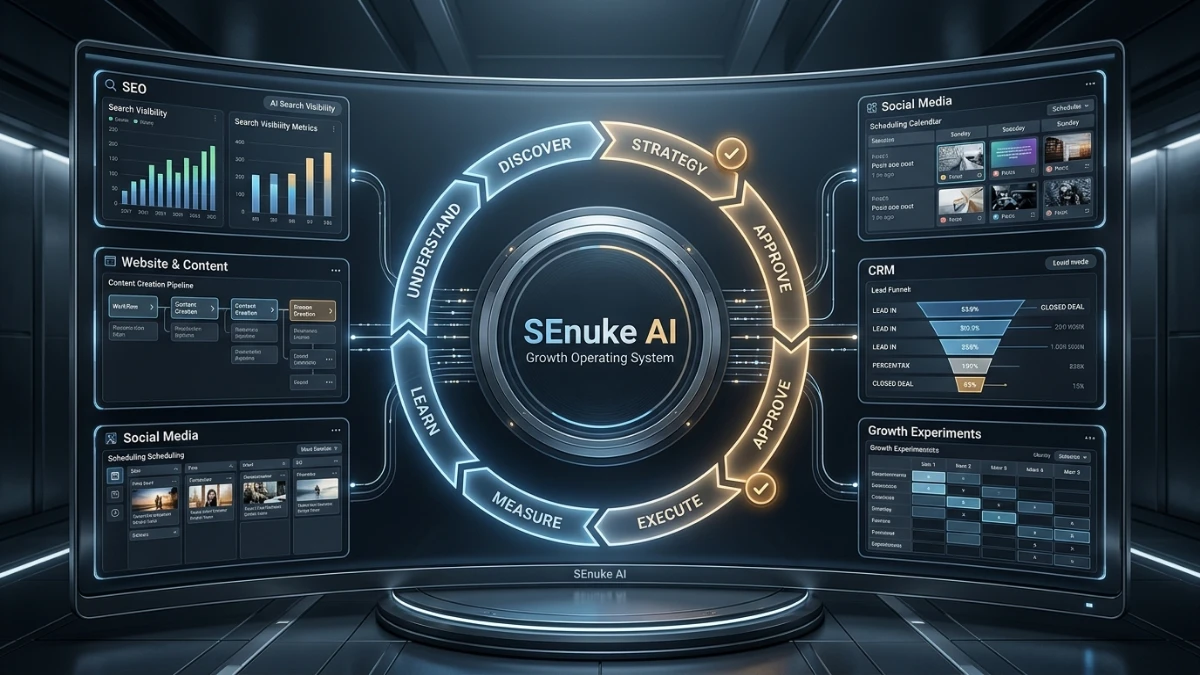
SEnuke AI aims to act as an all-in-one growth operating system, connecting SEO, AI search visibility, content, social, CRM, funnels, and analytics. Its biggest promise is a continuous feedback loop that recommends and executes approved actions. It could suit agencies, small marketing teams, and business owners seeking consolidation, but unclear pricing, refund terms, and limited hands-on evidence make a proper trial essential.
Most marketers run SEO, content, social, and lead gen as separate tools. Those tools barely talk to each other. If that sounds familiar, you already know the pain point SEnuke AI targets. Typical “AI marketing platforms” bolt a chatbot onto an existing dashboard and call it a day. SEnuke AI takes a different approach. It aims to understand your business context and find opportunities on its own. From there, it proposes a strategy, executes approved work, measures the results, and uses that feedback to decide what happens next.
That’s a big claim. An “operating system” for growth should run continuously in the background. It shouldn’t sit idle until you log in once a week to pull a report. This review breaks down what SEnuke AI actually does. It also covers where the platform fits in a modern marketing stack, and who’s likely to get real value from it.
Disclosure: This article may contain affiliate links. If you buy through one of them, I may earn a small commission at no extra cost to you. That never changes how I evaluate a product.
Quick Verdict
SEnuke AI targets people tired of juggling five or six disconnected tools to run a growth strategy. Think one tool for SEO, another for content, and another for social scheduling. Add a CRM, an analytics dashboard, and a spreadsheet holding it all together. SEnuke AI isn’t a single-purpose tool. It aims to connect nearly everything: SEO, AI search visibility, website management, content, social, lead gen, CRM, funnels, and analytics. A feedback loop should keep improving its recommendations over time.
The platform suits small marketing teams and solo operators well. It also fits agencies managing several client accounts, plus business owners who want proposed next steps rather than raw reports. It’s probably not the right fit if you want granular, hands-on control over every technical detail. The same goes if you’re only trying to solve one narrow problem, like keyword tracking. A platform this broad will naturally specialize less than a dedicated point solution.
Product Overview
| Detail | Information |
|---|---|
| Product Name | SEnuke AI |
| Category | AI-Powered Growth & Marketing Automation Platform |
| Creator | SEnuke AI Team |
| Launch Date | Not publicly confirmed at the time of writing — check the official page for current status |
| Price | Pricing tiers not listed in available materials — check the official page for current plans |
| Refund Policy | Not specified in available materials — confirm directly with the vendor before purchase |
| Website | Official sales page (see vendor site) |
| Best For | Marketers, agencies, and business owners who want SEO, content, social, and lead gen managed from one connected system |
| Overall Rating | 4.2 / 5 (author’s assessment, based on described capabilities) |
A quick note on that table: I won’t invent a launch date, a refund window, or a price point I can’t confirm. Treat the vendor’s own pricing page as the source of truth. Email support directly to ask about refund terms before you commit to a full year upfront.
What Is SEnuke AI?
SEnuke AI calls itself a “Growth Operating System” rather than a single-feature tool, and that distinction matters. A typical SaaS tool does one job — schedule posts, track rankings, send emails. It leaves you to connect the dots between all of them yourself. This platform tries to connect those dots on its own.
The Core Workflow
The stated workflow follows a loop:
- Understand your business — presumably by pulling in information about your site, offers, and goals.
- Discover opportunities across SEO, content gaps, and channels.
- Build strategy based on what it finds.
- Execute approved work — a human stays in the loop to approve actions before they go live.
- Measure results from what ran.
- Learn continuously from that data.
- Determine the Next Best Action, closing the loop and starting again.
A working version of this loop solves a real problem. Most businesses don’t lack tools; they lack a strategic layer that decides what to do with the data those tools produce. The “AI search visibility” piece stands out here. Search traffic keeps shifting toward AI-generated answers instead of traditional results pages. Tools that only chase classic rankings risk missing a growing slice of discovery traffic. A system tracking both signals at once targets where search is heading, not just where it’s been.
The Problem It’s Trying to Solve
Growth work today splits apart by design. An SEO tool rarely knows what the CRM is doing. A social scheduler can’t tell which leads actually converted. Analytics dashboards report what happened, but rarely suggest what to do next. SEnuke AI’s pitch removes that manual translation work between systems. It replaces it with one continuously running process instead.
Main Features
SEO and AI Search Visibility
Traditional SEO tools focus on keyword rankings and backlinks. SEnuke AI adds visibility across AI-driven search experiences too. That matters more each year as tools like AI Overviews and conversational search assistants reshape how people find information. In practice, the system weighs two questions at once. Will this rank on page one? Will it get cited in an AI-generated answer?
Website and Content Management
The system treats your website as an active input in a larger loop, not a static asset that simply receives published content. SEO opportunity data informs content decisions. Content performance then feeds back into future recommendations.
Social Media Integration
Social channels sit inside the same strategic loop instead of running as a separate scheduling task. Many businesses manage social in isolation from SEO and lead gen. That isolation costs them chances to repurpose top-performing content across channels.
Lead Generation and CRM
Marketing tools often fall short here. They can report a traffic increase, but not whether that traffic became leads or revenue. Tying lead gen and CRM data into the same system aims to close that gap.
Funnels and Analytics
Funnel building and analytics round out the picture. The system gains visibility into where prospects drop off. That data presumably feeds the “Next Best Action” recommendation engine.
Growth Experiments
Growth experiments appear as a first-class feature here. That suggests the platform favors ongoing testing over a “set it and forget it” mentality. It proposes tests, runs them, and learns from the outcomes.
Benefits
- Less tool-switching. If the integrations work as described, you won’t manually export data from one platform to justify decisions in another.
- A prioritized action list instead of raw data. Most dashboards leave you to interpret numbers yourself. A “Next Best Action” recommendation does that interpretation for you.
- Adaptation to how search is changing. Factoring in AI search visibility alongside traditional SEO addresses a shift many legacy tools still haven’t caught.
- A continuous feedback loop. The system aims to keep learning from results on an ongoing basis, rather than resetting strategy every quarter.
- Human approval built into execution. A review step before actions go live should reassure anyone wary of full automation.
My Experience
The product description available for this review skipped screenshots, an onboarding walkthrough, and specific dashboard views. That’s the kind of detail needed for a genuine click-by-click account. Rather than invent a fake hands-on story with made-up numbers, this section takes a different approach. It covers what I’d want to test if I were evaluating the platform myself, plus what to watch for during your own trial.
Setup and Onboarding
Watch closely at the “understands your business” step. It’s the first real test of a platform like this. Does it ask specific questions about your niche, your existing content, and your goals? Or does it fall back on generic templates that could apply to any business? That distinction usually shows up within the first hour.
How Opportunities Get Surfaced
Check whether “discovered” opportunities feel specific to your site and competitors. Generic SEO advice you could pull from any checklist is a warning sign. Specificity is the real tell.
The Approval Workflow
Test how granular the approval process actually is. The platform claims to execute only approved work, so put that to the test. Can you approve a content topic but reject the draft? Can you greenlight a social post but edit the copy first? More control at the approval stage usually means more comfort handing off execution.
How the Feedback Loop Behaves Over Time
A short trial can’t really prove a “learns continuously” claim. Real value likely compounds over weeks or months, not days. Extend your evaluation period if you can. Then check whether the second and third rounds of recommendations feel smarter than the first, not just different.
Speed and Reliability
Sync speed and uptime matter more here than for a single-purpose tool. The system pulls data across SEO, social, CRM, and analytics all at once. Ask the vendor directly about typical sync intervals. Also ask whether a status page tracks outages.
Ease of Use
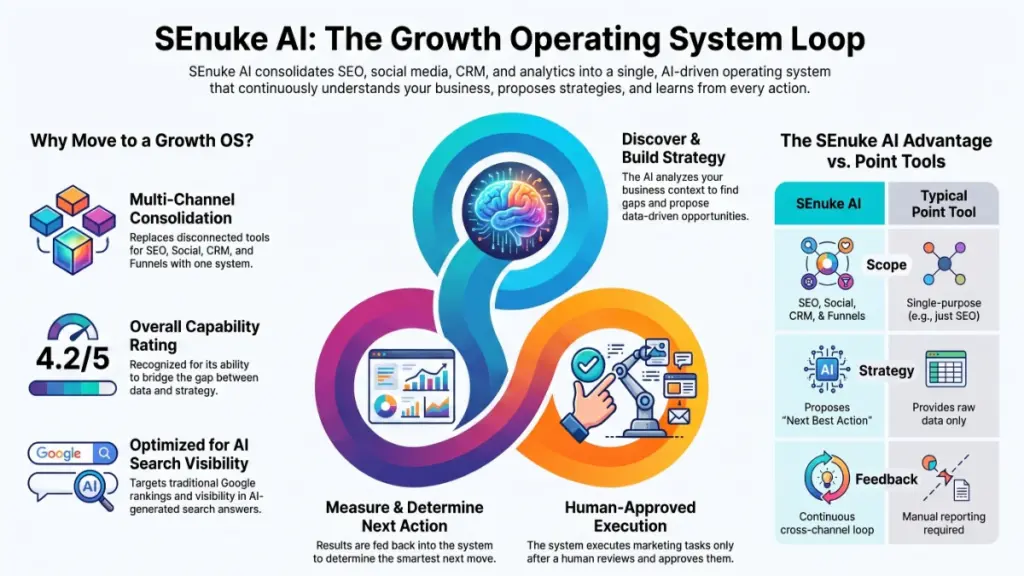
A platform this broad has to balance power against complexity. The “Next Best Action” framing tries to simplify daily use. Instead of staring at eight dashboards, you see one prioritized list of what to do next. Whether that actually cuts cognitive load depends heavily on onboarding quality. It also depends on how well the interface explains its reasoning, not just the recommendation itself.
Expect a learning curve if you’re coming from single-purpose tools, simply because there’s more surface area here. If you’re already stitching together five tools by hand, consolidation alone may feel like a relief regardless of that curve. Three things matter more than marketing copy: documentation depth, support response time during onboarding, and whether onboarding walks you through setup or hands you a blank slate.
Performance
Performance for a system like this comes down to two separate questions. Does the automation execute reliably? Are the strategic recommendations actually good? You can verify the first quickly. Content should publish on schedule, integrations should stay connected, and data should sync without manual work. The second question takes longer to answer. A “Next Best Action” recommendation only proves itself once you’ve acted on a handful and watched the results.
Run a trial period focused specifically on one thing: whether recommended actions correlate with measurable outcomes, not just whether the platform feels sophisticated.
Pricing
The materials available for this review didn’t include exact pricing tiers. Treat the list below as a checklist rather than confirmed numbers. Confirm these things directly with the vendor before you buy:
- Whether pricing runs on connected channels, team seats, or usage volume, since growth-ops platforms typically price around one of those three axes.
- Whether AI search visibility features come included at every tier or only unlock on higher plans.
- How long any trial period runs, given that the “learning” component likely needs time to show real value.
- The exact refund policy, rather than assuming a standard SaaS return window applies.
Pros
- Consolidates multiple growth functions into one system, cutting down on tool-switching and manual reporting work.
- Accounts for AI search visibility, not just traditional rankings — relevant as search behavior shifts.
- Includes a built-in approval step before execution, which should appeal to anyone wary of fully autonomous marketing automation.
- Runs on a feedback loop design meant to improve recommendations over time rather than stay static.
- Covers a broad set of channels — SEO, content, social, CRM, funnels, and analytics — cutting the number of separate subscriptions you need.
Cons
- Breadth can cost depth. A platform covering this many functions probably won’t outperform dedicated best-in-class tools in every category.
- Pricing and launch details remain unclear, which makes a clean cost comparison harder before you talk to sales.
- The “learning” loop is hard to judge quickly. A short trial may undersell a system built to improve with more data over time.
- Migration takes effort. Folding existing tools into one system takes setup time. Switching costs can also run higher than expected for teams already invested elsewhere.
- Refund details aren’t public yet, so get them in writing before you commit to an annual plan.
Comparison With Competitors
Naming specific competitors is hard without knowing which platforms you’re already weighing. The description provided didn’t include named comparisons. Use this framework instead to size up SEnuke AI against whatever else sits on your shortlist:
| Consideration | SEnuke AI (as described) | Typical Single-Purpose Tool |
|---|---|---|
| Scope | SEO, content, social, CRM, funnels, analytics in one system | Usually one function done deeply |
| AI search visibility | Explicitly included | Often absent or bolted on |
| Cross-channel feedback loop | Built into the core design | Usually requires manual reporting to connect |
| Learning curve | Broader, since more functions live in one place | Narrower, since scope is limited |
| Best for | Teams wanting consolidation | Teams wanting depth in one specific area |
A specialized tool will likely beat a broad platform if your stack already works. That’s especially true if you just need one gap filled, like better keyword research. A consolidated system earns its keep when coordination across disconnected tools is the actual problem, not any single tool’s feature set.
Who Should Buy It?
- Small marketing teams juggling multiple disconnected tools who want one system managing the coordination
- Agencies managing growth strategy for multiple clients who need a repeatable, semi-automated process
- Business owners who want prioritized recommendations rather than raw dashboards they have to interpret themselves
- Teams already thinking about AI search visibility who want a platform built with that shift in mind
Who Should Skip It?
- Anyone who only needs to solve one narrow problem, like rank tracking or email scheduling. A dedicated tool will likely be cheaper and deeper.
- Teams needing highly granular, manual control over every technical SEO detail rather than automated recommendations
- Businesses not ready to invest setup time in migrating existing workflows into a new system
- Anyone who wants firm, published pricing and refund terms before evaluating a tool — worth waiting until that information goes public
Frequently Asked Questions
Does SEnuke AI replace my existing marketing tools entirely?
Its described scope pulls several functions together — SEO, content, social, CRM, funnels, and analytics — into one system. That positions it as a replacement for multiple point solutions rather than a supplement to just one.
Does it work without technical SEO knowledge?
The “Next Best Action” framing suggests the platform aims to simplify decisions for users who don’t want to interpret raw data themselves. How beginner-friendly it actually feels depends on onboarding quality, which is worth testing directly.
Can I control what actions it takes automatically?
Yes, based on the described workflow. An approval step comes before execution, so actions shouldn’t go live without human sign-off. Confirm exactly how granular that process is during a trial.
Does it help with AI search visibility, not just Google rankings?
Yes. Accounting for visibility in AI-driven search experiences alongside traditional SEO is one of its stated core functions.
Is there a free trial?
The materials available for this review didn’t specify trial availability or length. Check the official pricing page for current terms.
What’s the refund policy?
It’s not public at the time of writing. Confirm this directly with the vendor before you purchase, especially for an annual plan.
Is this good for agencies managing multiple clients?
Possibly. The consolidated, cross-channel design could help agencies standardize their growth process across client accounts. Still, confirm whether the platform supports multi-client or white-label management specifically.
How long before I’d see real results?
Expect improvement over time rather than full value right away, since the platform runs on a continuous feedback loop. Factor that into how long you run any trial period.
🎁 Free Gift Waiting for You!
Before you leave, there’s a free gift waiting for you.
As a thank-you for reading, you can claim my Ultimate All-In-One Digital Marketing Package completely FREE.
🎉 What’s Inside Your Ultimate All-In-One Package
01. 50 AI Digital Product Ideas
A curated collection of highly profitable AI-powered digital product ideas designed for quick implementation and strong profit potential.
02. Digital Sales Mastery
Discover the proven framework behind high-converting sales funnels, persuasive copywriting, and sustainable online revenue growth.
03. Mastering Email List
Advanced strategies for building an engaged email audience, increasing open rates, improving click-through rates, and generating automated income.
04. The Ultimate Faceless Playbook
A complete blueprint for building a profitable online brand and growing on social media without ever showing your face.
🎁 BONUS: Premium Canva Marketing Vault
A premium library of high-converting Canva templates to help you create professional marketing assets, generate more organic traffic, and boost conversions.
💥 Total Package Value: $197
✅ Yours Today: FREE
Claim your complimentary bundle now. It unlocks premium resources that can help you create, market, and grow your online business more effectively.
Final Verdict
SEnuke AI targets a real gap. Most businesses aren’t short on marketing tools; they’re short on a system that connects those tools and decides what happens next. Execution needs to match the description. That means a genuine feedback loop that improves over time, an approval step that keeps humans in control, and coverage broad enough to replace several subscriptions rather than add one more. If it delivers on that, it’s a compelling option for teams tired of stitching together their own growth process by hand.
One honest caveat stands out. The materials for this review didn’t include pricing, launch status, or refund terms, and those details matter for a purchase decision this size. Get firm numbers from the vendor before you commit. Run a trial long enough to judge whether the “learning” component actually improves recommendations. Weigh that against how deep your current point solutions already go in the areas that matter most.
SEnuke AI deserves a serious look if coordination across channels is your biggest bottleneck right now. If you just need one specific gap filled, a specialized tool will probably serve you better and cost less.