

I’ve watched AI vendors squabble over API access and pricing for four years now. Even so, this one feels different. It isn’t a pricing dispute or a rate-limit complaint. Instead, two of the most powerful people in tech are using a coding tool as a battlefield, and developers are caught in the middle.
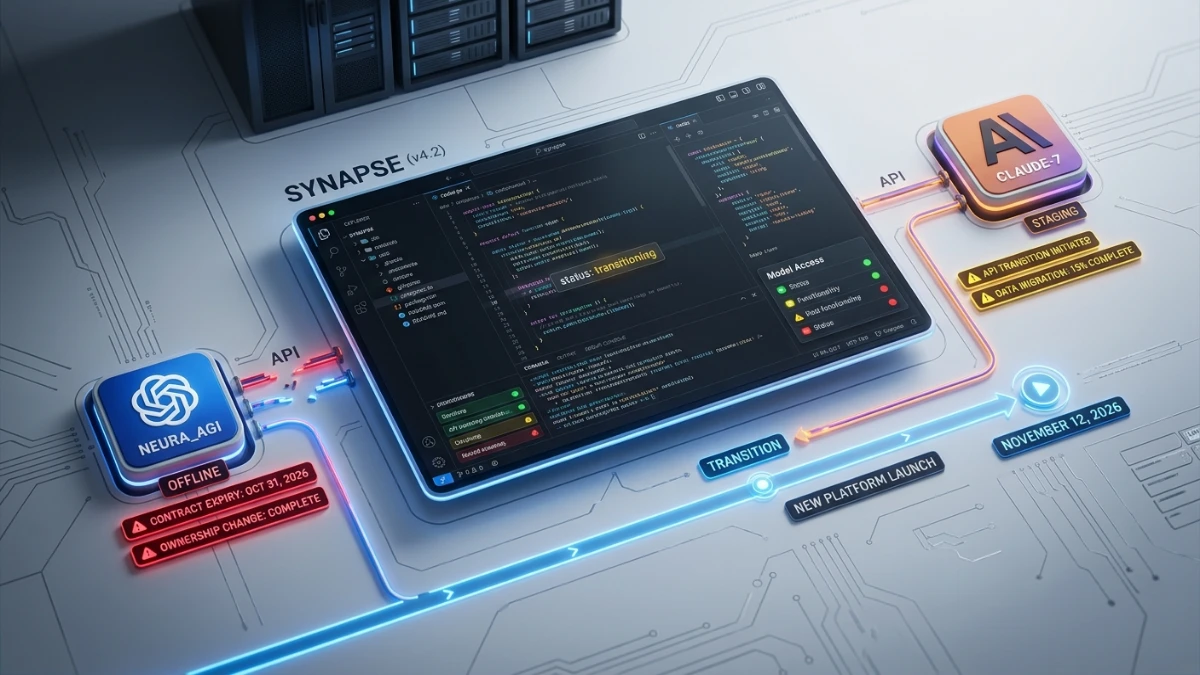
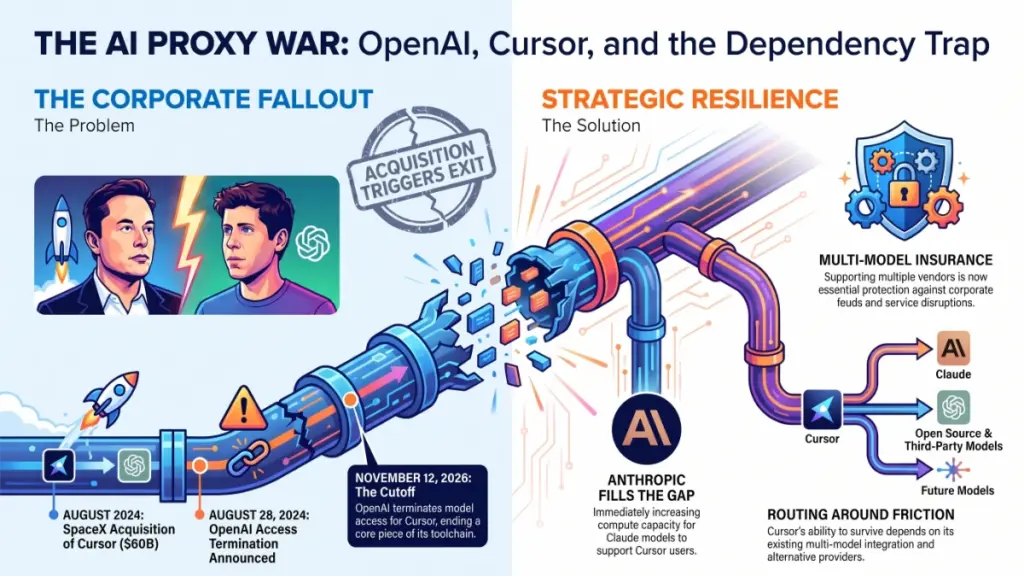
OpenAI announced on August 28 that it will stop supplying its models to Cursor. SpaceX, Elon Musk’s company, now owns the popular AI coding assistant. As a result, OpenAI says it doesn’t trust SpaceX to use its technology within the terms of service. Specifically, the company points to a pattern of contract violations across Musk’s other ventures. Consequently, OpenAI wants the cutoff to take effect on November 12, 2026.
Why It Matters
If you use Cursor for daily coding work, this isn’t just corporate drama. In fact, it’s a direct hit to your toolchain. Cursor built its reputation partly on model choice, including OpenAI’s models. Therefore, losing that option changes what the product can do for you, even if only temporarily.
Beyond the product itself, the people involved matter too. Sam Altman and Musk have fought for years, and that rivalry boiled over earlier this year during a trial tied to Musk’s $150 billion lawsuit against OpenAI. Musk argued OpenAI had abandoned its nonprofit roots for private gain, but a federal jury sided with OpenAI on procedural grounds. Now, the same rivalry is shaping decisions about a working developer tool with real users.
What Triggered the Cutoff
SpaceX closed its roughly $60 billion all-stock acquisition of Anysphere, the startup behind Cursor, earlier this month. According to OpenAI, that change of ownership triggered a contract clause letting it walk away. As a result, OpenAI is exercising that option now, since the company doubts SpaceX will honor its usage terms under Musk’s ownership.
Musk didn’t stay quiet. He posted on X that he “couldn’t care less,” and called Altman and OpenAI president Greg Brockman untrustworthy. In the same post, he repeated his long-standing claim that they seized control of what began as a nonprofit. By contrast, Cursor co-founder Michael Truell, now a SpaceX executive, struck a calmer tone, saying the company is talking with OpenAI to resolve the dispute before the cutoff date.
Anthropic Steps Into the Gap
Here’s the part I find genuinely interesting: hours after OpenAI’s announcement, Anthropic said it would boost compute capacity for Claude models inside Cursor. Meanwhile, Anthropic already works with SpaceX on other projects, so the move looks like a straightforward opportunity play. After all, when a rival creates friction for a shared customer, you show up with more capacity, not less.
For that reason, this is a meaningful signal for Cursor’s users. It suggests the product won’t face a single-model dependency, even if OpenAI and Cursor never patch things up. However, whether Claude fully replaces what OpenAI’s models offered is a different question, since only real-world usage inside the IDE will answer it. After all, benchmark scores on paper don’t always predict how a model feels in daily coding work.
Pricing and Availability
So far, neither company has announced pricing changes tied to this dispute. Still, mark November 12, 2026 on your calendar, since that’s the date OpenAI proposed for ending model access inside Cursor. That date could still shift if the two companies reach a new agreement, and Truell’s comments suggest that door remains open.
Industry Implications
I’ve told clients for years that the biggest hidden risk in building on any AI vendor isn’t pricing or rate limits. Instead, it’s dependency. This dispute puts that risk on full display, since a tool used by working developers just lost a core model provider over a fight that has nothing to do with product quality.
Given that, the practical lesson for companies building AI products is one I repeat often: treat multi-model support as insurance, not a luxury. Notably, Cursor can partially route around this loss precisely because it never relied on a single model provider.
Limitations and Open Questions
Some facts here remain unsettled. For instance, nobody has independently verified OpenAI’s contractual justification beyond its own blog post, and Musk’s team disputes that framing entirely. Similarly, we don’t yet know whether the two sides will settle before November, or on what terms. Nor do we know how far Anthropic’s compute increase goes, or whether it fully replaces what OpenAI provided.
What to Watch Next
November 12 is the next real checkpoint. Either the two sides reach a resolution, or Cursor’s OpenAI-backed features go dark on schedule. Beyond that immediate deadline, watch this dispute as a preview of something bigger: personal and corporate rivalries in AI are starting to shape product availability, not just headlines. If vendors will pull access over an ownership change tied to a personal feud, every company building on third-party models should take notice.
So, if you build on Cursor, use this moment wisely. First, check what happens to your workflow if OpenAI access disappears in November. Then, make sure you’re not more locked into a single model than you realized.