

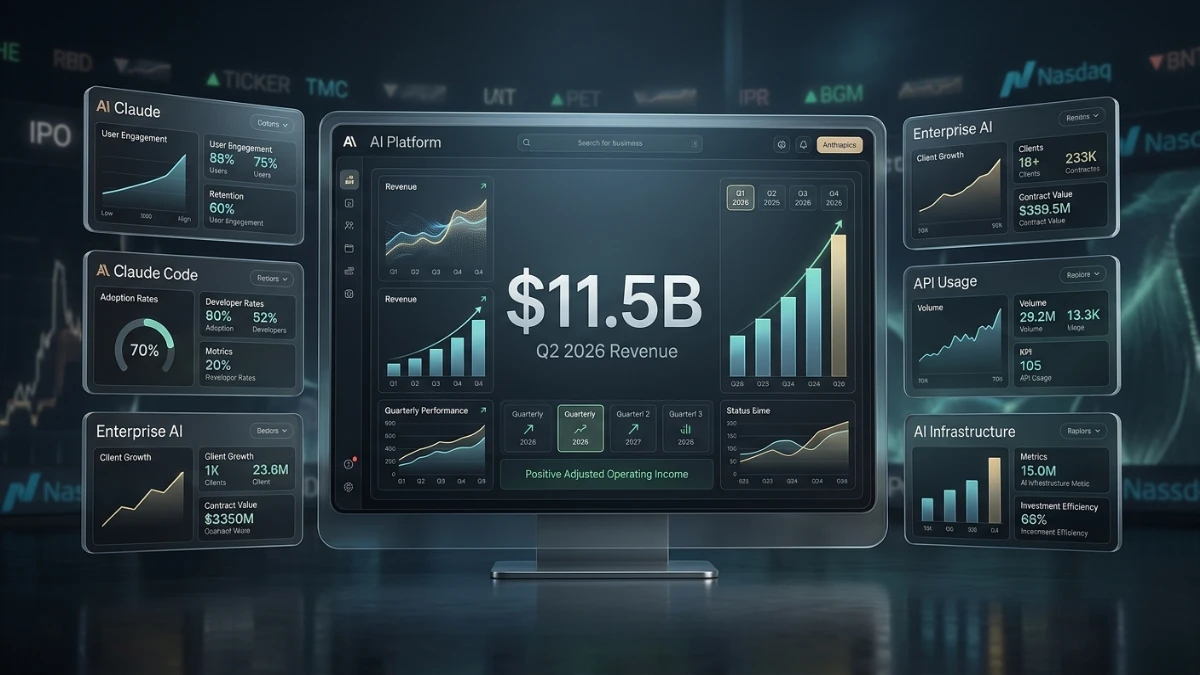
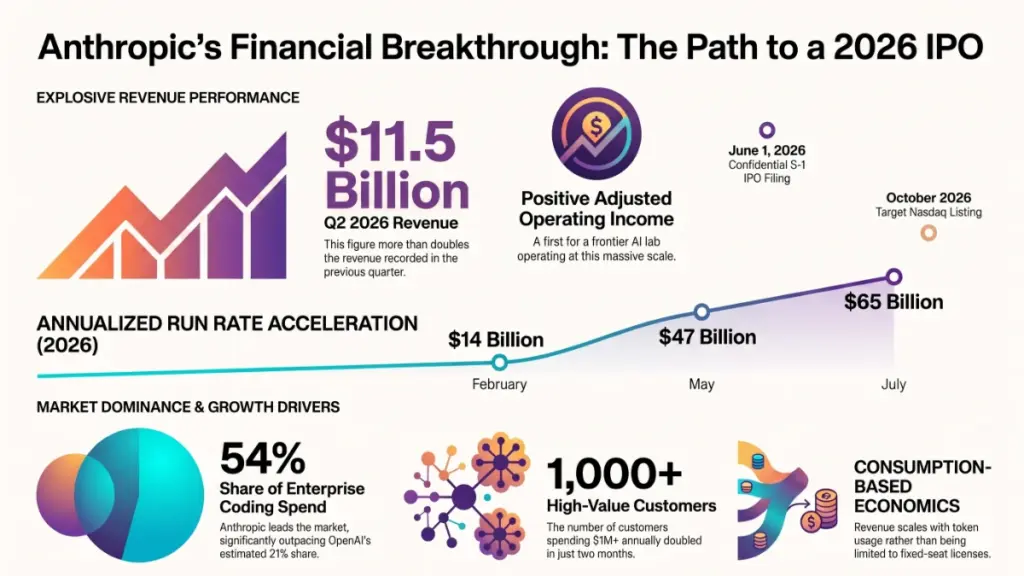
Anthropic told prospective investors that its second-quarter 2026 revenue topped $11.5 billion. That’s more than double the $4.73 billion it booked in Q1. It’s also roughly 14 times the $787 million it recorded in the same quarter last year.
Preliminary documents reviewed by Bloomberg add another detail. Anthropic posted positive adjusted operating income for the quarter. That’s a first for a frontier AI lab operating at this scale.
The combination matters. It changes the kind of evidence Anthropic can offer the market. For three years, labs have leaned on annualized run-rate figures. A run rate takes recent revenue and multiplies it out across twelve months. It shows direction, not what a company actually collected.
Q2 2026 is different. It’s a completed quarter of recognized revenue. It comes with an operating income line attached. And it arrives as Anthropic prepares for a possible October IPO.
Why It Matters
Run-rate numbers point toward a business’s trajectory. They don’t prove a company banked the cash. A completed quarter with positive adjusted operating income carries more weight.
Investors, enterprise buyers, and competitors are all asking the same question right now. Can frontier AI labs turn real operating leverage, or will outside capital keep subsidizing their growth forever? Anthropic can now point to at least one quarter that answers yes.
Independent verification isn’t really possible from the outside. These are preliminary, unaudited numbers. Anthropic shared them with prospective investors ahead of a public listing. Bloomberg reported the figures could still change. Even so, the scale and consistency of the disclosure give it more weight than a typical run-rate headline.
The Numbers, and What They Actually Cover
Anthropic’s 2026 revenue climb has been steep, even by AI industry standards. The company’s annualized run rate sat near $9 billion at the end of 2025. It reached $14 billion in February. It crossed $30 billion in April. By May, it topped $47 billion. Reuters and Bloomberg reported it exceeded $65 billion by late July.
Now layer the new quarterly data on top of that run-rate progression. Q1 2026 brought in $4.73 billion in recognized revenue. Q2 brought in more than $11.5 billion. Together, that’s roughly $16.2 billion in first-half revenue. These are actual bookings, not a projection.
Bloomberg reported that Anthropic recorded positive adjusted operating income for the quarter, based on documents shared with prospective investors. The company declined to comment when asked about the figures.
It helps to be precise about what “adjusted operating income” does and doesn’t tell you. It’s an operating-income measure calculated after specific accounting adjustments. It isn’t a GAAP profitability figure. It doesn’t account for financing costs, taxes, or other expenses below the operating line. Forbes’ coverage of the disclosure noted these are booked sales, not a run-rate projection. But the operating income figure remains adjusted, not audited.
Claude Code’s Role in the Growth Story
Claude Code, Anthropic’s agentic coding product, drives part of this acceleration. Anthropic said in February that Claude Code’s annualized run-rate revenue had passed $2.5 billion. That’s up from roughly $1 billion in November 2025, about six months after general availability.
The February disclosure included several other data points. Weekly active users had doubled since January 1. Business subscriptions had quadrupled since the start of the year. Enterprise use accounted for more than half of Claude Code’s revenue.
Compare that to Anthropic’s $14 billion company-wide run rate from the same February moment. Claude Code’s disclosed run rate worked out to roughly 18% of the total. That’s a same-moment run-rate comparison, not a share of Q2’s recognized revenue. Anthropic hasn’t published a Claude Code-specific figure since February. Treat any claim that the product reached an $8 billion run rate as an outside estimate, not a confirmed number.
Menlo Ventures tracks enterprise AI spending and also holds a stake in Anthropic as an investor. The firm estimates Anthropic held around 54% of enterprise coding-model spend in 2025. That’s up from about 42% six months earlier. OpenAI’s estimated share sat near 21%. This figure measures modeled API usage and workload share across every way developers access Claude. It doesn’t measure Claude Code’s standalone share of the coding-tool market. Given Menlo’s investor relationship, read the estimate with that context in mind.
Where the Revenue Is Actually Coming From
Coding drives visible growth, but it isn’t the majority of Anthropic’s business. Third-party estimates from Sacra put the company’s business-customer base above 300,000 accounts as of October 2025. Those customers account for roughly 80% of revenue. Enterprise and startup API calls, priced per token, drive most of that total. Anthropic itself said the number of customers spending more than $1 million annually doubled in about two months, from over 500 in February to more than 1,000.
This consumption-based structure differs meaningfully from traditional SaaS economics. A seat-based software company grows mainly by adding users or raising prices. Anthropic’s enterprise and API business can expand without adding a single seat. Existing customers simply route more workloads, more tokens, and more embedded product usage through Claude. Claude Code, Claude for Work, and Anthropic’s broader API business function as separate but reinforcing growth engines. They don’t operate as a single revenue line.
Availability and the Path to a Public Listing
Anthropic confidentially filed a draft S-1 registration statement with the SEC on June 1, 2026. The filing came days after the company closed a $65 billion Series H round. That round valued Anthropic at $965 billion, the highest valuation of any private AI company at the time.
Morgan Stanley, Goldman Sachs, and JPMorgan Chase are the reported lead underwriters. Multiple outlets, including Bloomberg and CNBC, report a target listing window as early as October 2026 on the Nasdaq.
The filing remains confidential, so the full S-1 isn’t public yet. That means audited financials, customer concentration data, executive compensation, and risk factors all stay out of view for now. The Q2 figures now circulating come from documents Anthropic shared with prospective investors during the pre-IPO process. They don’t come from a filed prospectus. Until Anthropic files publicly or the deal prices, treat the October timeline, the valuation, and even the revenue figures themselves as subject to change.
OpenAI filed its own confidential S-1 about a week after Anthropic. Reports indicate OpenAI has since pushed its IPO target from 2026 into 2027. If that timeline holds, Anthropic would reach public markets first among the two leading U.S. frontier labs.
Industry Implications
Positive adjusted operating income sends a signal to enterprise buyers, even as a preliminary and unaudited figure. It suggests Anthropic’s pricing on Claude and Claude Code isn’t purely subsidized. That matters for procurement teams weighing multi-year contracts. Skepticism about frontier-lab economics has lingered for years.
The disclosure also raises the bar for competitors. OpenAI has reported a run rate above $40 billion. Bloomberg notes OpenAI may calculate that figure using different methodology. Neither company’s numbers line up on a clean, like-for-like basis without more disclosure than either has provided.
The AI coding market offers useful context here. Menlo Ventures estimates enterprises spent roughly $4 billion on AI coding tools in 2025. That’s up from about $550 million in 2024. Menlo calls coding generative AI’s first genuine “killer use case.” The category represents over half of measured departmental AI spending. If that growth keeps compounding, Claude Code’s position inside it will matter more to Anthropic’s overall story than its current ~18% run-rate share suggests today.
Limitations and Open Questions
Several parts of this disclosure remain unresolved. First, the figures are preliminary. Bloomberg explicitly describes them as subject to revision. Anthropic shared them with investors ahead of a listing rather than filing them with regulators as final numbers.
Second, “adjusted operating income” excludes unspecified items. It may look materially different once GAAP figures eventually appear in a public S-1. Third, no confirmed product-level breakdown of Q2 revenue exists yet. Anthropic hasn’t disclosed how much of the $11.5 billion came from Claude Code specifically, versus broader API consumption or Claude for Work, since the February Claude Code figure.
Fourth, compute costs remain a genuine variable. Anthropic keeps expanding infrastructure capacity through agreements with AWS, Google, Microsoft, NVIDIA, and Broadcom. Reuters reports that investors are watching whether revenue growth can keep outpacing the cost of serving increasingly compute-intensive workloads. A single profitable quarter doesn’t resolve that tension. It gives the company a stronger opening argument for its IPO roadshow, nothing more.
Future Outlook
Watch for the public S-1 as the next concrete milestone, if and when Anthropic files it. That document would replace investor-only disclosures with audited financials and a full risk-factor section. Critically, it could finally show segment reporting — how much of Anthropic’s revenue comes from Claude Code versus its broader enterprise and API business. Until then, treat claims about product-level revenue shares, including Claude Code’s, as estimates built from partial, same-moment comparisons rather than confirmed breakdowns.
The coding-tool market won’t stay static either. Menlo’s data already shows Anthropic’s estimated coding-spend share moving from 42% to 54% in six months. That share can move in either direction. OpenAI, Google, and open-weight alternatives all compete for the same developer workloads. Enterprise buyers will likely shift their evaluation criteria over time too. Expect the focus to move from adoption and usage growth toward harder measures: completed engineering tasks, review overhead, and production reliability.
Conclusion
Anthropic’s Q2 2026 disclosure offers a genuinely different kind of data point. Run-rate announcements have defined AI industry coverage for years. This is a completed quarter, more than $11.5 billion in revenue, and — on an adjusted basis — positive operating income. It offers meaningful evidence that the company’s enterprise and coding-driven growth can translate into something closer to sustainable economics. Claude Code clearly helps drive that trajectory.
The disclosure doesn’t prove GAAP profitability on its own. It also doesn’t confirm exactly what Claude Code contributed. Those answers will most likely come once — and if — Anthropic’s S-1 goes public. Until then, the safest read matches what the underlying documents actually support: a strong, still-preliminary quarter, inside a still-unresolved question about how AI-lab economics hold up at scale.