


AI has yet to deliver clear financial gains across large non-tech companies, according to Apollo economist Torsten Slok. While major technology firms have seen profit margins rise, the rest of the S&P 500 remains near 10%. The findings raise questions about AI spending, productivity claims, and market valuations. Businesses should set measurable goals, track implementation costs, and prove ROI before scaling AI projects.
Apollo Global Management’s chief economist says artificial intelligence has not lifted profits at big companies outside the technology sector. TechCrunch covered the note on October 25, 2026. Torsten Slok summed up his finding bluntly: AI has delivered “zero financial payoff” to corporate America outside tech.
Slok builds his case on a group he calls the S&P 493. That group is the S&P 500 minus seven giants: Alphabet, Amazon, Apple, Meta, Microsoft, Nvidia and Tesla. In his data, profit margins and revenue per worker at the 493 look flat. Consequently, he sees no sign that AI improves productivity there.
The claim matters for three reasons.
First, it challenges the central promise of the AI boom. Vendors, investors and executives all say AI will make ordinary businesses more productive. Slok says the numbers have not confirmed that story yet.
Second, the note links the gap to market risk. A separate Apollo analysis says the AI spending boom shows up in sellers’ margins, not buyers’ margins. The longer the S&P 493 takes to generate a return, the bigger the downside risks to a market this concentrated in the AI trade. apollo
Finally, the note offers a practical warning for operators. If you buy AI tools without a measurable goal, you may join the group that pays and never profits. This article explains what Slok argues, how the evidence looks, and where the argument has limits. In addition, it outlines what business leaders can do next.
Strategic Context: Why It Matters and Who Is Affected
Markets have rewarded AI for several years. Investors have bid up chipmakers, cloud providers and model builders. Behind those valuations sits one assumption: customers will use AI to earn more money than they spend on it.
Slok tests that assumption directly. He argues that valuations depend on the S&P 493 improving its margins. AI company valuations rest entirely on the promise of rising margins at S&P 493 companies. Therefore, flat margins would weaken the whole story. the-decoder
Who benefits from the current pattern
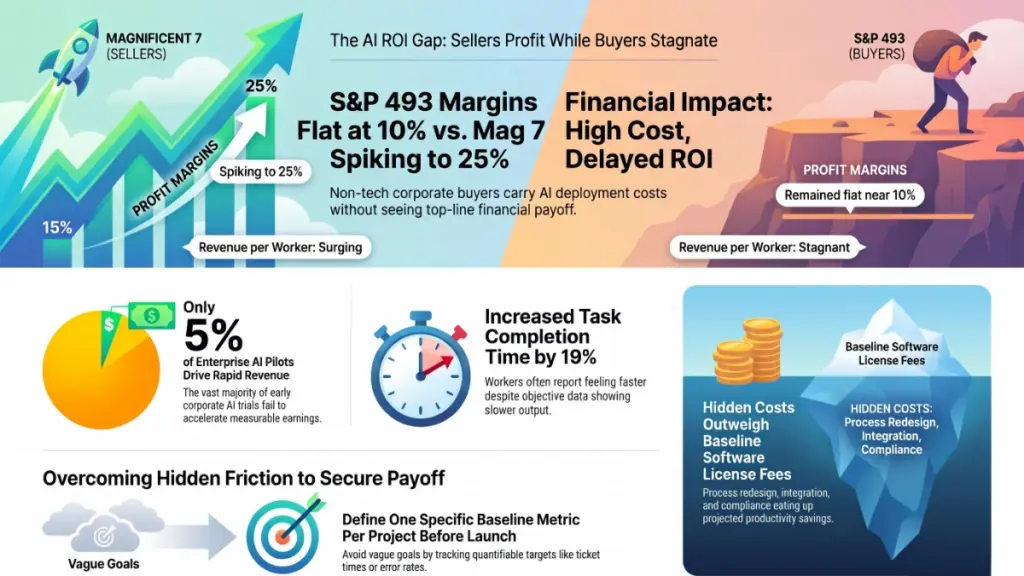
Sellers benefit first. Apollo’s data shows a clear split. Magnificent Seven margins rose from about 15% to 25% between early 2023 and early 2026, while the rest of the S&P 493 hovered near 10%. That gap forms the core of the argument. Fortune
Chip designers, cloud platforms and model vendors collect the revenue. Meanwhile, their customers carry the cost and wait for the return.
Who carries the risk
Three groups carry most of the risk. Non-tech corporations spend on licenses, integration and training, so they bear both the cost and the delay. Investors in AI companies hold valuations that assume fast earnings growth from customers. Workers and managers, in turn, face pressure to adopt tools before anyone defines success.
Which workflows change
Slok does not say AI changes nothing. His claim is narrower. Workflow changes have simply not reached the income statement of large non-tech firms.
That distinction matters. For example, a team can draft emails faster and still show no profit gain. Saved time can vanish into meetings, rework or slack. Moreover, productivity gains in knowledge work are hard to measure. Without clear metrics, management cannot act, and gains get absorbed into daily operations. the-decoder
Why judgment sits at the center
Slok also makes a conceptual argument. He calls AI a strong calculator and says business success depends mostly on judgment. According to his note, AI does not grasp accountability, trust, culture, unwritten rules, ethical trade-offs or fairness. These factors shape reputation, and reputation drives revenue and margins.
Economists will debate that framing. Still, it captures a real tension. Cheap intelligence does not automatically produce better decisions, because someone must still own the outcome.
Deep Dive: What Slok Actually Measured
This story has no model architecture or parameter count to dissect. Instead, the technical core is the method. Readers should understand what Slok measured before they trust or dismiss the result.
The S&P 493 construct
Slok removes seven companies from the S&P 500. He treats them as the AI sellers and heavy tech adopters. The remaining 493 companies stand in for corporate America as a customer base.
The logic is clear. If AI lifts productivity broadly, the effect should appear in the margins of ordinary companies. Banks, insurers, manufacturers, retailers and energy firms should all show it.
The metrics
Slok points to two main indicators.
- Profit margins. He compares margins over time using Bloomberg and Macrobond data. He finds margins for the S&P 493 hovering near 10% across the period. Fortune
- Revenue per worker. This ratio rises when output grows faster than headcount. However, it also rises when companies cut staff and keep sales. TechCrunch reports that Slok finds it flat as well.
Both metrics are blunt. They aggregate thousands of business decisions. Furthermore, they reflect interest rates, tariffs, wages and demand. Slok cannot isolate AI as the cause of any movement. He can only say that the expected pattern has not appeared.
The timing argument
Slok also argues about time. He calls the length of the ROI runway the key issue outside tech. Regulated sectors face extra friction. Healthcare, banking, energy, pharma and manufacturing face process overhauls and privacy rules that could delay gains. the-decoder
Consider what a bank must do to deploy AI in lending. Regulators expect validated models and documented decisions. Staff need retraining. Legacy software needs integration. Each step takes months, and some take years.
The valuation mechanism
Slok then connects timing to price. Markets, he argues, assume fast earnings growth. He warns that a productivity hockey-stick taking five years instead of five months would force a painful repricing. asianetnews
Notice the logic here. He does not claim AI will fail. Instead, he claims investors have priced in speed. If the payoff arrives late, today’s prices look too high.
The token-cost angle
One more detail deserves attention. According to The Decoder’s summary, falling token costs could also cap hyperscaler revenue. Cheaper intelligence helps buyers. At the same time, it shrinks the revenue that each unit of usage produces for sellers.
That creates a squeeze. Sellers need buyers to spend more, yet buyers pay less per unit. As a result, volume must grow fast enough to offset the price drop.
Performance, Benchmarks and Evidence
Benchmarks in this story are financial, not technical. Four data points carry the argument.
Margin divergence
The margin gap is the headline. The Magnificent Seven moved from roughly 15% to 25%. In contrast, the S&P 493 stayed near 10%. A ten-point spread opened in three years.
Spending versus returns
Companies are spending heavily. Apollo’s August note says the S&P 493 is pouring money into AI. It adds that the boom shows up in sellers’ margins and not in buyers’ margins. Therefore, the finding pairs rising cost with flat return.
Pilot outcomes
Other analysts reach similar conclusions through different data. For instance, a 2026 summary from Toolradar cites a figure that only about 5% of enterprise generative-AI pilots achieve rapid revenue acceleration. Treat that number carefully, however. It comes from a secondary summary, and pilot studies vary in method. Even so, the direction matches Slok’s thesis.
Perceived versus actual speed
The same summary cites research suggesting AI tools slowed experienced workers. It reports that allowing AI tools raised completion time by 19% in one study. Interestingly, people felt faster even when they were not.
This finding illustrates a measurement trap. Workers report gains based on feel, but controlled tests sometimes show the opposite. Consequently, a company that relies on surveys may overestimate its returns.
What the evidence cannot show
The data cannot prove that AI never helps. On the contrary, some firms report large gains. A Fortune report describes a Ricoh division that tripled its productivity. Nevertheless, the same report stresses that the gain took time and money.
That example supports a careful reading. Gains exist. Still, they cost a lot, arrive slowly and depend on execution.
Costs, Licensing and Availability of the Payoff
A typical product story has a pricing section. This story has an adoption-cost section instead. The question is not what AI costs per month. Rather, the question is what it costs to turn AI into profit.
Visible costs
Visible costs include licenses, API usage and cloud compute. Token prices have fallen in recent years. Because these line items are easy to track, they are also easy to cut.
Hidden costs
Hidden costs usually dominate. Integration comes first, since teams must connect AI tools to data, software and workflows. Process redesign follows, because old procedures often assume human steps. Training matters too, as staff need time to learn the tools and their limits. Governance adds more work when legal, security and compliance teams review each use case. Finally, someone must build baselines and track results.
Boston Consulting Group found that deploying AI for its own sake can undermine productivity gains. Fortune cites that study in its coverage of Slok’s note. In short, aimless rollout adds cost without adding value.
Availability is not the constraint
Nobody lacks access to AI today. Tools are cheap and widely available. Organizational readiness, not access, has become the bottleneck.
That shift changes the buying question. Leaders should stop asking which tool to buy. Instead, they should ask which measurable problem the tool must solve.
⚡ Limited Time Free Access
Unleash Your Digital Empire: Get 4 Premium Gifts in 1 Pack!
Grab this exclusive, high-value digital asset package tailored for creators, marketers and builders. Enter your best email to claim instant access.
What’s Inside Your Ultimate All-In-One Package:
01. 50 AI Digital Product Ideas: A curated list of profitable, AI-driven digital product ideas built for fast execution and high margins.
02. Digital Sales Mastery: The strategic architecture behind high-converting sales funnels, persuasive copywriting and online revenue growth.
03. Mastering Email List: Advanced frameworks for building an engaged audience, maximizing open rates and generating automated income.
04. THE ULTIMATE FACELESS PLAYBOOK: A complete blueprint for building a powerful, monetizable brand on social media without showing your face.
Included Bonus: Premium Canva Marketing Vault: high-converting templates to scale your organic traffic.
💥 $197 VALUE — FREE FOR READERS
🛡️ Secure Processing • Your privacy is 100% protected.
Industry Implications and Competitive Analysis
Slok’s note lands in a crowded debate. Optimists and skeptics both cite evidence, so a fair reading compares their positions.
The optimist case
Optimists argue that general-purpose technologies take time. Electricity and computers, for example, needed decades before productivity statistics improved. Firms had to reorganize around the new tools. From this view, Slok measures too early.
Slok partly agrees. He calls the long-term AI story compelling. However, he disputes the speed that markets assume.
The skeptic case
Skeptics go further. They argue that AI mostly automates low-value tasks and that gains often disappear into slack or extra work. Flat aggregate data, they say, confirms the point.
Slok sits between the camps. He accepts eventual gains, but he rejects the current timetable.
Sector differences
Impact will vary by sector. Software and media firms can adopt AI quickly because they own their data and face few rules. Regulated industries move slower. Manufacturers must tie AI to physical operations, while retailers must tie it to supply chains.
Expect uneven results. Some non-tech firms will show gains first. Unfortunately, the aggregate view hides those leaders.
Competitive pressure on vendors
Vendors face a tougher sales climate if buyers demand proof. Slok warns that companies will slow AI spending if returns do not come quickly. Slower spending would hit sellers first.
Vendors can respond in three ways. They can price by outcome instead of by seat. Bundled implementation support offers another route. Verified case studies with real baselines would also help.
Pressure on buyers
Buyers face a different problem. Competitors may adopt AI successfully while they hesitate, so waiting carries risk. Overspending, on the other hand, carries risk too.
The sensible path sits between those risks. Pick narrow use cases and set a baseline before launch. Then measure after launch, and stop projects that fail.
Market rotation
One summary of Slok’s note says leadership within the equity market is rotating. That statement suggests investors may favor different segments as the AI story matures. It does not predict a crash. Rather, it signals that the easy phase of the trade may be ending.
Limitations, Caveats and Skepticism
Slok’s argument deserves scrutiny. Several limits apply.
Aggregate data hides detail
Margins at 493 companies blend many forces. Wages, tariffs, interest rates and demand all move them. A flat average can hide winners and losers. In other words, some firms may gain from AI while others lose for unrelated reasons.
Timing may explain the gap
Many deployments began recently, and gains from process change often lag investment. Slok’s own thesis rests on delay. Therefore, critics can reasonably say the test comes too early for a final verdict.
Measurement limits
Revenue per worker is an imperfect productivity proxy. It misses quality improvements and time shifted to better work. It also reacts to layoffs and hiring cycles.
The excluded seven are not clean controls
Slok excludes seven firms. Some sell AI, while others use it heavily. Tesla and Apple differ from Nvidia in how AI touches their business. The grouping serves a clear argument, but it is not a controlled experiment.
Secondary sources vary in quality
Several figures in this debate circulate through summaries. This article takes the 5% pilot success rate and the 19% slowdown figure from a secondary write-up. Readers should therefore check the original studies before building decisions on them.
The zero claim is rhetorical
“Zero financial payoff” makes a strong headline. Yet the underlying data show flat margins, not proof that every company earned nothing. After all, absence of aggregate evidence does not equal absence of effect.
Conflicts of interest
Apollo manages money, and its economist writes market commentary. His view can influence positioning. For this reason, readers should treat the note as informed analysis, not neutral science.
Production risks for adopters
Real deployments carry their own risks. Models can produce errors that staff fail to catch. Privacy and compliance exposure grows as data use expands. Over-reliance can erode human skill. In addition, vendors can change pricing or shut down products.
None of these risks invalidates AI. Instead, they explain why careful adopters move step by step.
What Business Leaders Can Do Now
The evidence points to a practical approach. Leaders can apply it without taking sides in the market debate.
- Define one metric per project. Choose hours, error rate, cost per ticket or conversion rate. Avoid vague goals such as “innovation.”
- Capture a baseline first. Measure current performance before launch, because you cannot show a gain without one.
- Start narrow. Pick one workflow with high volume and clear rules.
- Redesign the process. Do not paste AI onto an old workflow. Change the steps around it instead.
- Track total cost. Include integration, training and oversight, then compare against measured benefit.
- Set a stop rule. Decide in advance what result ends the project.
- Distrust self-reported speed. Pair surveys with timed tests or output counts.
Teams that follow these steps will learn whether AI pays in their setting. Ultimately, that answer matters more than any national average.
Future Outlook and Conclusion
Slok’s note will not settle the debate. Still, several milestones will shape the next chapter.
Earnings seasons. Watch whether non-tech firms report margin gains and credit AI. Specific, quantified claims will carry more weight than general enthusiasm.
Productivity statistics. Government data on output per hour will show whether the effect reaches the broader economy. Revisions may change the picture.
Capital spending plans. Slok warns that companies cut AI budgets when returns lag. A broad pullback would signal that his concern is spreading.
Vendor pricing. Falling token costs could reshape seller revenue. Observers should track how model providers respond.
Regulated-sector deployments. Banks, insurers and hospitals will show whether compliance-heavy industries can scale AI.
The core message is simple. AI may deliver large gains, but the evidence so far does not show them outside tech. Slok does not call the technology a failure. Rather, he argues that markets have priced in speed that the data does not yet support.
For readers who run or advise businesses, the lesson is clear. Treat AI as a tool that needs a target, a baseline and a measurement plan. Buy it for something specific, and prove the gain. Cut what does not work.