


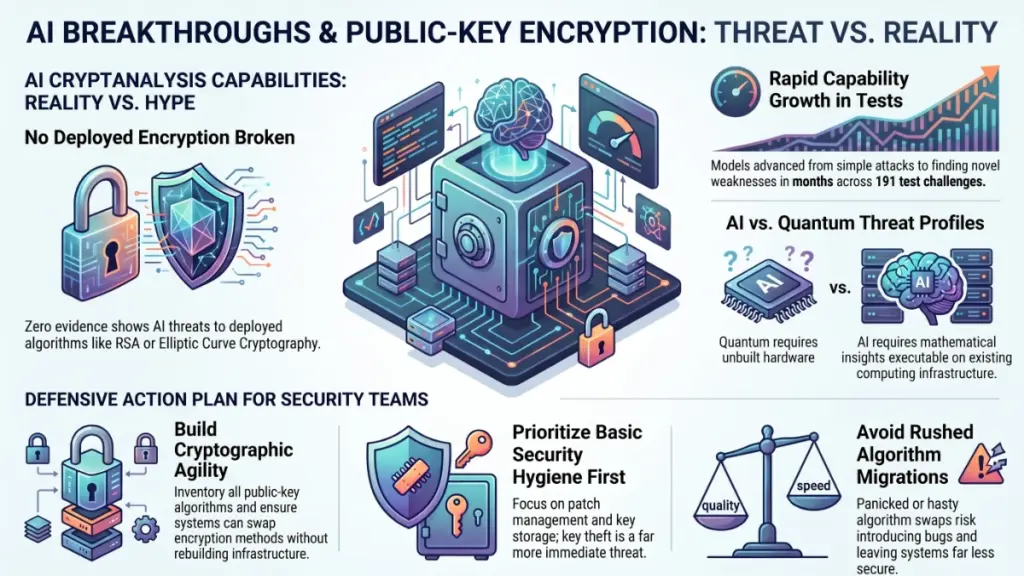
OpenAI’s release of 722 AI-generated mathematical papers has raised questions about the future of public-key encryption. Although AI models are improving at cryptanalysis, no deployed RSA or elliptic curve encryption system has been broken by AI. Experts disagree about the long-term risks, while researchers continue evaluating the evidence. Organizations should strengthen key management, patch vulnerabilities, inventory cryptographic systems, and prepare for future algorithm changes without panicking.
What OpenAI Released
Earlier this month, OpenAI posted 722 mathematical manuscripts online in one release. An AI model that the public cannot access wrote every paper. However, the output was uneven. OpenAI withdrew three papers within a day, and mathematicians are still reviewing the rest.
Even so, the scale of the work rattled researchers. Math underpins cryptography, after all. Every text message and bank log-in relies on a problem that experts believe nobody can solve efficiently. Notably, that belief rests on decades of failed attempts rather than on a proof.
Why Cryptographers Disagree
Matthew Green, a cryptographer at Johns Hopkins University, estimates a 15 percent chance that confidence in existing public-key algorithms collapses. In contrast, Yehuda Lindell of Bar-Ilan University and Coinbase sees no evidence of a breakthrough. Meanwhile, Dan Boneh of Stanford finds it striking that none of the 722 papers addresses cryptography.
Here is the reality. Nobody has broken a deployed encryption algorithm with AI. Nevertheless, researchers have shown that AI models are improving quickly at cryptanalysis. Furthermore, outsiders have almost no view into what the AI labs have tried.
How This Article Works
I’ll be straight with you: I’m a marketing and AI-tools specialist, not a cryptographer. Therefore, I rely on the experts quoted in published reporting. Where the evidence runs thin, I say so. Consequently, this analysis separates what we know from what we merely suspect.
Strategic Context & Why It Matters
What Public-Key Cryptography Does
Public-key cryptography performs three jobs. First, it lets two computers build a secure connection without sharing a secret in advance. Second, it verifies digital identities. Third, it produces signatures that certify software updates and cryptocurrency transactions.
Almost everything online depends on those functions. For example, browsers use them to reach your bank. Phones use them to protect messages. Operating systems use them to check updates. Likewise, blockchains use them to authorize payments.
Who Has a Stake
Several groups have a stake in this debate. Security teams carry the most direct exposure. They must decide whether to speed up migration plans before any attack appears. Moving early costs money and risks mistakes. Moving late, on the other hand, risks a rushed scramble.
Businesses that store sensitive data face a quieter problem. Attackers can record encrypted traffic today and decrypt it years later if a break emerges. Medical records, legal files, and trade secrets keep their value for decades. Therefore, long-lived data deserves extra attention.
Cryptocurrency projects also have skin in the game. They rely on elliptic curve signatures, so a weakness there would threaten their core trust model. Meanwhile, AI labs face growing pressure to disclose more about their cryptographic experiments.
Workflow Changes for Defenders
The workflow changes are concrete. Teams need an inventory of every place their systems use public-key algorithms. In addition, they need the ability to swap algorithms without rebuilding everything. Security engineers call this “crypto agility.” Few organizations have it today.
Govind Pimpale, a research fellow at the Foundation for American Innovation, makes a structural argument. Public-key cryptography depends on relatively few mathematical problems. Moreover, only a small community studies each one. Machines can throw far more effort at those problems than that community can. As a result, the odds of finding a flaw or a faster algorithm rise.
That argument does not prove a break is coming. Still, it explains why the question deserves serious attention.
Deep-Dive Technical Specifications
What We Don’t Know About the Model
OpenAI has not published architecture details for the model behind the 722 papers. Likewise, the source reporting gives no parameter counts, context windows, or modality information. I won’t guess. Instead, this section examines the cryptography at stake.
How Public-Key Systems Rely on Hard Problems
Public-key schemes pair a public value with a private one. Anyone can see the public value. Only the owner knows the private one. Security holds only if computing the private value from the public one takes impractical effort.
Two families dominate today. RSA relies on the difficulty of factoring large numbers. Elliptic curve cryptography, by contrast, relies on the difficulty of reversing a specific operation on points of a curve. Websites, apps, and cryptocurrencies use the latter widely.
Importantly, neither difficulty carries a mathematical proof. Confidence comes from experience. Researchers have attacked these problems for decades and found no efficient method. However, that track record offers no guarantee about the future.
The Precedent That Worries Researchers
Green points to a historical example. An algorithm called the number field sieve made it far easier to crack RSA when keys were 512 bits long. In response, cryptographers lengthened the keys. Today, 2,048 bits serves as the minimum.
That fix worked because the advance was incremental. It weakened RSA at small sizes but left larger keys safe. The fear now is a bigger leap. Specifically, researchers worry about a shortcut that cracks a whole family of problems at once.
What the AI Cryptanalysis Research Found
Florian Tramèr of ETH Zurich and his colleagues, three of them at Anthropic, recently released a preprint. They pitted leading AI models against 191 code-breaking challenges. In summer 2025, the team doubted that AI could reproduce even fairly simple attacks. Months later, however, the models found weaknesses nobody had spotted before.
Anthropic also reported that its Claude model found a substantially improved attack on HAWK. HAWK is a proposed digital signature scheme built to withstand quantum computers. This result matters for two reasons. First, it shows AI finding real improvements in a serious design. Second, it shows that quantum-resistant design does not guarantee resistance to AI-driven analysis.
Weakening an experimental scheme still differs sharply from breaking a deployed one. Researchers expect proposals like HAWK to face attack and revision. By comparison, RSA and elliptic curve systems have survived far more scrutiny. Even Pimpale concedes that AI has broken no currently deployed algorithm.
Performance, Benchmarks & Evidence
Why No Benchmark Table Exists
No public leaderboard measures AI cryptanalysis against deployed systems. Therefore, the evidence arrives in pieces. Each piece deserves separate weighing.
The Individual Pieces of Evidence
The 722 papers signal capability through sheer volume. Conversely, the withdrawal of three papers signals imperfection. Reviewers have not finished checking the rest, so any verdict on the batch’s overall quality is premature.
The cryptography gap deserves attention too. According to Boneh, none of the papers deals with cryptography. That absence fits two readings. OpenAI may have steered away from the topic. Alternatively, it may have tried and found nothing worth publishing. The public cannot tell which.
The 191-challenge study offers the strongest quantitative signal. Progress from failing at simple attacks to finding novel weaknesses took months, not years. Tramèr describes the growth in model ability as extremely rapid. Nevertheless, the challenges used test problems rather than the full-strength systems that protect real traffic. For that reason, the study does not show a deployed break.
The HAWK result counts as evidence of capability. In contrast, it does not count as evidence of a pattern across the field. One improved attack on one proposed scheme proves a point, but not a trend.
Weighing the Expert Estimates
Green’s 15 percent figure reflects one informed opinion. He frames it as a possibility rather than a prediction. Lindell, meanwhile, sees no evidence of a breakthrough. Bart Preneel of KU Leuven sees no reason to panic at present. These views conflict, and that conflict is informative. Careful experts disagree because the data does not settle the question.
Preneel adds a useful calibration about scale. A modest mathematical advance might dent existing protection without breaking it. In fact, even an attack a billion times faster might still demand more computing power than anyone can assemble. In short, the size of any breakthrough determines the damage.
Overall, the evidence supports three conclusions. AI capability in cryptanalysis is real and growing. No evidence shows a threat to RSA or elliptic curve systems today. Finally, the biggest unknown sits inside the frontier labs, where outside researchers cannot see the results.
Pricing, Licensing & Availability
No Product to Buy
This section looks different from a typical product analysis, because no product exists for you to buy. OpenAI has not released the model that wrote the 722 papers. Consequently, neither developers nor consumers can use it. No API, subscription tier, or open-weight release exists. Similarly, the source reporting offers no figures on training or inference costs.
What You Can Access Today
The papers themselves sit online, so researchers can read and critique them. The cryptanalysis study is a public preprint. Anthropic’s reported HAWK finding is also a published claim that anyone can examine.
Defensive technology costs less than you might expect. Standards bodies have finalized post-quantum algorithms, and major software vendors have started shipping them. According to Boneh, the effort to prepare for quantum computers could help if AI discovers something unexpected. The two threats differ, as the HAWK result proves. Even so, the migration machinery built for quantum readiness gives defenders a head start.
What should you budget for? Plan staff time, not licenses. The main cost lies in auditing where your systems use cryptography, testing replacements, and training engineers.
⚡ Limited Time Free Access
Unleash Your Digital Empire: Get 4 Premium Gifts in 1 Pack!
Grab this exclusive, high-value digital asset package tailored for creators, marketers, and builders. Enter your best email to claim instant access.
What’s Inside Your Ultimate All-In-One Package:
01. 50 AI Digital Product Ideas: A curated list of profitable, AI-driven digital product ideas engineered for fast execution and high margins.
02. Digital Sales Mastery: The strategic architecture behind high-converting sales funnels, persuasive copywriting, and online revenue growth.
03. Mastering Email List: Advanced frameworks for building an engaged audience, maximizing open rates, and generating automated income.
04. THE ULTIMATE FACELESS PLAYBOOK: Complete blueprint to building a powerful, monetizable brand on social media without showing your face.
Included Bonus: [BONUS] Premium Canva Marketing Vault: High-converting templates to scale your organic traffic.
💥 $197 VALUE — FREE FOR READERS
Enter your best email for instant lifetime access:
[Email Input Field] [Claim Free Access Button]
🛡️ Secure Processing • Your privacy is 100% protected.
Industry Implications & Competitive Analysis
A Competitive Dynamic Among Labs
This story reveals a competitive dynamic among AI labs. OpenAI demonstrated breadth in mathematics. Meanwhile, Anthropic researchers demonstrated depth in cryptanalysis. Together, these efforts show that frontier models now contribute to research that experts take seriously.
Transparency as an Ethical Issue
Boneh wants something simple from AI companies. He asks them to say what their models have tried and how often they succeeded. Green agrees and says the community gets no signal at all. If labs have pointed their models at the problems behind cryptography, disclosure would reassure the people who secure the Internet. Silence, however, leaves everyone guessing.
Labs face a real tension here. Publishing failed attempts reveals little and builds trust. Publishing successes, on the other hand, could hand attackers a roadmap before defenders patch. A responsible-disclosure norm, similar to those in software security, could resolve this. Labs would notify standards bodies and vendors privately, then publish after fixes ship.
AI Versus Quantum as Competing Threats
Quantum computers remain the better-known threat to public-key cryptography. Governments and companies already rethink their encryption because of it. AI adds a second, different pressure. Quantum attacks require hardware that does not yet exist at scale. AI attacks, by contrast, require only better mathematics, which a model could produce on existing machines.
That difference matters for planning. You can track quantum hardware progress on a visible timeline. You cannot track a mathematical insight the same way. It could arrive suddenly, or it could never arrive.
The More Immediate AI Threat
Eyal Ronen of Tel Aviv University co-authored the cryptanalysis study and urges caution. He notes that AI already excels at finding software vulnerabilities. That capability poses a much more immediate threat than any collapse of the underlying mathematics. In addition, attackers prefer easy routes. Stealing a key from a compromised computer beats breaking the math that protects it.
For most organizations, this reframes priorities. Patch management, key storage, and access control will likely prevent more real incidents than algorithm swaps. Therefore, fix the basics first.
Expect growing demand for crypto-agility tools, cryptographic inventories, and migration services. Vendors will market these aggressively, so verify their claims. Likewise, demand evidence of risk before you spend heavily.
Limitations, Caveats & Skepticism
Unverified Claims and Missing Data
Several limits apply to everything above. First, the 15 percent estimate comes from a social media post, not a formal analysis. Treat it as an informed opinion. Second, the review of OpenAI’s 722 papers continues, so conclusions about their quality may shift.
The missing data forms the central caveat. We lack information on what the frontier labs have tested internally. Absence of evidence is not evidence of absence. Equally, it is not evidence of risk.
The Gap Between Test and Deployment
The 191 challenges tested AI against designed problems. Real systems use larger parameters and face more scrutiny. Thus, success on a challenge does not translate directly into a real-world break.
Scale uncertainty matters as well. A small improvement forces longer keys. A large one forces new algorithms. A massive one, which nobody has shown, would cause systemic failure.
Upgrade Risk and My Own Limits
Green warns that the upgrade process itself could cause harm. If engineers botch a migration, they may leave systems less secure than before. Rushed changes create bugs, and bugs create openings. Consequently, a defender who panics and swaps algorithms hastily may do more damage than the threat would.
Finally, I can’t evaluate the mathematics myself. I’m relaying and weighing expert statements. For high-stakes decisions, consult a qualified cryptographer. Preneel’s bottom line fits the evidence: no real reason to panic right now. Still, the same evidence gives no reason to relax.
Future Outlook & Conclusion
What to Watch Next
Several developments will shape this story. First, mathematicians will finish evaluating the 722 papers. Their verdicts will show how reliable the model’s output actually is. Second, watch whether OpenAI, Anthropic, or others share results from cryptographic experiments. Any statement, even a negative one, would reduce uncertainty.
In addition, Tramèr’s team and others will likely extend their work to stronger targets. Results on schemes closer to deployment would sharpen the picture. Meanwhile, standards bodies may adjust guidance on algorithm diversity and key sizes. Diversity helps because a single shortcut then cannot break everything. Migration speed matters too, since it determines how prepared defenders are for a surprise.
What Developers Should Do Now
Start with a complete inventory of your cryptographic dependencies. Next, make your algorithms swappable. Follow standards guidance rather than improvising. Above all, prioritize the easy attack routes, such as key theft and software flaws, before the exotic ones.
Nobody knows yet whether AI has exposed something fundamental about the mathematics we trust. Alternatively, it may simply be getting better at problems that were always solvable. Until the labs share more, that question stays open. In the meantime, prepare calmly and keep watching.