


TrafficGenie’s free live training explores how one AI-powered platform claims to automate SEO, AEO, and GEO by generating content, images, and videos without manual work. This guide examines those claims, explains the differences between modern search optimization methods, highlights important questions to ask during the webinar, and helps marketers evaluate whether AI automation can truly improve long-term search visibility.
I’ve tested marketing software for seven years. One pattern repeats every time: search behavior shifts, and a wave of “hands-free” tools promises to shift with it. We’re in the middle of a big shift right now. Search is moving from classic Google rankings toward answer engines like ChatGPT, Perplexity, and Google’s AI Overviews.
A free live training landed on my radar recently. It promises to cover SEO, AEO, and GEO through one automated engine. I wanted to break down the promise, test it against reality, and list what I’d want answered before signing up.
That training belongs to TrafficGenie. The free live session runs on July 14, 2026, at 10:00 AM EDT. Here’s the honest rundown.
What Is the TrafficGenie Live Training, Exactly?
TrafficGenie calls itself an AI-powered content and traffic engine. The pitch is simple: the engine creates content, images, and video for every post automatically. It then works to get that content found across Google, ChatGPT, and other AI-driven search surfaces.
The July 14 training walks through the mechanics. Expect a demo of the automation itself. Expect case studies showing real traffic results too.
You’ve probably seen this format before. A live session opens, automation gets promised, results get teased, and an offer usually closes things out. None of that makes a tool bad by default. Plenty of legitimate software launches this exact way. Still, walk in with a checklist, not just curiosity. That’s what this article gives you.
Why SEO, AEO, and GEO Are Three Different Games Now
These three disciplines used to overlap almost completely. They don’t anymore. Client dashboards have told me a consistent story over the past two years: fewer clicks come from classic blue-link search, and AI assistants now capture a growing share of attention without sending readers to a results page at all.
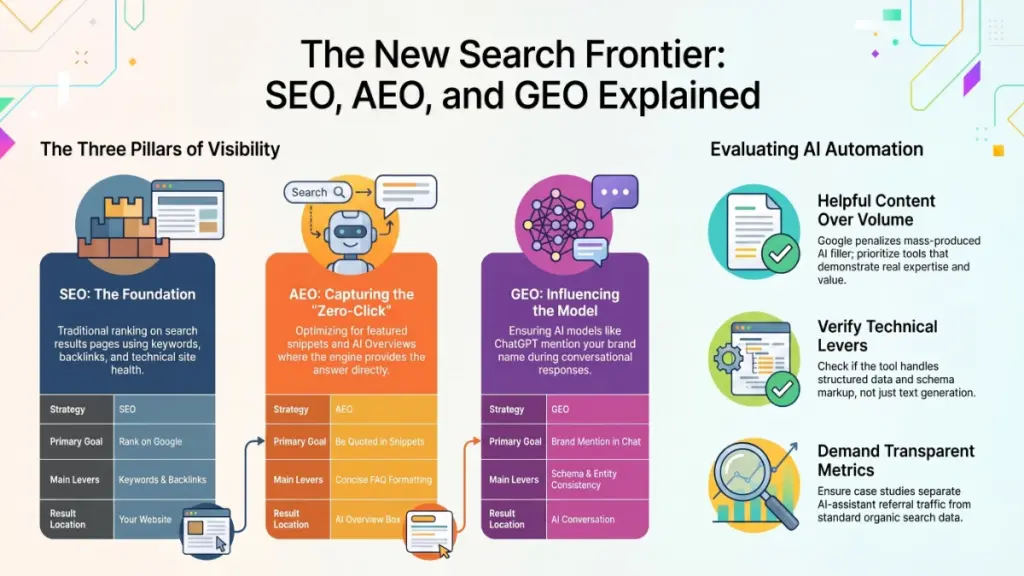
SEO Still Anchors Everything
SEO stands for Search Engine Optimization. Most people picture this first: ranking pages on Google through keywords, backlinks, technical health, and content depth. SEO hasn’t disappeared. Nearly every other strategy still builds on top of it.
AEO Wins the Answer, Not the Click
AEO stands for Answer Engine Optimization. It targets a different prize entirely — landing inside the answer itself, whether that’s a featured snippet, an AI Overview box, or a voice assistant response. Readers often skip the click here. The win comes from becoming a source the answer engine trusts enough to quote directly.
GEO Gets You Mentioned by Name
GEO stands for Generative Engine Optimization, and it goes one layer further. Large language models like ChatGPT, Claude, and Gemini decide whether to mention your brand by name during a conversation. No ranking page exists to check in this world. The model either says your name, or it stays silent.
Each discipline rewards different work. Backlink profiles and keyword targeting drive classic SEO. Short, self-contained, directly-answerable content drives AEO. Structured data, topical authority, and citations across the wider web drive GEO. A tool that claims to automate all three at once makes a bold promise — one worth watching demonstrated live, not just described on a slide.
What the Training Says It Will Cover
The session description outlines a packed agenda for July 14:
- How the AI engine generates content, images, and video for each post automatically
- How that output gets positioned across Google search, ChatGPT, and other AI search results
- A hands-free approach to SEO, AEO, and GEO without writing, designing, or juggling separate tools
- Real-world traffic case studies
- New opportunities opening up inside AI-driven search right now
This agenda covers a lot of ground for one session. Two things follow from that. The team clearly has plenty to show. Expect the pacing to move fast, favoring vision and case studies over granular mechanics. That’s typical for a launch training — it doesn’t make the session weak. It just means you should bring sharp questions to the Q&A if you want specifics.
The Honest Case for “Hands-Free” Content Tools
I don’t oppose all-in-one AI content tools on principle. I’ve used several in client work, and the strong ones save real hours. Most marketing stacks I’ve audited contain five or six disconnected tools that never talk to each other. A single engine handling content, images, video, and distribution genuinely appeals to me for that reason. If TrafficGenie consolidates that mess into one workflow, that alone carries value, separate from how well the AEO and GEO piece performs.
Where I’d Slow Down
The “without writing” promise deserves closer scrutiny. Fully automated content works in narrow situations, like programmatic pages built off structured data. But unedited AI content published at scale has also backfired badly elsewhere. Some sites saw manual actions or ranking drops after publishing large volumes of thin, unedited AI pages.
Google’s helpful content guidance has stayed consistent on this point. The guidance doesn’t penalize AI assistance itself. It penalizes content that reads as mass-produced with no real expertise behind it. So bring one question into the training: does the output hold up against that standard, and does a human still review it before publishing?
What I’d Actually Ask During the Live Session
Bring this list if you attend. Years of watching automated-content pitches disappoint six months later shaped every question on it.
On content generation:
- Does the tool cite sources or verify facts, or does it invent claims from the model’s training data alone?
- Can you review and edit before publishing, or does everything go live automatically?
- How does the tool handle E-E-A-T signals like author bios and credentials? Google’s guidance treats these as the line between helpful content and filler.
On AEO and GEO:
- What mechanism actually improves AI citation rates? Structured data, schema markup, and consistent entity signals currently move that needle. Ask whether the tool touches those, or whether “AEO/GEO optimization” just means FAQ formatting.
- Do the case studies separate organic search traffic from AI-referral traffic? GA4 can split these two sources now, so a credible case study should show that split rather than one blended number.
On the business side:
- What does the tool cost after the free training? Is pricing transparent up front, or does it only appear at the pitch’s end?
- Does a trial period exist? What happens to published content if you cancel?
None of these questions read as hostile. I ask every vendor these same things when evaluating tools for clients. Reputable companies answer directly. Vague or deflected answers usually signal how a tool performs once the novelty fades.
How This Fits Into the Bigger AI Search Shift
The shift itself matters, regardless of any single tool’s performance. Conversational AI now handles a growing share of information-seeking behavior. Google’s own AI Overviews have redefined what a “top result” looks like for countless queries. Clients have asked me directly, more than once this year, whether a blog still justifies the investment.
My answer hasn’t moved much. Content that answers real questions clearly still earns its keep. Content structured for both humans and machines to parse quickly still wins. Content that reflects genuine first-hand knowledge still outperforms generic summaries. That holds true whether a person writes it, an AI assistant helps, or a fully automated platform produces it. Tools change constantly. The requirement to be a source worth citing hasn’t changed at all.
Signals Worth Tracking, Regardless of Tool
A few signals deserve attention no matter which platform you choose:
- Structured data and schema markup matter more now, since AI systems lean on these to understand and trust content.
- Topical authority — a cluster of related, in-depth content around one subject — still correlates strongly with both rankings and AI citations.
- Freshness and consistency carry extra weight for AI systems, which increasingly favor recently updated, actively maintained sources.
- Multi-platform presence across forums, review sites, and industry publications feeds directly into whether generative engines treat you as worth citing.
A training that addresses these mechanics earns your 45 minutes. A training that stays at the level of big promises and testimonial screenshots reveals that within the first fifteen minutes, and you can act on that read.
SEO vs. AEO vs. GEO: A Quick Side-by-Side
Here’s the cheat sheet I keep pinned in my own notes for clients hearing “GEO” for the first time.
| SEO | AEO | GEO | |
|---|---|---|---|
| Goal | Rank on Google’s results page | Get quoted in a featured snippet or AI Overview | Get mentioned by name in an AI chat response |
| Where the reader ends up | On your site, after a click | Often still no click | Almost never a click |
| Main levers | Keywords, backlinks, technical health | Concise, self-contained answers; FAQ formatting | Schema markup, entity consistency, third-party mentions |
| How you measure it | Rankings, organic traffic | Snippet/Overview appearances | Manual prompt testing, brand-mention tracking |
| How mature the tooling is | Very mature | Moderately mature | Still early and fragmented |
Keep that last row in mind during any GEO-focused pitch, including this one. Tools that track ChatGPT or Perplexity brand mentions still trail the maturity of rank-tracking tools built over two decades. That gap doesn’t disqualify a platform from doing GEO well. It just makes “how do you measure GEO results” a fair question, since most vendors would honestly answer “imperfectly, and we’re improving it.”
Common Questions Worth Having Answered Before You Buy Anything
Does AI-generated content get penalized by Google? Not simply for being AI-assisted. Google’s guidance names helpfulness, accuracy, and genuine expertise as the real factors. Mass-produced content with no added value tends to get hit, no matter who or what wrote the first draft.
Can one tool realistically handle SEO, AEO, and GEO at once? Partly, yes. Structured content and schema markup benefit all three disciplines at once. Full GEO optimization, though, depends on signals outside any single platform, like mentions on third-party sites. No content tool controls those signals completely, so stay skeptical of any claim that GEO comes “solved” in one dashboard.
How does anyone track AI-referral traffic? Modern analytics platforms, including GA4, now separate AI-assistant referral traffic from standard organic search. A trustworthy case study should show that split. A single blended traffic number hides which channel actually did the work.
Is a free training just a sales pitch? Usually, yes, at least in part. Nothing’s wrong with that format as long as the educational content stands on its own. Here’s my test: would the session still help me if I bought nothing afterward? A “no” answer means the training label does more marketing than teaching.
Should beginners attend, or is this only for experienced marketers? Beginners can attend without trouble. The core concepts — structured content, clear answers, credible sources — apply at any experience level. Just expect the case studies to assume some familiarity with basic SEO terms. Pause and look up any term that feels unfamiliar rather than skipping past it.
Red Flags Worth Watching For
A few patterns show up across weak launch trainings. None of them prove a tool is bad on their own. Together, though, they’re worth noticing.
Vague Numbers Instead of Real Ones
Watch for phrases like “massive traffic increase” without a starting baseline. Real case studies show before-and-after numbers side by side. They name the time frame too. A jump from 50 visitors to 500 sounds impressive, but the raw numbers matter as much as the percentage.
No Mention of Editing or Review
Some tools publish content the moment it generates. Others build in a review step before anything goes live. Listen for which model TrafficGenie follows. A tool with zero human checkpoints carries more risk, especially for sites that already rank well and have something to lose.
Pricing That Only Appears at the End
Transparent companies usually mention pricing early, even in passing. Pricing revealed only after forty-five minutes of buildup often signals a harder sales push waiting at the close. That’s not automatically dishonest. It’s still worth noticing.
Testimonials Without Context
A screenshot of a traffic graph tells you little on its own. Ask what niche the example came from. Ask how long the site existed before using the tool. Ask whether other marketing efforts ran alongside it. Context turns a testimonial into useful evidence.
Who This Training Is Actually For
The stated focus serves a few groups particularly well:
- Solo creators and small business owners who lack a full content team and want one workflow instead of five tools
- Marketers without an AEO/GEO strategy yet who want a fast overview of how AI search has changed content discovery
- Anyone relying entirely on manual content production and curious whether automation has matured enough to lighten that load
Experienced SEO professionals running structured data implementations already will likely find the session light on depth. A broad-audience session rarely leaves room for a line-by-line schema walkthrough. The live demo and case studies will teach that audience the most instead.
What I’d Do Before July 14
A few practical steps, if you’re planning to attend:
- Register early and check the time zone conversion. 10:00 AM EDT lands at 7:00 AM PDT, 2:00 PM UTC, and 3:00 PM CEST. Confirm that against your own clock, since the agenda and bonuses usually get announced in the opening minutes.
- Write down your current traffic sources. Your own baseline — how much traffic comes from organic search versus everywhere else — helps you judge the case studies critically.
- Prepare specific questions for the Q&A, using the list above as your starting point.
- Skip the purchase decision in the room. Live trainings build around urgency, and this one likely follows the same pattern as most launch webinars. A genuinely useful tool stays useful tomorrow, after you’ve had time to think it over.
The Bottom Line
TrafficGenie’s pitch taps into something real. Search has fragmented across Google, AI Overviews, and conversational assistants, and most small businesses lack the bandwidth to chase all three by hand. Whether one automated engine delivers strong results across SEO, AEO, and GEO at once remains an open question — one that needs demonstration, not just description. A free live training with case studies offers a reasonable place to see that proof, as long as you walk in with sharp questions instead of passive curiosity.
Treat July 14 like any vendor demo, if you decide to attend. Watch the mechanics behind the results, not just the results themselves. Push past the “hands-free” claim and ask what’s actually happening underneath it. Whatever you decide afterward, one thing stays constant: structured, genuinely helpful, well-sourced content keeps winning, no matter which tool ends up producing it for you.