

CastAI is launching an AI-powered video platform that transforms existing videos into multilingual digital spokespersons using face swapping, outfit changes, and AI lip-sync across 300+ languages. This article explores the platform’s promises, practical use cases, strengths, limitations, and what marketers should evaluate during the live launch before deciding whether it’s worth adopting.
There’s a specific kind of email that lands in my inbox at least three times a week: “Join us live to discover the tool that will change everything.” Most of the time, I archive it without a second thought. Every so often, though, one crosses my desk that’s actually worth unpacking. CastAI’s upcoming launch event is one of those.
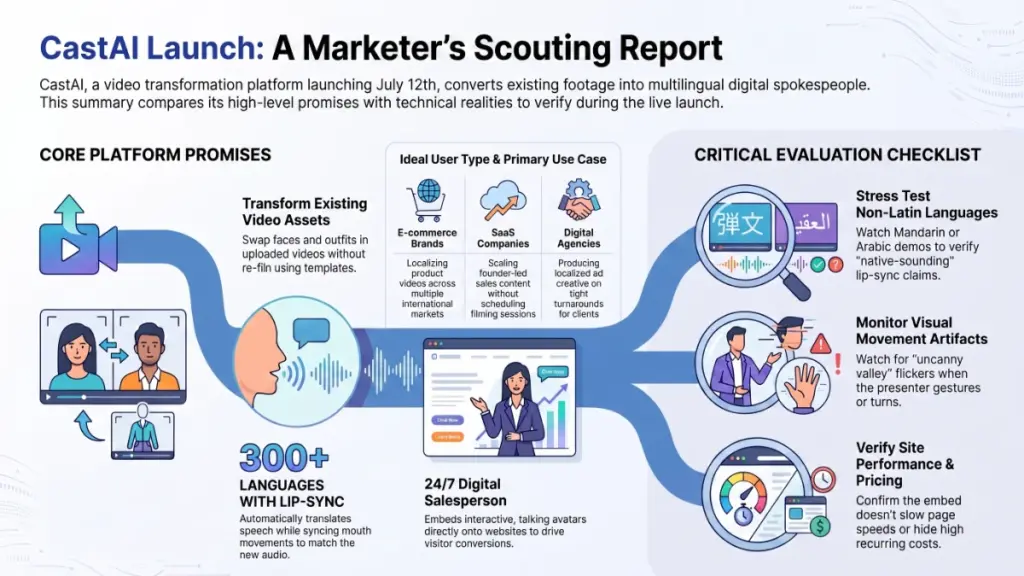
On Sunday, July 12th at 8:00 PM EDT, CastAI is hosting a live webinar. It’s introducing what the company calls a next-generation video transformation platform. The pitch is bold. Take any existing video, swap the face, change the outfit, and translate the speech into more than 300 languages with native-sounding lip-sync. Then deploy the result as a talking, selling avatar embedded directly on a website. No filming required. Editing software stays optional. Coding skills aren’t needed either.
I’ve spent the better part of four years watching AI marketing tools come and go. Over that time, I’ve learned to separate “genuinely useful” from “impressive in a fifteen-minute demo but useless three weeks in.” I haven’t put CastAI through its paces myself yet. This is a pre-launch webinar, not a product I’ve had my hands on for a month of client work, so consider this less a review and more a scouting report. Here’s what’s being promised, how it fits into where AI video tools are heading, and the questions I’d want answered before committing a client’s budget to it.
What Is CastAI, Exactly?
CastAI positions itself as more than a typical “AI avatar” generator. If you’ve used tools like Synthesia, HeyGen, or Colossyan, you already know the basic category. Pick a digital presenter, type a script, and out comes a video of someone talking. CastAI’s angle differs in one important way: it claims to work with existing video rather than only generating brand-new avatar footage from scratch.
How the Face-and-Voice Swap Is Supposed to Work
In practice, that means you’d take a video you already have. Maybe it’s a product demo, a testimonial, or a founder pitch. You’d use it as a base. The platform then swaps in a different face and changes the clothing. It also re-renders the audio in another language while keeping the lip movements synced to match. According to the pitch, the result looks and sounds like a completely different person speaking a completely different language. Nobody has to step in front of a camera again.
That’s a meaningfully different workflow than most avatar tools on the market. Most competitors require users to build everything from a template character rather than transform footage they already own. Whether the execution matches the ambition is the real question. That’s exactly what a live demo is supposed to answer.
The Core Features Being Promised
Based on the promotional materials for the July 12th event, here’s what CastAI says it will demonstrate.
The Visual Transformation Claims
Face and outfit swapping. The platform reportedly replaces the presenter’s face and clothing in an uploaded video. It preserves the original movement, background, and framing while doing it. That sounds simple in a bullet point, but it’s notoriously difficult to execute convincingly. Inconsistent lighting, awkward jaw movement, and the dreaded “uncanny valley” flicker have sunk plenty of competitors in this exact category.
Translation into 300+ languages with native lip-sync. This is the headline feature, and it’s the one I’m most curious about. Dubbing tools that resync lip movement to translated audio have improved dramatically over the past two years. HeyGen and ElevenLabs have both made real strides here. Still, “native-sounding” carries a lot of weight in that sentence. Native speakers notice unnatural phrasing and robotic intonation almost instantly. This is especially true in languages with mouth-shape patterns very different from English, such as Mandarin, Arabic, or Vietnamese. If CastAI has genuinely solved this across 300 languages, that would mark a significant technical achievement rather than just a marketing checkbox.
The Distribution and Convenience Claims
Website embed as a live “digital salesperson.” CastAI pitches an avatar that visitors can talk to directly on a website. It greets and converts visitors around the clock without a human team behind it. This moves the tool from “content creation software” into “onsite conversion tool,” a more crowded and heavily scrutinized space. Chatbot-style video widgets already exist. Think Tidio or Intercom with an avatar layer. The real differentiator will be how natural the interaction feels and how well it plugs into existing CRM and analytics stacks.
No filming, no editing, no code. Nearly every AI content tool’s marketing copy makes this exact promise these days, so it’s worth treating with a healthy dose of skepticism until you click through the interface yourself. “No code” often means “no code, as long as you don’t need anything custom.” I’d want to see the actual embed process before taking that claim at face value.
Why This Category Matters Right Now
Here’s the thing worth understanding before evaluating any tool in this space: AI-generated video presenters aren’t a novelty anymore. They’re becoming a real line item in marketing budgets.
Sales teams have relied on recorded video pitches for years because video consistently outperforms plain text for engagement and trust-building. The problem has always been scale. Filming a personalized video for every lead, every language, and every landing page variant is expensive and slow. Tools that promise to remove the camera crew entirely are chasing a genuinely large pain point, not a manufactured one.
At the same time, this space has become one of the most hype-saturated corners of the AI tools market. I’ve watched at least a dozen “revolutionary AI avatar” launches over the past two years. The split between the ones that delivered and the ones that quietly disappeared six months later almost always comes down to a few boring, unglamorous factors. Rendering quality under real-world conditions matters more than demo lighting. Pricing needs to survive at scale. And the company needs to stick around long enough to keep improving instead of getting acquired and shelved.
None of that is a knock on CastAI specifically. I genuinely don’t know yet which category it will fall into. It’s simply the lens worth bringing into that Sunday night webinar instead of taking the launch-event energy at face value.
What to Watch For During the Live Demo
If you’re planning to attend, here’s where I’d keep my eyes sharpest, based on where similar tools have historically stumbled.
- Lip-sync quality on a language very different from English. Spanish or French dubbing tends to look easier for these platforms to nail, since the mouth shapes stay close to English. Watch specifically for a demo in a tonal or non-Latin-script language, like Mandarin, Japanese, Hindi, or Arabic. That’s a far better stress test of the “native lip-sync” claim.
- How the face swap handles side angles and hand gestures. Front-facing, static demos represent the easiest case for this kind of software. When the presenter turns their head, gestures, or moves around the frame, that’s where face-swap artifacts tend to show up.
- Load time and interactivity of the website embed. A talking avatar on a landing page only helps if it doesn’t tank page speed. Page speed still shapes both conversion rate and search ranking. Ask directly what the embed’s impact on Core Web Vitals looks like.
- What happens to the original video’s audio quality and background noise. Voice-swapping tools sometimes introduce a flat, slightly robotic vocal texture. This shows up especially when the source audio wasn’t recorded in a clean environment.
- The actual pricing structure, not just the “early bird” number. Webinar launches build around urgency: cash prizes, countdown timers, limited-time discounts. That’s a normal sales tactic, but it also means the price shown live rarely tells the full story. Find out what the ongoing monthly cost looks like once launch pricing expires. Also confirm the per-video or per-minute rendering limits, since that’s where “unlimited” claims quietly fall apart.
Who This Kind of Tool Is Actually For
Even before seeing CastAI in action, it’s possible to make some reasonable predictions. Some businesses will get real value here. Others probably won’t.
Likely a strong fit:
- E-commerce brands wanting localized product videos across multiple markets without hiring a presenter for each language
- SaaS companies running founder-led sales content that needs to scale beyond one person’s calendar
- Agencies producing localized ad creative for international clients on tight turnarounds
Likely a weaker fit:
- Businesses in highly regulated industries, such as healthcare, finance, or law, where a synthetic spokesperson could raise compliance concerns
- Brands whose whole identity centers on a specific, recognizable human presenter, since audiences tend to notice when “the person from the videos” doesn’t quite look right
- Anyone expecting broadcast-quality output straight out of the gate; most tools in this category still benefit from manual cleanup on the final render
That second point about disclosure deserves a moment of attention. It’s not just a nice-to-have. Depending on where your audience is located, using an AI-generated presenter without disclosing that fact can run into advertising transparency requirements. The FTC in the U.S., for instance, has grown increasingly vocal about synthetic media disclosure in commercial contexts. That’s a conversation worth having with whoever handles compliance at your company, not an afterthought.
The Honest Trade-Offs Nobody Puts in the Webinar Slide Deck
I’ll be straight with you. Every tool in this category, no matter how polished the demo, comes with trade-offs that tend to get glossed over in a live sales event. A few are worth keeping in mind regardless of how CastAI performs on the 12th.
Uncanny valley fatigue is real, and it’s audience-dependent. Some viewers barely register that they’re watching a synthetic presenter. Others clock it instantly, and it undermines trust rather than building it. There’s no universal answer here; it depends heavily on your industry and audience sophistication.
Translation quality and cultural nuance aren’t the same thing. A tool can nail pronunciation and lip-sync while still producing a script that reads stiff or culturally off in the target language. This happens especially with idioms, humor, or region-specific phrasing. Budgeting for native-speaker review of translated scripts still makes sense, even with a strong tool.
“Live cash prizes” and countdown pricing function as sales mechanics, not product signals. I understand why companies do it; urgency drives signups. Still, it’s worth mentally separating the excitement of the event format from an actual assessment of fit. Sleep on it before committing to an annual plan.
Ongoing support and update cadence matter more than the launch feature list. The AI video space moves fast. A tool that looks impressive at launch can fall behind competitors within a year if the company doesn’t keep investing. Ask during the Q&A portion of the webinar about the product roadmap and how often the avatar and translation models get updated.
How to Get the Most Out of the July 12th Webinar
If you’re going to spend an hour of your Sunday night on this, here’s how I’d approach it. The goal is walking away with something useful rather than just launch-day adrenaline.
- Bring a real use case in mind before you log in. “I want to localize our onboarding video into Spanish and Portuguese for our LATAM expansion” gets you a far more useful answer during Q&A than a vague “this looks cool.”
- Ask about export formats and ownership rights. Can you download the final video file, or does it stay locked into their embed system? That affects whether you can repurpose content across email, social, and paid ads.
- Find out what happens to your original source footage. Any tool that processes your video needs to store it somewhere during rendering. Ask directly about data retention and whether your footage feeds into their model training.
- Watch the replay critically, not passively. If you can, rewatch specific demo segments a second time. Pay attention to the same details flagged above: mouth movement on side angles, background consistency, audio texture.
- Compare the early-bird price against at least two competitors before committing. HeyGen, Synthesia, and Colossyan all publish transparent pricing you can check the same day. A side-by-side comparison, even a rough one, quickly tells you whether the “lowest early-bird pricing” claim actually holds up.
Bottom Line
CastAI’s promise is turning any existing video into a multilingual, face-swapped, always-on digital spokesperson. That sits at the ambitious end of what current AI video technology can do. Some pieces of that pitch, like translation and lip-sync, reflect a technology that has genuinely improved over the past year. Others are harder to verify. Seamless face-swapping across a full range of motion and truly “native” delivery across 300 languages fall into that harder category, at least outside a controlled demo environment.
None of that means you should skip the webinar. Localized video content and scalable sales presenters sit on plenty of roadmaps this year. An hour spent watching a live demo, with a critical eye and a specific use case in mind, is a reasonable way to spend a Sunday night. Just walk in treating it as a scouting mission rather than a done deal. Ask the pointed questions. Watch the harder language demos closely. Get real clarity on pricing once the countdown timer stops ticking.
Tools in this space will only keep improving. Whether CastAI turns out to be one of the ones still standing in eighteen months remains a genuinely open question. That’s exactly what Sunday’s live launch should help answer.