


OpenAI has introduced GPT-5.6 Sol alongside Terra and Luna in a limited preview, focusing on stronger coding, reasoning, and cybersecurity capabilities backed by its most advanced safety framework yet. The new models offer improved performance, revised pricing, enhanced caching, and layered security protections. While access remains limited, GPT-5.6 signals a major shift toward AI systems that balance powerful automation with built-in safeguards.
OpenAI has begun a limited preview rollout of its GPT-5.6 model family, headlined by a flagship system called Sol, alongside two lighter siblings named Terra and Luna. The launch, announced on June 26, 2026, arrives with the company’s most extensive safety architecture to date, built specifically to handle the model’s sharp jump in cybersecurity and coding capability. Access is currently restricted to a small set of vetted partners, with broader availability expected in the coming weeks.
For anyone tracking the frontier AI stack, this release matters less for raw benchmark scores and more for what it signals: labs are now treating agentic capability and containment as a single engineering problem, not two separate ones.

What’s Actually New in the GPT-5.6 Lineup
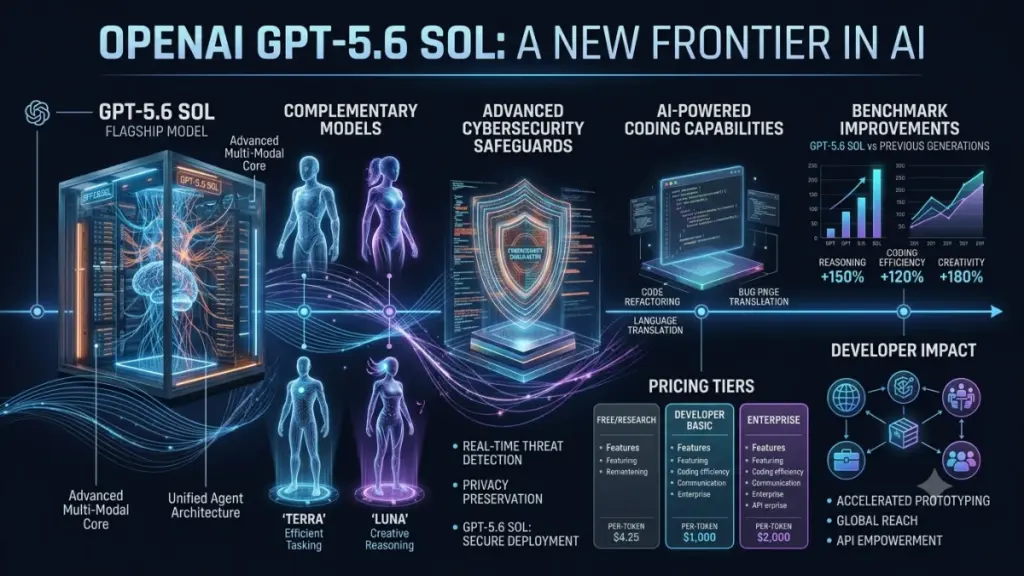
The GPT-5.6 family introduces a naming convention that separates generation number from capability tier, a structural choice that should make future upgrades easier to track for developers building on the API.
- Sol — the flagship, positioned as the most capable model OpenAI has shipped
- Terra — a mid-tier model priced roughly half of GPT-5.5 while matching its performance
- Luna — a low-cost, high-speed option aimed at everyday productivity workloads
A new “max reasoning” setting gives Sol extended thinking time on harder tasks, while a separate “ultra mode” coordinates multiple subagents to tackle complex, multi-step work — a meaningful step toward practical AI automation for engineering-heavy workflows.
Benchmark Performance: Coding, Biology, and Cybersecurity
On Terminal-Bench 2.1, a test built around command-line planning and tool coordination, Sol’s ultra configuration posted a leading score in the low-90s percentage range, ahead of comparable large language models from other frontier labs. Standard Sol and Terra also outperformed the prior GPT-5.5 generation.
In biology-focused evaluations using GeneBench v1, which measures long-horizon genomics analysis, Sol reportedly beat GPT-5.5’s results while consuming fewer tokens per task — a notable efficiency gain for research-heavy use cases.
The most consequential jump, however, is in offensive and defensive security testing:
- On ExploitBench, Sol matched a rival lab’s preview-tier model while using roughly a third of the output tokens
- On ExploitGym, a third-party benchmark co-developed with UC Berkeley researchers, all three GPT-5.6 tiers showed strong gains as reasoning effort increased
- In controlled tests against Chromium and Firefox, Sol identified real vulnerabilities and exploitation building blocks but did not independently assemble a complete, working exploit chain
That last point is why OpenAI says Sol does not cross the “Cyber Critical” threshold defined in its internal preparedness framework, even though the model is meaningfully stronger at vulnerability research than its predecessor.
A Layered Safeguard System
Rather than relying on a single filter, OpenAI describes a stacked defense model built around several checkpoints:
- Training-level refusals that target disguised or jailbreak-style prompts
- Real-time classifiers that can pause generation mid-response for a secondary review by a larger reasoning model
- Account-level pattern review that looks across multiple conversations to separate legitimate security research from sustained misuse
- Differentiated access controls that calibrate what a given user or workload can reach
To pressure-test this stack, the company says it committed more than 700,000 A100-equivalent GPU hours to automated red-teaming aimed at finding “universal” jailbreaks — attack patterns that generalize across many prompts rather than exploiting one narrow gap. Human red-teaming through third-party testers is running in parallel and will continue throughout the preview window.
OpenAI is upfront that this comes with friction: legitimate security researchers, penetration testers, and developers doing dual-use work may occasionally get blocked or delayed while the system learns to distinguish defensive work from offensive intent.
Why It Matters for Developers and Digital Marketers
For teams evaluating AI tools for daily production use, this launch has a few practical implications worth flagging before you plan a migration or budget cycle around it.
- Pricing shifts are real money. Sol runs at $5 per million input tokens and $30 per million output tokens; Terra comes in at $2.50/$15; Luna at $1/$6. Terra in particular offers GPT-5.5-level output at roughly half the cost, which is worth testing against current spend.
- Caching rules changed. New cache writes are billed at 1.25x the standard input rate, with a 30-minute minimum cache life, while cached reads still get a 90% discount — a detail that affects cost modeling for high-volume automation pipelines.
- Access won’t be instant. The preview is gated to select partners first, coordinated with U.S. government review under an emerging cybersecurity executive order framework, so most developers should expect a wait before general availability.
- Expect more friction on security-adjacent prompts. Marketers and developers using AI for legitimate penetration testing, code auditing, or vulnerability disclosure work may see slower responses or occasional refusals during the preview as the classifiers calibrate.
The Bigger Picture
GPT-5.6 Sol’s release reinforces a trend that’s becoming standard across the frontier AI landscape: capability gains in coding and cybersecurity no longer ship without a matching investment in containment infrastructure. As agentic tools get better at finding software vulnerabilities, the safeguard stack around them is quickly becoming as newsworthy as the benchmark scores themselves.
For teams building automation workflows on top of these models, the near-term takeaway is practical rather than dramatic: watch the pricing tiers, budget for caching changes, and expect a phased rollout rather than immediate universal access.