


TL;DR: Claude wins for long-form quality and brand voice; ChatGPT remains the most versatile all-rounder; Jasper only justifies its price for large marketing teams needing templates; Copy.ai works for budget-conscious freelancers doing short-form copy; Writesonic offers the best middle-ground for SEO content. The key differentiator is memory and context management—invest in learning to prompt well rather than tool-hopping, and always edit AI output for human nuance.
Why Most AI Writing Reviews Fail You
If you’ve been searching for reliable AI writing assistant reviews, you’ve already hit the first obstacle: most reviews are written by people who spent 20 minutes with a free trial, or they’re thinly veiled affiliate plays that crown whichever tool pays the highest commission. I’ve been in the trenches since 2021, when I joined the GPT-3 API beta waitlist and became insufferable at dinner parties talking about it.
Four years and 50+ tools later, I have a very different perspective on what “best” actually means in 2024-2025.
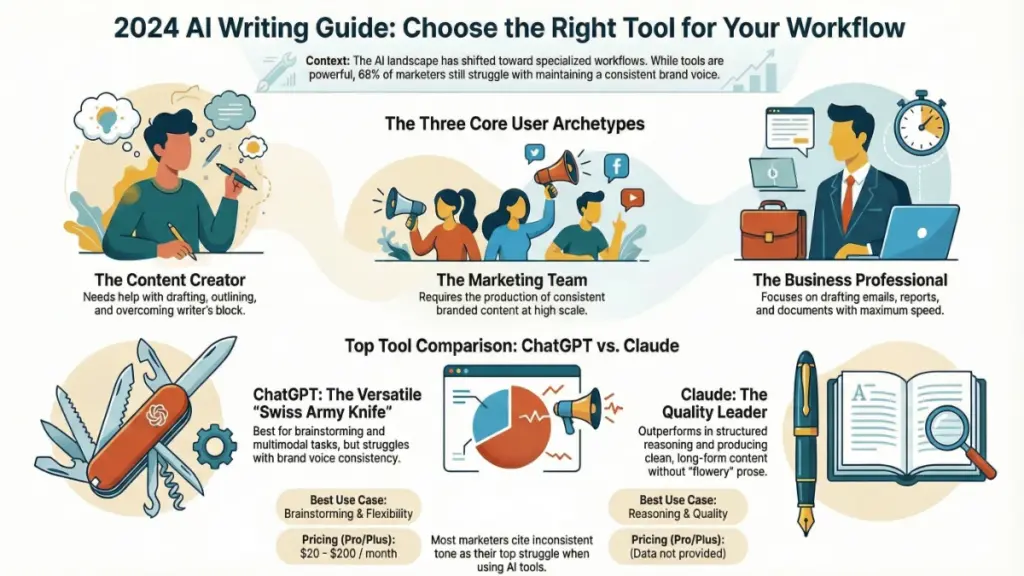
The AI writing landscape has fundamentally shifted. According to recent industry data, 68% of marketers using AI tools report “inconsistent brand voice” as their top frustration. Yet most reviews ignore this reality, focusing on features rather than workflow integration.
Here’s what I’ll cover: an honest breakdown of today’s top AI writing assistants — ChatGPT, Claude, Jasper, Copy.ai, Writesonic, and emerging players — with real takes on their strengths, weaknesses, and who they’re actually built for. I’ll also share hard-won lessons from helping clients spend (and sometimes waste) thousands of dollars on these platforms.
Let’s get into it.
Why Most AI Writing Assistant Reviews Get It Wrong
Before diving into specific tools, let’s address the elephant in the room: this category is genuinely hard to review fairly, and here’s why that matters for your bottom line.
AI writing assistants aren’t one-size-fits-all tools. A solo blogger has completely different needs than a 10-person content agency. A marketer writing ad copy lives in a different world than a consultant producing long-form thought leadership. I’ve watched clients buy tools based on flashy demo videos and abandon them within 60 days because nobody asked the most important question upfront: what do you actually need this for?
The Three User Archetypes
In my experience, most people fall into one of three buckets:
- Content creators and bloggers who want help drafting, outlining, or overcoming writer’s block
- Marketing teams that need to produce consistent branded content at scale
- Business professionals looking to write better emails, reports, and documents faster
The tool that wins for bucket one might be a disaster for bucket three. Recent comparative testing shows that Claude often outperforms in structured reasoning and long-form tasks, while GPT variants shine in creativity and multimodal applications. Keep your use case in mind as you read through these reviews — I’ll flag who each tool serves best.
ChatGPT: The 800-Pound Gorilla (For Good Reason)
Let’s start with the obvious one. ChatGPT is the tool that brought AI writing assistants into the mainstream, and after using it almost daily since early 2023, I have a nuanced take on where it stands in 2024-2025.
What ChatGPT Genuinely Does Well
ChatGPT’s conversational interface remains the most natural of any tool I’ve tested. You can bounce ideas back and forth, ask follow-up questions, and refine outputs through dialogue in a way that feels genuinely collaborative. The breadth of handling is remarkable — I’ve used it to draft email sequences, debug marketing copy, write LinkedIn posts, and outline entire content strategies in single sessions.
With ChatGPT Plus ($20/month), you get access to GPT-4 and the newer GPT-4o models, which produce noticeably better long-form content and more nuanced reasoning. Recent testing shows ChatGPT Plus tied with Claude as the best free AI writing option, excelling at brainstorming and overcoming writer’s block.
The plugin ecosystem and custom GPT features have matured significantly. The Canvas feature now allows direct editing of output within ChatGPT, while Advanced Voice Mode functions like having “your own personal Jarvis” for dictation and conversational refinement.
Where ChatGPT Falls Short
ChatGPT’s biggest weakness is brand voice consistency. For solo writers, this is manageable through careful prompting. But for teams trying to maintain consistent tone across multiple writers? It’s a real challenge. Each conversation starts fresh, and without serious prompt engineering or custom instructions, output can feel generic.
The web browsing feature remains hit-or-miss. While it helps with current SEO research, I’ve caught it pulling outdated information more times than I’d like. Additionally, some users report that GPT models can produce “flowery, excessive, or over the top” prose that lacks readability compared to Claude’s output.
Who ChatGPT Is For
ChatGPT is the Swiss Army knife of AI writing tools. If you’re new to AI-assisted writing, starting here makes sense. If you’re a power user wanting maximum flexibility and don’t mind investing in prompt engineering, it’s still hard to beat.
Pricing: Free tier (GPT-3.5) / $20/month for Plus (GPT-4) / $200/month for Pro
Claude: The One That Surprised Me Most (And Now Leads for Quality)
Full disclosure: I was late to Claude. I defaulted to ChatGPT for most of 2023 and only started seriously using Claude in late 2023. That was a mistake I’ve since corrected, and I’ll tell you why it’s become my top recommendation for serious writers in 2024-2025.