

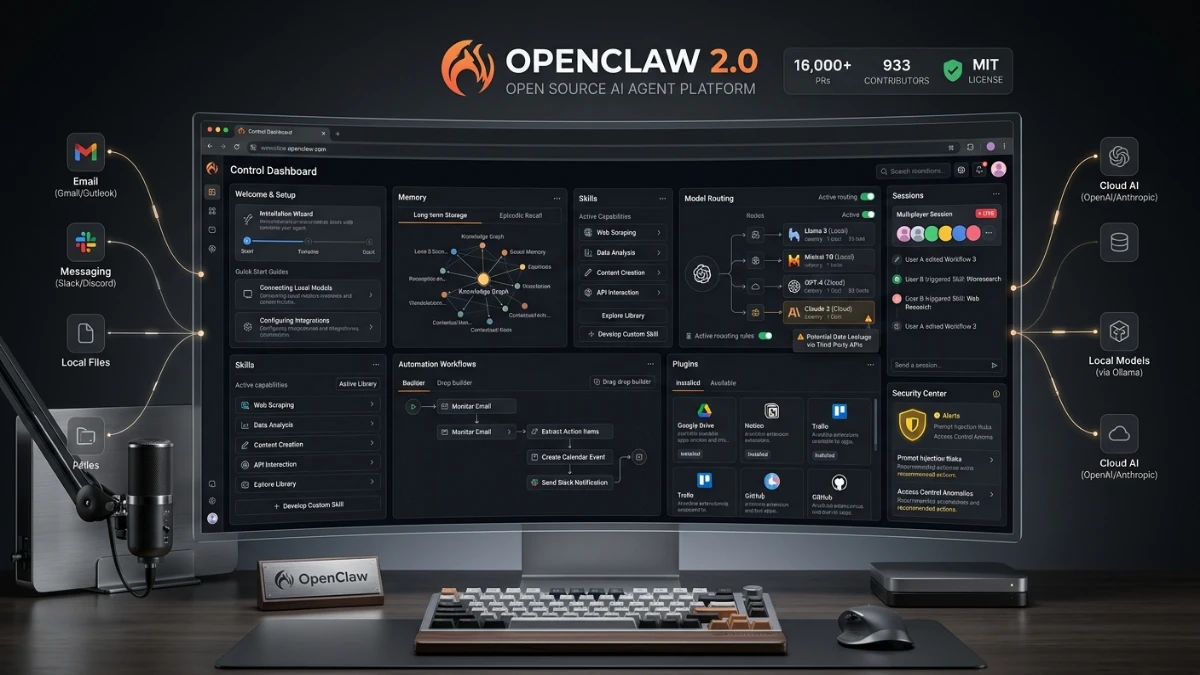
OpenClaw released version 2.0 on August 30. It’s the open-source personal AI agent that got people talking — and arguing — throughout 2026. Here’s the twist: the team didn’t set out to build a major version bump. They wanted to simplify installation and rebuild the browser interface. That work grew until it touched nearly every part of the product: installation, messaging, memory, skills, model support, automations, native apps, plugins, and security. Community manager Hannes Rudolph told the story on the OpenClaw blog. The release notes list over 16,000 merged pull requests from 933 contributors.
I spent this week going through the release notes, the blog post, and the discussion on Hacker News. Here’s the reality: this isn’t a flashy feature drop. It’s a foundation rebuild. Whether that matters to you depends entirely on how you already use tools like this.
Why It Matters
Are you a developer, founder, or team lead who’s curious about autonomous agents but put off by the setup tax? This release targets you directly. OpenClaw’s biggest historical complaint wasn’t capability. It was friction. You wanted an AI assistant that lives across your email, messaging apps, and files. Getting there meant wrestling with configuration most non-engineers had no interest in touching.
Version 2.0 bets on a different idea: easier onboarding, not more features, decides whether personal agents go mainstream or stay a hobbyist niche. That’s a real shift for a product category. Through 2025 and early 2026, this category mostly competed on autonomy and model access instead.
The move also matters for another reason. OpenClaw’s trajectory says something about the broader agent ecosystem. The tool exploded in popularity in 2025. It cooled off noticeably by early 2026 — its own community jokes about the Google Trends chart. Founder Peter Steinberger then joined OpenAI. OpenClaw itself became a foundation-run, non-profit open-source project. A major release from a project in that position tells you something useful. It signals whether “always-on personal agent” software has staying power, or whether it was just a 2025 flash point.
Technical Details
The release notes and blog post break the core changes into a few buckets:
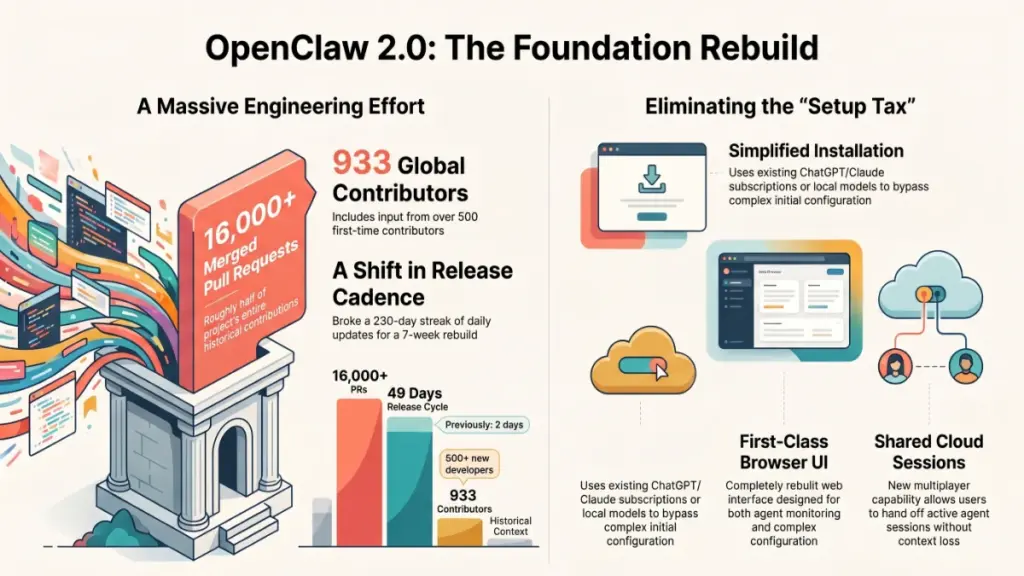
- Installation overhaul: First-time setup now starts from what’s already on your machine. It uses existing ChatGPT or Claude subscriptions, API keys, or local models. You skip the full configuration pass before your first conversation.
- Rebuilt browser app: The team rebuilt the web-based control interface as what they call a “first-class” surface. It’s meant to be where users configure and monitor their agent, not just an afterthought UI.
- Shared cloud sessions: A new multiplayer feature lets more than one person join or hand off a running agent session without losing context. The team says this came directly out of using their own tool internally while building the release.
- Cross-cutting rework: The team revised messaging, memory, skills, model routing, automations, native apps, and plugin architecture together, rather than shipping them as isolated features.
For scale: this single release holds roughly half of all pull requests ever merged into the project. It followed nearly seven weeks without a release — a sharp break from a cadence that had averaged a new release every couple of days over the prior 230 days.
Performance & Evidence
There’s no independent benchmark suite for something like this. Language models have leaderboards; “does this agent do what I ask without doing something I didn’t ask” isn’t a number you can chart. That leaves vendor claims and community experience as the only evidence available, and they don’t fully agree.
The company frames the update as a reduction in setup friction, and it says the release improves reliability for people upgrading existing installations, not just new users. The Hacker News thread that accompanied the release offers a messier but useful read on real-world usage. People run OpenClaw (or its more structured cousin, Hermes) for tasks like scraping job listings, monitoring home networks, managing Minecraft servers, and triaging email. Several commenters pushed back hard, though. They pointed to OpenClaw’s history of publicized security vulnerabilities. They also questioned whether a codebase built this fast — with over 500 first-time contributors on a single release — can realistically get safer as it gets bigger.
That tension is worth sitting with. People often treat a large contributor count as a health signal for open-source projects. For software with system-level access to email, messaging, and files, it’s also more surface area to audit.
Pricing & Availability
OpenClaw stays free and open source. You get it through GitHub, and it runs on macOS, Windows, and Linux. It works with hosted subscription models (OpenAI, Anthropic, and others), pay-as-you-go API keys, or local models. It connects to messaging platforms including WhatsApp, Telegram, Discord, Slack, Signal, and iMessage, among others. There’s no OpenClaw-specific subscription fee — your costs come from whichever model provider you connect it to. Version 2.0, tagged internally as 2026.8.1, is available now through the standard install and update paths on the project’s site.
Industry Implications
For developers, the installation changes lower the bar for experimenting with agent-based automation. They don’t necessarily change what’s possible — most of what OpenClaw does was already scriptable, as more than one Hacker News commenter pointed out. What changes is who can reasonably do it, and how fast.
Competing agent harnesses should take note too. Claude Code, Codex-based setups, and newer entrants like Hermes all came up repeatedly in the community discussion. OpenClaw’s move toward a friendlier browser experience and multiplayer sessions raises the baseline expectation for onboarding across the category. A few commenters noted that coding agent tools have already adopted features that trace back to OpenClaw’s early lead, like remote access and agent-to-agent handoff.
Enterprise and security teams should treat this release as a prompt, too — a reason to revisit governance around agent tooling generally. The concerns raised in the community aren’t unique to OpenClaw. But the project’s public vulnerability history makes it a specific example worth reviewing before you grant any agent broad account or device access.
Limitations & Open Questions
A few things remain genuinely unresolved:
- Security track record: OpenClaw has a public history of disclosed vulnerabilities. Does the architectural rework in 2.0 meaningfully change that trajectory? Only time and continued disclosure will show — a release announcement can’t settle that on its own.
- Whether “easier setup” renews interest: Independent coverage stays openly skeptical here. Competitors have caught up on the features that made OpenClaw notable in the first place, so a conservative, usability-focused release may not reverse its cooling popularity.
- Real-world reliability at scale: The team rewrote a large share of the codebase at once. Edge cases in upgrade paths and integrations are likely, even with their stated effort to test both fresh installs and upgrades before shipping.
Future Outlook
The OpenClaw foundation has signaled that the browser rebuild and shared sessions form a platform for future work, not a finished feature set. Expect incremental releases on top of this base, not another multi-month gap. The bigger open question is competitive. OpenClaw’s advantage in 2025 came from being first and most complete. Is easier onboarding enough to matter against a field that has since caught up on capability? Watch the next couple of release cycles — this announcement alone doesn’t answer that.
Conclusion
OpenClaw 2.0 represents a real, substantial engineering effort. Sixteen-thousand-plus pull requests isn’t a marketing number; it’s a workload. But be precise about what changed: this is primarily an onboarding and infrastructure release, not a new capability announcement. Did you try OpenClaw before and bounce off the setup process? This release addresses that directly. Did trust in an autonomous agent with broad account and file access hold you back instead? Nothing here resolves that concern, and the community reaction makes clear that plenty of technical users still aren’t convinced. It’s worth a look if setup complexity was your obstacle — and worth continued scrutiny either way.