

Google DeepMind released Gemini 4 Neon, a mid-tier frontier AI model balancing near-flagship intelligence with high speed and aggressive pricing ($3 input / $15 output per million tokens, plus a 95% cache discount). Designed for coding agents, enterprise multimodal work, and cyber defense, it leads several benchmarks on cost-per-task efficiency, though real-world performance still requires independent testing outside Google’s own agent harness.
Lead and Significance
What Google Announced
Google DeepMind released Gemini 4 Neon on November 18, 2026. The company says the model brings frontier-level intelligence with fast end-to-end task completion. In particular, it targets software engineering, knowledge work, and science workflows.
Before we dig in, a quick disclosure. I haven’t run Neon on client work yet. Therefore, every benchmark below comes from Google’s post or from the third-party evaluators it cites. I flag that wherever it matters.
The Headline Numbers
Here’s the main claim. Neon scores 61 on the Artificial Analysis Intelligence Index at its xhigh thinking level. As a result, it ranks third overall, just behind larger and slower models.
Meanwhile, Neon ranks second on the Vals Index and sits on the Pareto frontier there. It also ranks second on steerability on the new Agent Arena Index. Steerability measures how cleanly a model adapts when you correct it mid-task.
Google also stresses reliability. According to the company, Neon records its lowest fabrication rate yet in internal Google Antigravity testing. Furthermore, Google says the model excels at multi-step instruction following.
Price and Rollout
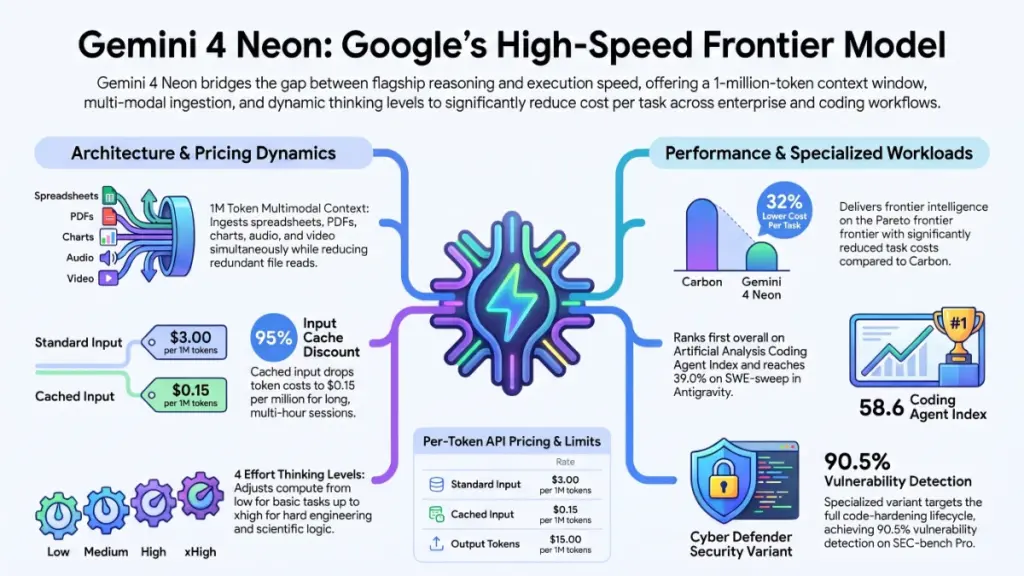
The price tells the other half of the story. Neon costs $3 per million input tokens and $15 per million output tokens. Cached input drops to $0.15 per million tokens. Additionally, the context window holds 1 million tokens.
The rollout starts today across several surfaces. Developers get Neon in the Gemini API through Google AI Studio. Enterprises can use it in Gemini for business, through the API and the model dropdown. Paid Google AI Pro and Ultra subscribers can try it in Google Antigravity. Finally, Pro and Ultra subscribers can pick it in the Gemini app.
Why This Launch Matters
Frontier models usually force a trade-off. You pick the smartest model and accept slow, expensive runs. Alternatively, you pick a fast model and accept weaker reasoning. Neon claims to narrow that gap. If the numbers hold, teams could run more agent tasks for less money.
Look, I’ll be straight with you. I’ve read plenty of launch posts that promise this exact trade-off. Most disappoint in practice. So I treat this one as a strong hypothesis, not a settled fact. Independent testing will decide.
Strategic Context and Why It Matters
Where Neon Sits in the Gemini 4 Family
Neon occupies the middle of the family. Google describes three roles. Carbon tackles the hardest, long-horizon projects. Hydrogen handles fast everyday execution. Neon, in between, balances depth and efficiency for complex, high-frequency workflows.
This positioning shows who benefits most. Let’s walk through each group.
Who Benefits Most
Engineering teams running agents. Teams that run coding agents all day care about cost per task and speed. Neon targets both. For example, Google reports a 32% lower cost per task than Carbon at the default high thinking level. That gap compounds when an agent runs hundreds of tasks.
Enterprise knowledge workers. Enterprise work lives in spreadsheets, PDFs, charts, audio, and video. Neon synthesizes across all of these inputs in one context window. Then it turns them into structured deliverables. Finance, accounting, legal, and tax teams stand to gain the most, since Google highlights results in each area.
Security defenders. Google built a separate variant, Gemini 4 Neon for cyber. It targets vulnerability finding, validating, and patching. Access starts with trusted defenders through the Fairwind Program.
Researchers and scientists. Google reports best-in-class scores on several science and math benchmarks. In addition, partner quotes describe a model that keeps exploring after bad results.
How Workflows Change
Three shifts stand out. First, orchestration gets cheaper. In Google Antigravity, Neon directs parallel Hydrogen subagents. A mid-priced model plans the work, and cheaper models execute the pieces. Consequently, large agent jobs cost less.
Second, effort becomes a dial. Neon offers four thinking levels, so teams can match intelligence and token spend to each workload. Simple tasks run at low effort, while hard tasks run at xhigh.
Third, steerability matters more. Long agent sessions fail when the model ignores a correction. Google’s second-place steerability ranking suggests Neon handles mid-task changes well. Real sessions will test that claim.
What Early Partners Say
A Glean product lead reports that Neon matched or exceeded Carbon on overall quality at 3x the speed and 60% of the cost. However, this is an early evaluation from a launch partner. Treat it as a data point, not a verdict. Similarly, a founder at Thoughtful Lab says Neon found subtle vulnerabilities that other models missed, using a fraction of the tokens.
What I’d watch is the pricing pressure. Google claims roughly 50% to 80% lower cost per task than top competing frontier models on certain indexes. If that holds, rivals will feel it. In turn, buyers will ask hard questions about why they pay more.
Deep-Dive Technical Specifications
What Google Discloses (and What It Doesn’t)
Google’s post reveals few architectural details. It gives no parameter count. It also skips the training recipe and the architecture itself. Anyone who claims to know those specifics is guessing. I’m not a data scientist, and I won’t pretend otherwise. Here is what the announcement does say.
Context Window and Modalities
Neon supports 1 million tokens. That fits large code repositories, long contracts, and big document sets in a single session. Moreover, the post notes that Neon handles context compaction reliably in long sessions. Compaction matters because even a million tokens fill up during multi-hour agent runs.
On modalities, Neon reads spreadsheets, PDFs, charts, audio, and video. It synthesizes across them in one pass. Google reports a 73.5% score on Chartography, a benchmark for reading dense professional charts. In the Gemini app, the model also reads uploads like spreadsheets, PDFs, and photos more precisely, according to Google.
Four Thinking Levels
Neon offers four levels that scale steadily. High is the default. Xhigh adds deeper, multi-step reasoning for the hardest engineering, analytical, and scientific workloads. Google says it refines these levels with each release. The goal is a smoother progression from one tier to the next.
In practice, this control matters a lot for budgeting. You can run routine work cheaply and save the expensive setting for the hard problems.
Agent Behavior and Orchestration
Google built Neon for long-running, tool-heavy workflows. The model cuts redundant file reads and shares progress as it works. When it debugs and refactors across repositories, it makes targeted, surgical edits. These traits matter more than raw scores for anyone who runs agents unattended.
In Google Antigravity, Neon runs standalone or as an orchestrator. As an orchestrator, it directs parallel Hydrogen subagents. Google’s demos also show a /swarm command. In one demo, a Neon agent swarm turned a single image into a 100,000-cell Google Sheet. That sheet used over 500,000 live formulas and no Apps Script.
The Demos
Google showed four demos. Neon drove Blender through MCP to build a 3D lab bench. It also wrote a first-person WebGL2 ski simulator with 10,200 lines of custom shaders. A third demo recreated Alan Turing’s 1936 study in interactive 3D. Demos show what a model can do at its best. They don’t show the failure rate, so keep that in mind.
Cyber Variant and Safety Stack
Gemini 4 Neon for cyber is a separate release. It targets the full code hardening lifecycle and rolls out to trusted defenders in the coming days.
On safety, Neon builds on the Gemini 4 safety and security stack. Google says it keeps Carbon-level protections against severe misuse and prompt injection. Real-time safeguards cover cyber and biosecurity misuse. Meanwhile, a chain-of-thought and action monitor runs across external surfaces.
The thing nobody tells you about launch posts is what they leave out. For instance, Google gives no latency figures in milliseconds. It offers only relative claims, such as 3x the speed of Carbon in one partner’s test. Measure latency on your own prompts before you commit.
Performance, Benchmarks, and Evidence
General Intelligence and Agents
Google cites many benchmarks. I group them by workload and note who ran each one.
On general intelligence, Neon scores 61 on the Artificial Analysis Intelligence Index at xhigh, ranking third overall. It reaches 70.9% on the Vals Index for second place. Additionally, it ranks second globally on the Agent Arena Index with a score of 1336 across 4,200+ real-world agent sessions.
The agent results look strong too. Neon takes first overall on Zapier’s AutomationBench at 56.3%. It also leads Vending-Bench 2 from Andon Labs at $16,843, a simulation of long-horizon business running. On Agents’ Last Exam v1.1, however, it only matches leading models at 75.8%.
Professional Work
For professional tasks, Google reports first place on both the Legal Research Bench and the Tax Agent Bench. Likewise, Neon ranks first on most Surge AI benchmarks across finance, accounting, spreadsheet modeling, and complex constraint following. These results explain why Google pitches Neon at enterprise buyers.
Coding Results
Neon ranks first overall on the Artificial Analysis Coding Agent Index at 58.6. It scores 65.2% on Terminal-Bench 4.1. On FrontierCode 2.0, it reaches 46.2% at the default high setting.
The SWE-sweep result deserves a closer look. Neon scores 12.8% on the mini-SWE harness. Inside Google Antigravity, however, that score more than triples to 39.0%. Google presents this as proof of what the Antigravity harness unlocks. I read it two ways. On one hand, the harness clearly matters. On the other hand, the 39.0% figure ties the result to Google’s own tooling, so you may not reproduce it in a different setup.
Science and Math
Google calls Neon best in class on three science and math benchmarks. It scores 70.5% on Terminal-Bench Science, 84.0% on RiemannBench, and 71.3% on HLE-Diamond.
Cyber Results
The cyber numbers come from the dedicated variant. On AutoBaxBench, Neon beats Carbon across the easy, medium, and hard tiers. It reaches a state-of-the-art 76% on the hard tier. On WebExploitBench v1.2, it hits 51.26% at half the cost of competing large models.
Across the code hardening lifecycle, the results break down as follows:
- Finding vulnerabilities: 90.5% on SEC-bench Pro, at roughly half the cost per challenge.
- Validating exploits: frontier-level performance on ExploitGym, using half the tokens of Carbon.
- Patching: 70.7% on CWE-bench v2, a 3.4% uplift over Carbon.
Safety and Alignment Numbers
Google also reports several safety figures. Neon refuses 1.98% of tasks on Terminal-Bench 4.0 and 0% on Terminal-Bench-Science. It matches Carbon with 0.0% cheating on Terminal-Bench 4.0. On the coding cheating evaluation, it takes shortcuts on just 2.45% of tasks, the lowest rate of any Gemini 4 model.
In addition, Neon posts a 0.09% misaligned action rate on the agentic safety suite and a 99.2% pass rate on the agent honesty evaluation. On the Gray Swan prompt injection benchmark, it reached a 0.0% attack success rate with real-time safeguards at its highest thinking level.
Cost Efficiency
Cost per task may matter most. At high, Neon pairs a strong Artificial Analysis score with a 32% lower cost per task than Carbon. It sits on the Pareto frontier on both Vals and Agent Arena, with roughly 50% to 80% lower cost per task than top competing models. At xhigh, it still costs 36%+ less per task than competitors at their highest setting.
Here is how I read this evidence. Raw scores shift with every release. Cost efficiency, by contrast, decides whether a model survives in a real budget. Pareto language also helps, because it means no other tested model beats Neon on quality and cost together.
Pricing, Licensing, and Availability
Token Pricing
Pricing comes first, because it decides adoption.
| Item | Price |
|---|---|
| Input tokens | $3 per million |
| Cached input tokens | $0.15 per million |
| Output tokens | $15 per million |
| Context window | 1 million tokens |
The cached-input rate stands out. At $0.15 per million, it carries a 95% discount. Agents that reread the same codebase or document set benefit enormously. As a result, long sessions with stable context could cost far less than the headline rate suggests. Put stable material at the front of your prompts so it caches well.
Output tokens cost five times as much as input tokens. Thinking tokens likely count toward that bill, though you should confirm the details in Google’s documentation. Higher thinking levels will raise your spend per task.
Availability by Audience
Availability varies by audience.
- Developers: Use the Gemini API paid tier in Google AI Studio and Android Studio. Paid Google AI Pro or Ultra subscribers can try Neon in Google Antigravity. All Pro and Ultra subscribers can try it in AI Studio.
- Enterprises: Use Neon in Gemini for business through the API or the model dropdown. Google Antigravity supports it too.
- Consumers: Google AI Pro and Ultra subscribers can pick Neon from the model dropdown in the Gemini app. Tasks in the app can now run on it.
- Defenders: Eligible Fairwind Program members start receiving access over the next few days. Others should contact their Cloud account team.
Licensing
Google’s announcement says nothing about open weights. Neon looks like a closed, hosted model. As far as the post shows, you cannot download it or run it on your own hardware. Teams with strict data residency rules should ask Google directly.
I’ll add one personal note. I like transparent pricing, and this mostly delivers it. Google publishes clear per-token rates. The Fairwind path, however, falls back to “contact your account team.” That’s the part I always dislike.
⚡ Limited Time Free Access
Unleash Your Digital Empire: Get 4 Premium Gifts in 1 Pack!
Grab this exclusive, high-value digital asset package tailored for creators, marketers, and builders. Enter your best email to claim instant access.
What’s Inside Your Ultimate All-In-One Package:
01. 50 AI Digital Product Ideas: A curated list of profitable, AI-driven digital product ideas engineered for fast execution and high margins.
02. Digital Sales Mastery: The strategic architecture behind high-converting sales funnels, persuasive copywriting, and online revenue growth.
03. Mastering Email List: Advanced frameworks for building an engaged audience, maximizing open rates, and generating automated income.
04. THE ULTIMATE FACELESS PLAYBOOK: Complete blueprint to building a powerful, monetizable brand on social media without showing your face.
Included Bonus: [BONUS] Premium Canva Marketing Vault: High-converting templates to scale your organic traffic.
💥 $197 VALUE — FREE FOR READERS
Enter your best email for instant lifetime access:
[Email Input Field] [Claim Free Access Button]
🛡️ Secure Processing • Your privacy is 100% protected.
Industry Implications and Competitive Analysis
A Crowded Field
Neon enters a crowded market. OpenAI, Anthropic, and others all ship frontier models with agent features. Google’s announcement names no specific rivals, though. It uses phrases like “top competing frontier models” and “larger, slower models.” That vagueness limits what I can compare, so I won’t invent head-to-head numbers.
Five Trends the Launch Reveals
The mid-tier is now a frontier tier. Google ranks Neon third overall on one index, behind only larger, slower models. A year ago, the fast model lagged far behind the flagship. Now Google argues the gap has shrunk to a sliver. Other labs will likely respond with efficiency-focused releases of their own.
Cost per task replaces cost per token. Per-token price tells you little. For example, a cheap model that needs three tries costs more than a pricier model that succeeds once. Google leans on cost per task across third-party benchmarks. Expect competitors to adopt the same framing.
Harness lock-in grows. The SWE-sweep result shows how much surrounding tooling matters. Every major lab now pushes its own agent environment. Consequently, teams that build deeply on one harness may find switching models harder than the API suggests.
Orchestration becomes the default architecture. Google positions Neon as an orchestrator over cheaper Hydrogen subagents. Buyers will likely pay for a mix of models, not one. Plan your budget around a portfolio.
Cyber becomes a product line. Google ships a dedicated cyber variant with controlled access. Labs now gate their strongest security features behind trusted-user programs. Defenders get better tools, and attackers face guardrails. Still, no guardrail is perfect.
Who Should Test Neon, and Who Should Wait
If you run high-volume coding agents and your bills hurt, test Neon. Likewise, test it if you handle multimodal enterprise documents. Security researchers who qualify for Fairwind should apply.
On the other hand, some teams should wait. If you need open weights, Neon doesn’t fit. If your current vendor’s ecosystem already works well, switching costs may outweigh the savings. And if you tackle the hardest long-horizon projects, Google itself points you to Carbon.
I’ve made expensive tool mistakes before. I once spent around $5K on a platform that dazzled in demos and failed in daily use. My rule since then is simple. Run a two-week pilot on real work before you sign anything.
Limitations, Caveats, and Skepticism
Vendor-Reported Evidence
Several caveats deserve attention before you rebuild any workflow around Neon. First, most evidence comes from Google or its partners. Google selected the benchmarks in its announcement, and companies naturally highlight wins. The post doesn’t list tests where Neon lagged. A complete picture needs independent replication, which takes weeks.
Second, some benchmarks are new or narrow. The Agent Arena Index is new, and Vending-Bench 2 simulates one specific business. A high score on one simulation doesn’t guarantee success on your operations.
Harness, Demos, and Partner Quotes
The jump from 12.8% to 39.0% on SWE-sweep depends on Google’s own harness. In a different environment, your results may land closer to the lower number.
Demos hide failure rates, too. The ski simulator and the Turing recreation impress, but they show peak performance. They say nothing about how many attempts failed first. Similarly, partner quotes carry incentives. Customers quoted in a launch post usually have commercial ties to the vendor. Their praise may be sincere, yet it reflects early, curated testing.
Safety and Cost Claims
Safety numbers need context. A 0.09% misaligned action rate sounds excellent. However, Google designed that suite. External red teams may find different results. Prompt injection also remains an unsolved problem across the industry, and the 0.0% attack success rate applies to one benchmark with safeguards at the highest thinking level.
Cost claims depend on workload as well. Cost per task varies with task type, thinking level, and caching behavior. A 32% saving versus Carbon at high doesn’t guarantee a 32% saving on your jobs.
Access and Vendor Risk
Only eligible trusted defenders get Neon for cyber at first, so most teams can’t verify those results themselves. Moreover, you can’t inspect the model, self-host it, or audit its training.
Vendor dependence carries risk too. Models get deprecated, pricing changes, and rate limits tighten. I’ve watched tools get acquired and shut down. Therefore, build abstraction layers that let you swap models without rewriting everything.
To be completely honest, none of these caveats make Neon bad. They make it unproven. That’s the normal state of any model on launch day.
Future Outlook and Conclusion
What to Watch Next
Gemini 4 Neon shifts the conversation from “which model is smartest” to “which model delivers the best result per dollar.” Google backs that shift with specific numbers. These include a 32% lower cost per task than Carbon, a 95% cache discount, and Pareto frontier placement on two indexes.
Three milestones deserve attention in the coming weeks. First, watch for independent evaluations from Artificial Analysis, Vals, and Arena. Community benchmarks on real codebases will tell you more than launch-day charts. Second, follow the Fairwind rollout. Early reports from security teams will show whether the cyber benchmarks translate to real vulnerability work. Third, track the competitive response. Pricing may shift again, and flexible teams will benefit.
Your Next Step
For developers, the practical move is simple. Pick two or three real tasks from your backlog. Run them on Neon at high thinking. Then compare cost, speed, and quality against your current model, and track the numbers in a spreadsheet.
That’s what I’d do, and it’s what I tell my clients. Don’t trust the leaderboard. Trust your own pilot.