


OpenAI has launched a limited preview of GPT-5.6, introducing Sol, Terra, and Luna with stronger cybersecurity safeguards and staged enterprise access. The new model family improves coding, biology, and security capabilities while adding advanced misuse detection and safety controls. Terra delivers GPT-5.5-level performance at roughly half the price, making GPT-5.6 a significant update for developers, businesses, and AI automation teams.
The Hook: What Just Happened
OpenAI began a limited preview of its GPT‑5.6 model family on June 26, 2026. The flagship system, called Sol, launched alongside two lighter tiers named Terra and Luna. The rollout stands out less for raw horsepower and more for the guardrails wrapped around it. OpenAI calls this its most heavily safeguarded model line yet. The company built it to contain the cybersecurity risks that come with a real jump in agentic capability.
For AI automation buyers and SaaS teams tracking the frontier AI stack, this launch signals a shift. Vendors are now pairing raw model power with defensive engineering. That trend will shape enterprise adoption for the rest of 2026.
Why the Staggered Rollout?
Prior releases went straight to general availability. GPT‑5.6 Sol, Terra, and Luna instead start with a narrow preview limited to trusted partners and enterprise organizations. OpenAI frames this as a temporary step, not a permanent access model. The company ties it to coordination with the U.S. government around a forthcoming cyber executive order framework.
Key rollout details:
- Preview access first — available through the API and Codex to select partners.
- General availability targeted for “coming weeks,” according to OpenAI’s release notes.
- Government coordination shaped the phased approach ahead of the public launch.
OpenAI says it does not want this kind of government-gated process to become the standard playbook for future launches. The company describes it instead as the fastest near-term path to a broader rollout.
Model Lineup and Naming Overhaul
GPT‑5.6 introduces a new naming convention. It departs from OpenAI’s earlier numbering scheme. The generation number (5.6) now sits alongside three capability tiers: Sol, Terra, and Luna. OpenAI says each tier can update on its own cadence going forward.
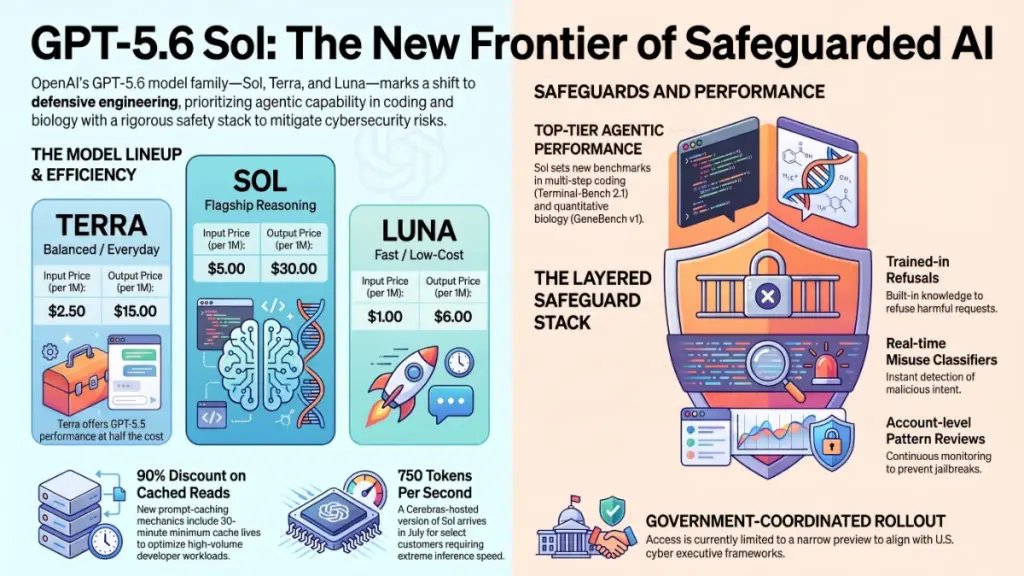
| Tier | Positioning | Input Price (per 1M tokens) | Output Price (per 1M tokens) |
|---|---|---|---|
| Sol | Flagship, top-end reasoning | $5 | $30 |
| Terra | Balanced everyday model | $2.50 | $15 |
| Luna | Fast, low-cost tier | $1 | $6 |
Terra roughly matches GPT‑5.5 performance at about half the cost. Luna targets budget-conscious, high-volume workloads.
Performance Claims: Coding, Biology, and Cybersecurity
OpenAI pitches GPT‑5.6 Sol as its most capable model to date. The company highlights gains across three agentic domains: software engineering, biological research workflows, and offensive/defensive cybersecurity tasks.
Coding. Sol reportedly sets a new benchmark result on Terminal-Bench 2.1. This test measures multi-step command-line planning and tool coordination. Enterprise developers increasingly lean on AI copilots for exactly this kind of long-horizon workflow.
Biology. OpenAI tested Sol on GeneBench v1, a genomics and quantitative-biology benchmark. Sol reportedly outperforms GPT‑5.5 there while using fewer tokens per task. That points to efficiency gains alongside raw capability.
Cybersecurity. This is where the release leans hardest. OpenAI says Sol matches rival lab benchmarks on offensive security tasks while using roughly a third of the output tokens. Reasoning-heavy configurations across the whole family also show marked gains on a UC Berkeley-developed exploit benchmark.
Sol did not cross OpenAI’s internal “Cyber Critical” threshold. In tests against Chromium and Firefox, the model identified vulnerabilities and exploitation building blocks. It reportedly could not chain them into a complete, working exploit on its own under test conditions.
The Safeguard Stack, Explained
Cybersecurity gains carry obvious dual-use risk. OpenAI published unusually detailed information about how it tries to contain misuse. The goal: block bad actors without slowing down legitimate security work like patching, debugging, and defensive testing.
The layered approach includes:
- Trained-in refusals at the model level, including resistance to jailbreak attempts and disguised intent.
- Real-time misuse classifiers that can pause generation mid-task. A larger reasoning model then reviews the output before it reaches the user.
- Account-level pattern review that scans multiple conversations. This helps separate persistent bad-faith use from legitimate dual-use security research.
- Differentiated access tiers, so the most sensitive capabilities stay restricted by default.
OpenAI admits this stack isn’t finished. The company expects some legitimate requests to get blocked or delayed by mistake during the preview. User feedback during this period should help tune the system before wider release.
Red-Teaming at Scale
OpenAI committed more than 700,000 GPU-hours to automated red-teaming. The team focused specifically on finding “universal” jailbreaks — attack patterns that generalize across many prompts rather than one-off exploits. Third-party human testers ran parallel expert red-teaming throughout this effort. OpenAI argues this combination catches both scale and creativity in adversarial testing.
Pricing and Infrastructure Notes
GPT‑5.6 also introduces revised prompt-caching mechanics. These include explicit cache breakpoints and a 30-minute minimum cache life. Cache writes now cost 1.25x the standard input rate. Cached reads keep the existing 90% discount.
OpenAI confirmed a Cerebras-hosted version of Sol arriving in July. It promises inference speeds up to 750 tokens per second for an initial set of select customers. This marks a notable bet on speed-focused infrastructure partnerships as competition in the large language model space intensifies.
Why It Matters for Developers, Marketers, and Remote Teams
- Developers get a coding-focused model with stronger long-horizon planning. Expect occasional friction from safety classifiers during the preview, especially on security-adjacent tasks like vulnerability research or penetration testing scripts.
- Digital marketers and automation specialists should watch the Terra tier closely. It roughly matches GPT‑5.5-class performance at half the price — a meaningful ROI shift for teams running high-volume content or workflow automation.
- Security teams gain a model built explicitly for defensive use cases: patch development, vulnerability discovery, and security education. Enterprises handling sensitive workloads should still weigh the differentiated access model before building critical pipelines around it.
- Remote and distributed teams using AI-assisted coding tools may see benefits first, since Codex is one of the initial preview access points.
What This Means Going Forward
The GPT‑5.6 launch reflects a broader pattern across the frontier AI stack. As models get meaningfully better at cybersecurity-relevant tasks, vendors are shifting toward slower, more instrumented rollouts instead of immediate general availability. Expect more staged, government-coordinated releases industry-wide as reasoning and agentic capabilities keep climbing. Any team evaluating AI tools built on these evolving safety frameworks should track this trend closely.