

OpenAI has launched GPT-5.6 with its flagship model, Sol, but initial access is restricted to vetted U.S. partners following a White House request. The release highlights growing government influence over frontier AI deployments. While GPT-5.6 delivers major improvements in coding, biology, and cybersecurity, developers and businesses worldwide may face delayed access, making AI provider diversification increasingly important.
OpenAI unveiled GPT-5.6, its newest model family, in late June 2026. But the rollout comes with a catch. The Trump administration asked OpenAI to limit initial access to a small group of vetted U.S. partners.
This marks one of the clearest cases yet of a government directly shaping how a frontier AI stack reaches the market. The industry has grown used to instant global access to new large language models. This gated release breaks that pattern, and AI automation buyers should take notice.
What Is GPT-5.6, Exactly?
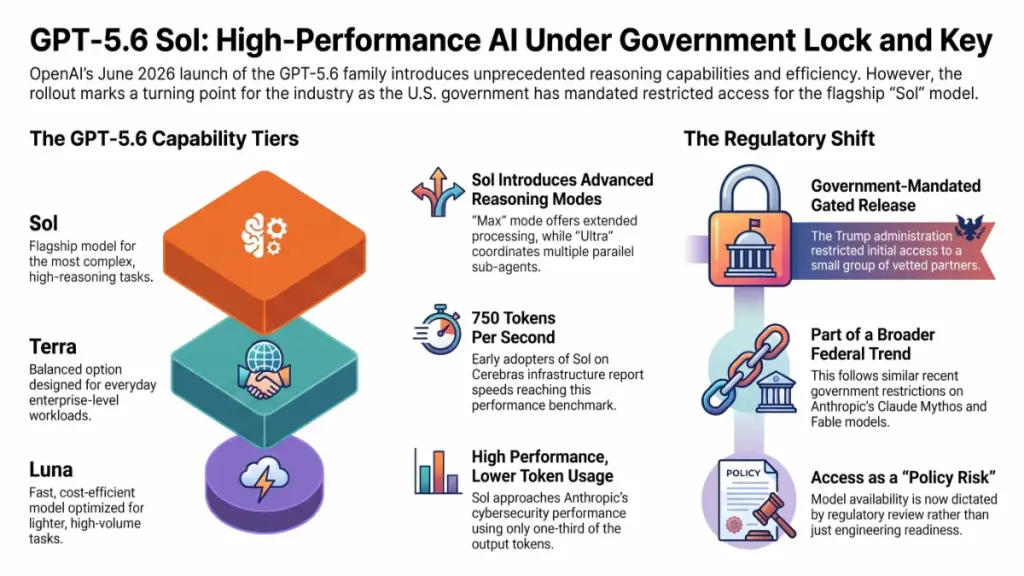
GPT-5.6 succeeds GPT-5.5. It ships as a family of three distinct models, each built for a different capability tier:
- Sol – the flagship, most capable model in the lineup
- Terra – a balanced option for everyday enterprise workloads
- Luna – a fast, cost-efficient model for lighter tasks
OpenAI also overhauled its naming system. Earlier generations carried use-case labels like Thinking, Instant, and Cyber. GPT-5.6 instead organizes models by raw capability tier, and OpenAI plans to carry this structure into future releases.
Sol introduces two new reasoning modes. A “max” mode gives the model extra time to work through complex problems. An “ultra” mode coordinates multiple sub-agents in parallel to tackle harder, multi-step tasks.
Access will roll out gradually. ChatGPT and Codex will gain the series after an initial preview period for select partners. Sol will also run on Cerebras infrastructure, reportedly reaching speeds up to 750 tokens per second for early adopters.
Performance Gains: Coding, Biology, and Cybersecurity
OpenAI reports measurable gains over GPT-5.5 in three domains:
- Coding — Sol handles command-line workflows that require planning, iteration, and tool coordination more effectively.
- Biology — the model processes complex genomic analysis using fewer tokens than its predecessor.
- Cybersecurity — Sol’s performance approaches Anthropic’s Claude Mythos Preview, yet it consumes roughly one-third the output tokens.
That cybersecurity benchmark stands out, but OpenAI frames it carefully. The company says Sol did not cross the “Cyber Critical” threshold on its internal safety framework. During tests against Chromium and Firefox, the model found <cite index=”2-13″>bugs and exploit primitives but didn’t independently build a complete, working exploit under test conditions</cite>.
OpenAI also flags a broader limit of any benchmark claim. Fixed thresholds can’t capture every real-world use case, and they can’t predict every way a model might combine with external tools. This uncertainty likely explains why OpenAI chose staged access and stronger safeguards over a full public launch.
Why the White House Is Involved
This detail carries the most industry-wide weight. Before releasing GPT-5.6, OpenAI briefed the Trump administration on the models. The administration then asked the company to limit initial distribution.
OpenAI says it’s coordinating with the executive branch on the rollout. At the same time, the company wants to avoid making this a permanent policy. OpenAI argues that gated releases risk <cite index=”2-19″>cutting off users, developers, businesses, cybersecurity researchers, and international partners</cite> from the most capable tools available.
Still, OpenAI hasn’t pushed back hard against Washington’s involvement. The administration, for its part, appears eager to extend this kind of review process to future model launches.
OpenAI frames the restriction as a temporary, safety-driven step. The company describes it as groundwork for a repeatable government-industry process tied to an upcoming presidential cybersecurity framework. OpenAI says it expects broader availability within weeks.
Anthropic Faced a Similar Restriction First
This isn’t the first time U.S. authorities have intervened in a frontier model launch. Weeks earlier, the government forced Anthropic to suspend access to Claude Mythos 5 and Claude Fable 5 for all customers. Officials cited cybersecurity concerns and worries about potential access by China.
Anthropic negotiated for roughly two weeks. The government then partially lifted the restriction and let Anthropic restore Mythos 5 access for more than 100 U.S. institutions. Fable 5, however, reportedly remains disabled.
Why It Matters for Developers, Marketers, and Remote Teams
This trend carries direct, practical consequences for the people building on these platforms:
- Access delays now pose a policy risk, not just a technical one. Teams planning workflows around a frontier model like Sol may face unpredictable availability windows tied to government review rather than engineering readiness.
- Cybersecurity teams lose early access to the most capable defensive tools. If elite reasoning and cyber-capable models stay gated to a shortlist of partners, independent security researchers and smaller firms must work with weaker alternatives.
- International teams may face a full lockout. Marketing agencies, SaaS companies, and automation consultancies outside the approved partner list shouldn’t expect day-one access to next-generation models.
- Procurement and vendor diversification matter more than ever. Businesses that depend heavily on one frontier LLM provider for automation pipelines should build contingency plans around multiple providers. Both OpenAI and Anthropic have now faced government-driven access disruptions in 2026.
The Bigger Picture
GPT-5.6 Sol’s restricted debut follows closely behind Anthropic’s own government-mandated suspension. Together, these events point to a new phase for the AI industry, one where regulatory and national-security review shape model releases as much as engineering milestones do.
This practice could easily become standard rather than a one-off. If it does, geopolitics may end up driving adoption speed as much as product readiness does. Anyone building an AI-powered stack in 2026 should track that variable as closely as benchmark scores.