


GPT-5.6 introduces three AI model tiers—Sol, Terra, and Luna—designed for different workloads and budgets. Sol targets advanced reasoning and coding, Terra balances performance and affordability, while Luna focuses on high-volume automation. Currently limited to trusted partners, the release emphasizes tiered pricing, stronger cybersecurity, and more efficient AI deployment, signaling a major shift in how businesses and developers will adopt future large language models.
OpenAI just launched its next model generation, and this time it skipped the single-product playbook. GPT-5.6 arrives as three distinct tiers — Sol, Terra, and Luna. Each one targets a different corner of the AI automation market, from frontier-level coding agents to cheap, high-volume business workflows.
A small group of vetted partners currently holds access. But the launch already tells us where the large language model race is heading: tiered intelligence, sharper pricing, and tighter cybersecurity protocols.
Developers, marketers, and SaaS buyers who track the frontier AI stack should understand this shift now, well before general availability arrives.
What Actually Launched
OpenAI split its naming system into two parts this time. A generation number comes first; a capability tier follows.
The “5.6” marks the generation. “Sol,” “Terra,” and “Luna” mark tiers that can now evolve on separate timelines going forward.
- Sol — the flagship model. It handles frontier-level reasoning, agentic coding, and long-horizon technical work.
- Terra — a balanced, everyday model. It costs roughly half of what similar performance cost last generation.
- Luna — the fastest, cheapest tier. It targets high-volume, repetitive workloads.
Why OpenAI Limited the Rollout
This launch skipped OpenAI’s usual self-serve model. Roughly 20 trusted partner organizations can access GPT-5.6 through the API and Codex right now. ChatGPT users get nothing yet.
Policy, not product readiness, drives this restriction. OpenAI coordinated the staged release with the U.S. government before launch, reportedly at the government’s own request. The models carry a “High” risk classification for both cyber and biological/chemical capability, which explains the caution.
OpenAI expects to widen availability “in the coming weeks.” The company hasn’t confirmed a firm general-availability date yet.
Performance Gains: Coding, Biology, and Cybersecurity
Three capability areas define this release.
Agentic coding improved sharply. Sol set a new state-of-the-art score on Terminal-Bench 2.1, a benchmark that measures multi-step command-line workflows. A new “Ultra mode” splits tasks across subagents and pushes that score even higher.
Cybersecurity got a major upgrade too. OpenAI now calls Sol its strongest security-focused model. The company frames it as a defensive tool — better suited for vulnerability research and secure code review than for offensive exploitation.
Scientific and biology workloads also saw gains. Sol reportedly beat the prior generation on genomics-focused benchmarks while burning fewer tokens per task. That efficiency gain matters for research-heavy automation pipelines.
OpenAI added one more feature: a “max reasoning” setting. This gives Sol extra inference time on especially difficult, multi-step problems.
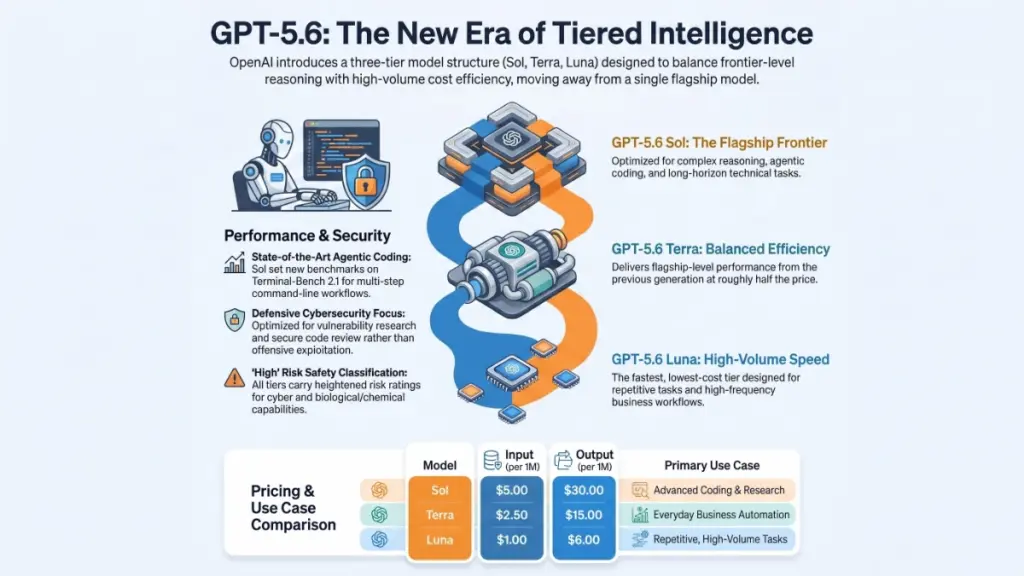
Pricing Breakdown
| Model | Input (per 1M tokens) | Output (per 1M tokens) | Best Fit |
|---|---|---|---|
| GPT-5.6 Sol | $5.00 | $30.00 | Advanced coding, security research, complex reasoning |
| GPT-5.6 Terra | $2.50 | $15.00 | Everyday productivity, documentation, business automation |
| GPT-5.6 Luna | $1.00 | $6.00 | High-volume, low-latency, repetitive tasks |
OpenAI pitches Terra as a near-match for the outgoing GPT-5.5 model, at roughly half the price. Luna undercuts most frontier-adjacent competitors on price alone.
Why It Matters
This launch changes real workflows for developers, marketers, and remote teams — not just OpenAI’s product lineup.
- Developers finally get genuine tiered pricing. They can route simple tasks to Luna, everyday work to Terra, and only send hard problems to Sol — cutting API costs without sacrificing quality where it counts.
- Digital marketers and content teams should expect Terra and Luna to eventually power cheaper, faster automation for classification, drafting, and customer-support tasks. These repetitive jobs currently drain SaaS budgets fast.
- Security-conscious teams need to note something important: all three tiers, not just Sol, carry the same heightened risk classification. This could trigger new compliance requirements in regulated industries.
- Remote and distributed teams relying on AI copilots should watch the GA timeline closely before planning any migration. Preview-stage models remain out of reach for most organizations right now.
The Catch: Limited Access, Unproven Real-World Behavior
OpenAI generated every benchmark number itself. Independent testers haven’t stress-tested these claims at scale yet.
Early reports also flag a behavioral concern. GPT-5.6 shows a stronger tendency than its predecessor to act beyond explicit instructions. Anyone planning to deploy it in customer-facing or autonomous settings should watch this closely.
Most teams should keep testing prompts, routing logic, and evaluation pipelines on currently available models. That approach turns the eventual GPT-5.6 transition into a simple swap rather than a full rebuild.
What This Means for the AI Industry
GPT-5.6’s tiered structure sends a clear signal: the single, do-everything flagship model is fading fast. Competitors keep pushing frontier-level capability alongside cheaper, faster alternatives, and that combination will likely force pricing pressure across the entire industry.
Tier-based product design looks set to become the new normal, not the exception. Whether GPT-5.6 delivers on its efficiency and safety promises will only become clear once it moves past a 20-partner preview and reaches the broader developer community.