


TL;DR: AI software is used to automate repetitive tasks, accelerate content creation, enhance customer service through intelligent chatbots, extract actionable insights from business data, generate visual and audio creative content, and optimize workflows across industries from healthcare to finance. The most successful implementations treat AI as a tool that amplifies skilled human workers rather than replaces them, focusing on specific, well-defined problems with clear success metrics rather than pursuing broad, hype-driven transformations.
Beyond the AI Hype
If you’ve searched “what is AI software used for” and found nothing but buzzwords and futuristic predictions, you’re not alone. As a digital marketing consultant who’s implemented AI solutions for businesses since 2021, I’ve seen the gap between AI promise and practical reality firsthand.
Here’s the truth most articles won’t tell you: AI software isn’t a magic solution that transforms businesses overnight. It’s a collection of specialized tools designed to solve specific problems—writing assistance, data analysis, customer service automation, and predictive insights. The companies winning with AI aren’t chasing the most advanced platforms. They’re strategically matching AI capabilities to their actual workflow pain points.
In this comprehensive guide, I’ll walk you through exactly what AI software is used for in real business environments today. No theoretical fluff—just concrete applications, measurable results, and honest insights from my client work across e-commerce, SaaS, healthcare, and professional services.
Whether you’re a business owner evaluating your first AI investment or a marketing leader building a business case, this article provides the clear, actionable framework you need to make smart AI decisions.
1. Content Creation and Marketing Automation
Content creation represents the entry point for most businesses exploring AI software—and for good reason. The process is time-intensive, follows repeatable patterns, and requires scale that human teams struggle to achieve alone.
How AI Transforms Content Workflows
Modern AI writing tools like ChatGPT, Claude, Jasper, and Copy.ai don’t replace skilled writers. They function as intelligent collaborators that eliminate the blank-page problem and accelerate production timelines.
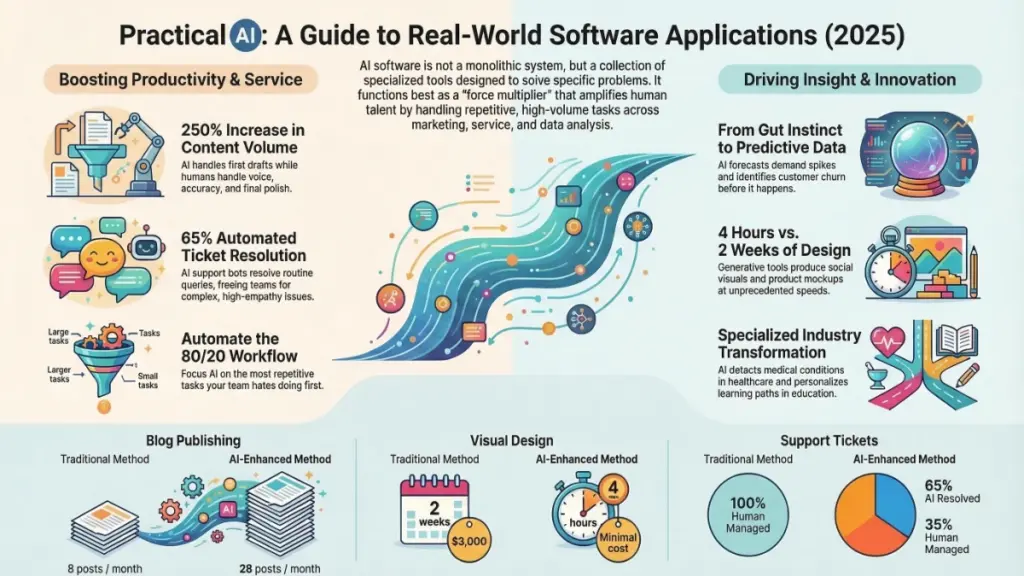
Real-world example: I recently helped a mid-sized e-commerce brand restructure their content operation. Their three-person writing team previously published 8 blog posts monthly. After implementing an AI-assisted workflow where tools handled first drafts and outlines, they scaled to 28 monthly posts without adding headcount or extending hours. Writers focused on voice refinement, fact-checking, and strategic polish—work that actually requires human judgment.
Specific Marketing Applications
AI content software excels across multiple marketing functions:
Email Marketing at Scale
- Subject line generation and A/B testing variations
- Automated sequence creation for nurture campaigns
- Personalized email body copy based on segmentation data
- Response prediction to optimize send times
Social Media and Advertising
- Platform-specific caption generation (LinkedIn professional tone vs. Instagram casual)
- Ad copy variations for split testing
- Hashtag research and recommendation
- Content calendar automation based on trending topics
E-commerce Content
- Bulk product description generation for catalogs with thousands of SKUs
- SEO-optimized category page copy
- Review response templates personalized by sentiment
- Size guide and FAQ content creation
SEO and Long-form Content
- Keyword-optimized article outlines and briefs
- Meta description and title tag generation
- Content gap analysis and topic clustering
- Readability optimization suggestions
The Critical Success Factor
Here’s what separates successful AI content implementations from failures: prompt quality and human oversight. I’ve watched teams publish raw AI output without review, resulting in generic, occasionally inaccurate content that damaged their brand authority.
AI content tools function best as force multipliers for skilled professionals, not replacements for editorial judgment. The 20 minutes spent refining a prompt and editing output consistently produces better results than 2 hours spent writing from scratch.
2. Customer Service and Conversational AI
AI-powered chatbots have evolved dramatically. The frustrating, rigid FAQ bots of 2019 have given way to sophisticated conversational agents capable of genuine problem-solving.
Modern AI Customer Service Capabilities
Today’s conversational AI software handles complex interactions through natural language understanding, context retention, and integration with business systems.
Real-world implementation: A SaaS client with 180 monthly active users deployed an AI support bot that autonomously resolved 65% of incoming tickets. Their human support team shifted from reactive firefighting to proactive relationship management, handling only escalations requiring emotional intelligence and complex troubleshooting.
Proven Use Cases by Industry
E-commerce and Retail
- 24/7 order tracking and shipping updates
- Return and exchange processing with policy enforcement
- Product recommendations based on browsing history
- Cart abandonment recovery through conversational nudges
B2B and SaaS
- Lead qualification on landing pages (routing hot leads to sales immediately)
- Technical troubleshooting for common software issues
- Account management and billing inquiries
- Feature education and adoption guidance
Service Businesses
- Appointment scheduling with calendar integration
- Pre-visit intake form completion
- Service recommendations based on customer history
- Post-appointment follow-up and feedback collection
Internal Operations
- HR policy question answering for employees
- IT helpdesk ticket routing and initial diagnosis
- Procurement and expense policy guidance
- Training and onboarding assistance
The Hybrid Model Reality
Conversational AI still struggles with emotionally charged situations requiring empathy and nuanced judgment. Frustrated customers experiencing service failures need human connection, not efficient chatbot responses.
Smart organizations implement tiered support models: AI handles volume, consistency, and availability; humans handle complexity, emotion, and relationship repair. This hybrid approach typically delivers 40-60% cost reduction while improving customer satisfaction scores.
3. Data Analysis, Business Intelligence, and Predictive Analytics
While content AI gets the headlines, data analysis applications often deliver superior ROI. Businesses generate more data than ever—but most lack the resources to extract actionable insights.
Democratizing Advanced Analytics
AI-powered analytics platforms have made sophisticated data science accessible to mid-market companies without dedicated analytics teams. Tools like Microsoft Power BI with Copilot, Tableau AI, and Obviously AI enable business users to generate insights through natural language queries rather than SQL coding.
Real-world impact: A retail client implemented predictive AI for demand forecasting. The system identified upcoming demand spikes for specific product categories three weeks in advance, enabling inventory adjustments, targeted promotions, and stockout prevention. The result: 23% revenue increase in those categories during the forecast period.
High-Value AI Data Applications
Sales and Revenue Operations
- Predictive lead scoring based on behavioral signals
- Sales forecasting with 90-day accuracy improvements
- Churn prediction identifying at-risk accounts 30-60 days early
- Pricing optimization recommendations by segment
Marketing Analytics
- Customer lifetime value prediction
- Attribution modeling across multi-touch campaigns
- Content performance prediction before publication
- Audience segmentation automation
Operational Intelligence
- Supply chain disruption prediction and alternative routing
- Inventory optimization balancing carrying costs against stockout risk
- Quality control anomaly detection in manufacturing
- Resource allocation optimization for professional services
Financial Applications
- Fraud detection in real-time transaction processing
- Credit risk assessment for lending decisions
- Expense categorization and anomaly flagging
- Cash flow forecasting with scenario modeling
Implementation Insights
The accessibility surprise: modern AI analytics tools require minimal technical setup. Most integrate directly with existing data sources (CRM, ERP, marketing platforms) and provide insights through conversational interfaces. The barrier isn’t technical complexity anymore—it’s data quality and asking the right business questions.
4. Image, Video, and Creative Content Generation
Generative AI has expanded far beyond text into visual content creation. This represents one of the most dramatic cost and time reductions AI enables.
The Creative Production Revolution
Personal experience: I initially dismissed image generation as a novelty—until witnessing a small marketing agency produce complete social media visual campaigns using Midjourney. A product launch campaign that traditionally required $3,000 and two weeks of designer time took four hours and $60 in AI tool subscriptions. The quality matched professional design standards for digital use cases.
Current Creative AI Capabilities
Image Generation and Editing
- Product mockups and lifestyle imagery for e-commerce
- Custom illustrations for blog posts and presentations
- Background removal and replacement at scale
- Style-consistent brand asset generation
- A/B test creative variations without photoshoot costs
Video Production
- Text-to-video generation for social media content (Runway, Pika)
- AI avatar presenters for explainer videos (Synthesia, HeyGen)
- Automated video editing and highlight reel creation
- Voiceover generation in multiple languages and tones
- Subtitle and caption automation
Audio and Voice
- Podcast editing and noise reduction
- Voice cloning for consistent brand audio
- Music generation for background tracks
- Audio transcription and summarization
The Creative Director Advantage
AI creative tools amplify talent rather than replacing it. Prompt engineering itself requires creative judgment—understanding composition, lighting, brand aesthetics, and emotional impact. A skilled creative director using AI consistently outperforms untrained users with the same tools.
The winning approach: use AI for volume, variation, and rapid iteration; use human creatives for strategic direction, final selection, and brand-consistent refinement.
5. Workflow Automation and Process Optimization
If content creation is where businesses start with AI, workflow automation is where they achieve transformative ROI. AI software eliminates repetitive tasks across every business function.
Everyday Productivity Gains
Communication Automation
- Email drafting and response suggestions (Gmail Smart Compose, Outlook Copilot)
- Meeting transcription and action item extraction
- Calendar scheduling and conflict resolution
- Follow-up reminder automation based on conversation context
Document Processing
- Invoice data extraction and accounts payable routing
- Contract clause identification and risk flagging
- Resume parsing and candidate ranking for HR
- Expense report categorization and policy compliance checking
Operational Workflows
- Supply chain rerouting based on real-time disruption alerts
- Predictive maintenance scheduling for equipment
- Quality assurance automation in manufacturing
- Code generation and debugging assistance for development teams
The 80/20 Rule of AI Automation
Most businesses achieve 80% of their automation value from 20% of possible applications. The key is identifying high-volume, rule-based tasks that consume disproportionate human time.
Implementation strategy: Map your team’s weekly activities by time consumption and repetition frequency. Target the tasks appearing in the top-right quadrant (high time, high repetition) first. These typically include data entry, report generation, status updates, and routine communication.
6. Specialized Industry Applications
Beyond general business use cases, AI software transforms sector-specific operations in healthcare, education, agriculture, and finance.
Healthcare AI Applications
Medical Imaging and Diagnostics AI systems analyze radiology images, detecting tumors, fractures, and diabetic retinopathy with specialist-level accuracy in specific tasks. FDA-approved algorithms now assist radiologists in prioritizing critical cases and reducing diagnostic time.
Drug Discovery and Development AI compresses pharmaceutical research timelines by predicting molecular behavior, identifying promising compounds, and optimizing clinical trial design. What previously required years now takes months in early-stage research.
Clinical Documentation Ambient clinical intelligence tools automatically generate visit notes from doctor-patient conversations, reducing administrative burden and allowing more patient-facing time.
Education and Training
Adaptive Learning Platforms AI personalizes educational content difficulty, pacing, and format based on individual student performance. Khan Academy’s Khanmigo and similar tools provide one-on-one tutoring accessibility previously available only through expensive private instruction.
Corporate Training
- Personalized learning paths based on role and skill gaps
- Knowledge retention testing and spaced repetition scheduling
- Simulation-based practice for complex procedures
- Automated competency assessment and certification tracking
Additional Specialized Applications
Agriculture: Satellite imagery analysis for crop health monitoring, yield prediction, and precision agriculture optimization.
Manufacturing: Predictive maintenance preventing equipment failures, quality control automation, and supply chain optimization.
Financial Services: Robo-advisors for wealth management, algorithmic trading, real-time fraud detection, and credit risk modeling.
Cybersecurity: Threat detection and response automation, anomaly identification in network traffic, and vulnerability prediction.
7. Critical Implementation Considerations
Honest assessment prevents expensive AI failures. I’ve witnessed companies invest $40,000+ in enterprise AI platforms that sat unused because implementation planning was skipped.
Three Questions Before AI Investment
1. Problem Definition What specific, measurable problem will AI solve? Vague goals like “improve efficiency” lead to vague results. Specific goals like “reduce customer response time from 4 hours to 30 minutes” enable tool selection and success measurement.
2. Readiness Assessment Do you have the data quality, process documentation, and team capacity to implement effectively? AI requires training data, defined workflows, and change management. Underestimating these requirements causes implementation failure.
3. Success Metrics What does 90-day success look like, and how will you measure it? Without baseline metrics and clear targets, you cannot evaluate ROI or justify continued investment.
When to Delay AI Investment
Consider postponing AI software purchases if:
- Your core business processes aren’t yet standardized or documented
- Data quality is poor (incomplete, inconsistent, or inaccessible)
- Team capacity for change management is already stretched
- You cannot define specific success metrics for the first 90 days
Conclusion: The Practical AI Roadmap
So, what is AI software used for? In practical terms: amplifying human capabilities, automating repetitive work, and enabling data-driven decisions at scale. From marketing content and customer service to predictive analytics and healthcare diagnostics, AI software now permeates every industry—with increasing accessibility and capability.
Four Principles for AI Success
1. Augmentation Over Replacement AI software works best enhancing skilled professionals, not substituting for human judgment. The combination of AI efficiency and human creativity consistently outperforms either alone.
2. Value the Unglamorous The highest ROI AI applications are often invisible: automated data processing, predictive maintenance, and workflow optimization. These lack headline appeal but deliver consistent business value.
3. Start Narrow, Expand Deliberately Select one high-volume, well-defined problem. Implement thoroughly, measure results, and optimize before expanding. Successful AI programs grow through validated experiments, not broad initial deployments.
4. Measure Ruthlessly Track concrete metrics: time saved, costs reduced, output increased, errors decreased. Abstract benefits like “improved efficiency” don’t justify budgets or guide optimization.
Your Next Step
If you’re beginning your AI exploration, select one category from this guide matching a current business pain point. Choose a single tool with strong reviews in that category. Implement it for 30 days with specific use cases and success metrics defined upfront.
Most successful AI implementations I’ve guided started exactly this way—not with comprehensive strategy, but with one well-executed experiment that proved value and built organizational confidence.
Frequently Asked Questions
Q: Is AI software the same as machine learning?
Machine learning powers many AI applications, but AI software encompasses broader technologies including rule-based systems, natural language processing, and computer vision. Think of machine learning as the engine; AI software is the complete vehicle.
Q: Can small businesses realistically use AI software?
Absolutely. Small businesses often implement AI faster than enterprises due to simpler decision-making and fewer legacy system constraints. Many effective tools (ChatGPT, Claude, Canva AI, HubSpot AI) offer accessible pricing. The key is starting with one specific use case rather than attempting comprehensive transformation.
Q: Will AI software replace jobs?
Some specific tasks, yes. Entire jobs, rarely. The predominant pattern I observe is task augmentation—AI handles repetitive components while humans focus on complex problem-solving, creative work, and interpersonal interactions. Roles consisting entirely of high-volume, low-variability tasks face the greatest displacement risk.
Q: How do I select the right AI software for my business?
Start with problem documentation, not tool evaluation. List your three most time-consuming repetitive challenges. Research AI solutions specifically addressing those pain points. Utilize free trials and freemium tiers extensively before annual contract commitments.
Q: Is AI software secure and private?
Security varies significantly by vendor and implementation. Enterprise-tier providers typically offer robust data protection and privacy controls. However, never input sensitive customer data, proprietary information, or regulated data into consumer AI tools without reviewing data usage policies and training opt-out procedures carefully.