

InstantlyClaw Review 2026: InstantlyClaw is a $4,497 managed OpenClaw hosting service for non-technical users wanting pre-built AI agents without setup hassle. It delivers 9 agents with 15 skills in 60 seconds, but alternatives like n8n ($20/mo), MindStudio (flexible subscription), or self-hosted OpenClaw (free) offer better value for technical users. Best for those prioritizing speed over customization; others should test free alternatives first.
The AI Agent Revolution of 2026
The question I keep hearing isn’t simply “Is InstantlyClaw any good?” — it’s “Compared to what?” And honestly, that’s the smarter question. Because in 2026, the AI agent space has exploded to the point where you genuinely have options. Good ones.
I’ve spent over nine years testing AI-powered SaaS platforms, and I’ve watched OpenClaw transform from a niche developer project into the fastest-growing open-source tool in AI history. Created by Austrian developer Peter Steinberger and launched on January 25, 2026, OpenClaw has achieved over 100,000 GitHub stars in under a week — a milestone that makes it the fastest-growing open source project in history. With that surge in attention came a wave of products trying to make OpenClaw accessible to non-technical users. InstantlyClaw is one of them.
But here’s what makes 2026 different: the landscape has matured rapidly. Nvidia CEO Jensen Huang declared at GTC 2026 that “Every single company needs an OpenClaw strategy”. Anthropic released Claude Cowork and Dispatch features. Perplexity launched business-centered alternatives. Snowflake introduced Project SnowWork. The competition isn’t just coming — it’s already here.
What I want to do in this review — and what most other reviews skip — is actually compare InstantlyClaw to real alternatives: n8n, MindStudio, Relevance AI, and self-hosted OpenClaw. That way, you can make a decision based on your actual situation, not a sales page. Let’s get into it.
What Is InstantlyClaw, Really? (Beyond the Marketing)
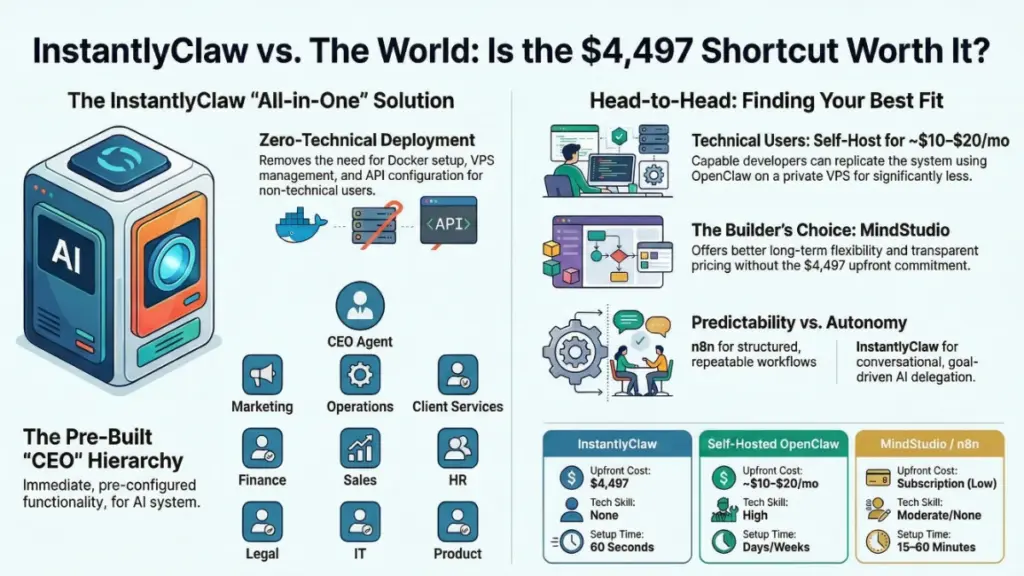
At its core, InstantlyClaw is a managed hosting and setup service built on top of OpenClaw. You’re not buying the AI technology itself — OpenClaw is open source and free. Instead, what you’re paying for is the removal of everything that makes OpenClaw hard to deploy: the Docker setup, server management, API configuration, and ongoing technical upkeep.
The product gives you a fully hosted OpenClaw instance, pre-loaded with 15 connected skills and a nine-agent team organized in a clear management structure. At the top sits a CEO agent. Below that, you have three department managers — Marketing, Operations, and Client Services. Then, at the bottom of the chain, six specialist workers handle content, SEO, data, automation, support, and research. Each agent carries persistent memory and can receive tasks through Telegram or a web dashboard, using plain everyday language.
Here’s the thing: OpenClaw itself is genuinely powerful. It can browse the web, send emails, manage documents, schedule tasks, and work across dozens of tools without being prompted every step of the way. The challenge has always been installation. Running OpenClaw from scratch typically requires local environment setup, dependency management, and permission configuration — all before meaningful work even begins. InstantlyClaw’s entire pitch is removing that friction.
Whether that friction removal justifies $4,497, however, depends entirely on your alternatives. So let’s look at them directly.
InstantlyClaw vs. Self-Hosted OpenClaw: The Value Equation
This is the most obvious comparison, and for users with technical skills, it’s also the most important one.
OpenClaw is free. If you can spin up a VPS — roughly $10–$20 per month on DigitalOcean or Hetzner — configure Docker, and work through the API setup process, you can run a fully functional OpenClaw instance for a small fraction of InstantlyClaw’s price. You’d still pay for LLM API usage either way, since that cost is tied to the AI model, not the platform.
Current Context: OpenClaw’s Rapid Evolution in March 2026
As of March 2026, OpenClaw has become the center of the AI agent universe. Nvidia debuted NemoClaw at GTC 2026, a set of services designed to make OpenClaw more reliable and secure. Anthropic’s Dispatch feature allows Claude Cowork tasks to run on local machines. Perplexity pitched itself as a more secure alternative at its first developer conference. This means the self-hosting option is getting more robust by the day.
So what does InstantlyClaw actually charge you for?
First and most obviously: time and configuration. The 15 pre-installed skills, the pre-built agent structure, the Telegram integration, SSL certificates, and firewall setup — all of that would take a capable developer anywhere from a weekend to several days to replicate from scratch. For non-developers, it may simply not be possible without hiring outside help.
Second, and just as importantly: managed infrastructure. Your instance runs on their servers, so they handle uptime, security patches, and maintenance. That’s genuinely valuable — though it also means your entire workflow becomes tied to their platform. If InstantlyClaw, operated by VineaSX Solutions LLC in the UAE, ever faces business disruption, your system goes with it.
There’s also a security angle worth considering. Security researchers have flagged concerns about OpenClaw’s broad system access by default, describing risks around prompt injection, credential leakage, and unintended data sharing. A managed hosting solution doesn’t eliminate those risks — it simply moves them to someone else’s server rather than your own machine.
Bottom line: If you’re technically confident, self-hosting OpenClaw wins on both cost and control. If you’re not technical, however, InstantlyClaw removes a genuine barrier — just make sure you weigh the vendor dependency carefully before committing.
InstantlyClaw vs. n8n: Structure vs. Autonomy
n8n is arguably the most credible alternative in the non-developer automation space, and this comparison is especially interesting because the two tools take completely different approaches.
n8n excels at connecting apps and orchestrating predictable, repeatable workflows using a visual, node-based builder. You define the logic step by step: trigger → condition → action → output. It’s structured, auditable, and reliable. n8n Cloud starts at $20 per month for 2,500 workflow executions, while the self-hosted Community Edition is completely free with unlimited workflows.
The 2026 Context: AI Agents vs. Workflow Automation
According to recent analysis, n8n automates workflows with deterministic steps, while AI agents handle ambiguous, language-heavy tasks. n8n excels at deterministic, structured workflows: when event X happens in system A, do Y in system B. It’s perfect for data syncing, notification routing, ETL pipelines, and any process where inputs and outputs are predictable.
InstantlyClaw, by contrast, is built around autonomous AI agents. Rather than defining the logic yourself, you simply give the agents a goal and they figure out the path. In theory, that’s more powerful. In practice, though, it’s also less predictable — and that difference matters a lot depending on what you’re trying to automate.
Here’s where the comparison gets honest: n8n works best for structured, repeatable business processes — syncing data between tools, sending triggered notifications, populating spreadsheets. If those are your main use cases, n8n is more reliable, far cheaper, and backed by a thriving community of templates and support.
That said, n8n does require you to be comfortable designing your own flows. Recent updates include LangChain integration support, which is powerful but requires technical setup to configure AI models and manage their responses. If you need an AI agent that can genuinely reason — reading a research brief, gathering information from multiple web sources, and producing a formatted report — n8n can handle that through its AI nodes, but building the workflow yourself takes time and some technical confidence.
My take: For non-technical entrepreneurs who want conversational, goal-driven AI delegation, InstantlyClaw is more immediately accessible than n8n. For anyone with even moderate technical comfort, though, n8n’s pricing structure is dramatically more favorable — especially since you’re paying ongoing LLM API costs regardless of which platform you choose.
InstantlyClaw vs. MindStudio: The No-Code AI Builder Alternative
MindStudio is the comparison that surprised me most when I dug into this space. It’s a no-code platform built specifically for creating AI agents, and most users can build a working agent in 15 minutes to an hour using the AI-powered Architect feature, which auto-generates agent structures from simple text descriptions.
The key difference from InstantlyClaw is this: MindStudio is a builder, not a pre-configured system. Rather than inheriting a fixed nine-agent hierarchy, you design the agents you actually need. The platform gives you access to over 200 AI models from OpenAI, Anthropic, Google, and other providers — without managing API keys or juggling multiple subscriptions yourself.
The 2026 Shift: From Workflow Automation to Intelligent Systems
The movement from tools like n8n to MindStudio reflects a larger change in how teams think about automation. In 2024, automation meant connecting apps. In 2026, it means building intelligent systems that handle complex processes autonomously. Companies using agentic workflows see 1.7x return on investment on average, with some marketing teams reporting 60% productivity increases per worker.
On pricing, MindStudio charges a base subscription plus usage costs for AI models, with no markup on model usage. That transparency is meaningful when you’re trying to forecast what you’ll actually spend each month. With 150,000+ agents now running on MindStudio across enterprises and SMBs, the platform has proven scalability.
Where InstantlyClaw has a genuine edge: the pre-built agent team and the 15 connected skills. If you want to delegate tasks on day one without building anything, InstantlyClaw is more immediately operational. MindStudio, by contrast, requires you to design your agents — which is fast, but it’s still a design process with a learning curve.
Where MindStudio clearly wins: flexibility, pricing clarity, and long-term iteration. If the pre-built InstantlyClaw agents don’t quite match your real workflows, you’re stuck working within someone else’s structure. With MindStudio, you simply build what you need. Recent additions include database querying, MCP server support, and advanced debugging tools.
My take: For most non-technical users who want AI agents tailored to their specific work, MindStudio is the smarter long-term investment. Furthermore, the lower and more transparent pricing structure is genuinely hard to ignore when comparing it against a $4,497 upfront commitment.
InstantlyClaw vs. Relevance AI: Enterprise-Grade Multi-Agent Systems
If InstantlyClaw’s multi-agent hierarchy appeals to you conceptually, then Relevance AI is the most direct comparison worth making. It’s a no-code platform designed specifically for building AI teammates — agents you can create, train, and assign to ongoing tasks across your business.
Relevance AI specializes in multi-agent systems where several AI agents collaborate on complex tasks. For example, a sales agent might delegate research to a data agent, copywriting to a content agent, and outreach to a communication agent — with each specialist handling its area and coordinating through the platform automatically.
That structure mirrors almost exactly what InstantlyClaw offers with its CEO-manager-specialist hierarchy. The critical difference, however, is that Relevance AI gives you full control over how those agents are built and what they can do. Additionally, it operates on a subscription model rather than asking for $4,497 upfront.
Relevance AI also offers a free tier, letting you test the concept before spending a dollar. Combined with its established user base and ongoing product development, it presents a noticeably lower-risk entry point than a new product from a smaller company.
My take: For users who want a managed AI workforce with active product updates and community support behind it, Relevance AI offers more flexibility at lower financial risk. Nevertheless, if “ready in 60 seconds with zero setup” is your top priority, InstantlyClaw still has a case to make.
The $4,497 Question: Total Cost of Ownership Analysis
Let’s be direct about the pricing, because it’s the factor that ultimately determines whether this product is right for you.
The one-time $4,497 includes 12 months of hosting, which renews at $250 per year, plus two months of LLM API credits. After those two months, API costs fall entirely on you — and depending on how heavily you run the agents, that variable expense can grow quickly.
Realistic Cost Scenarios for 2026
For moderate use, budget roughly $30–$100 per month in LLM API costs; heavy automation workloads may push that figure higher. When you factor in the $4,497 upfront plus ongoing API costs, the total first-year cost ranges from $4,797 to $5,697 depending on usage.
Compare this to alternatives:
- Self-hosted OpenClaw: ~$120–$240/year (VPS) + API costs
- n8n Cloud: $240/year (Starter) + API costs
- MindStudio: Subscription + transparent API usage costs
- Relevance AI: Free tier available, then subscription-based
When InstantlyClaw Makes Financial Sense
Here’s where the math genuinely works in InstantlyClaw’s favor:
- You’re non-technical and have zero intention of learning Docker, server management, or API configuration
- You have a clear list of high-frequency tasks — research, content drafting, email handling, scheduling — that you want to hand off immediately
- You run an agency and can apply the commercial rights across multiple client projects, spreading the cost efficiently
- You’ve compared it against hiring freelance or VA support (a capable VA typically costs $1,500–$3,000 per month)
When the Math Breaks Down
Conversely, here’s where the math breaks down:
- You’re technically capable and could self-host OpenClaw or set up n8n for dramatically less money
- Your use case is narrow and you realistically only need two or three of the 15 included skills
- You haven’t mapped out specific workflows — buying an AI agent platform without a clear use case plan is how $4,497 becomes an expensive experiment
- You expect fully autonomous, no-oversight operation — early users of unrestricted AI agents have encountered unexpected behaviors, including agents making unsanctioned purchases or flooding contacts with messages when given too much freedom. Human oversight remains essential at this stage.
The 30-day money-back guarantee gives you a genuine testing window. Map your top five use cases before you buy, then spend the first two weeks testing those specific workflows. After that, you’ll have real data to make the decision — not just hope.
Comprehensive Comparison Table 2026
| Feature | InstantlyClaw | Self-Hosted OpenClaw | n8n Cloud | MindStudio | Relevance AI |
|---|---|---|---|---|---|
| Upfront Cost | $4,497 one-time | Free (DIY setup) | $0 (self-host) or $20/mo | Subscription-based | Free tier available |
| Annual Hosting | $250/year after Y1 | ~$120–$240/year VPS | $240/year (Starter) | Included in subscription | Subscription-based |
| Technical Skill | None required | High (Docker, Linux) | Moderate | None required | None required |
| Setup Time | 60 seconds | 4–8 hours | 2–4 hours | 15–60 minutes | 30–90 minutes |
| Agent Structure | Pre-built (9 agents) | DIY | DIY via AI nodes | Build your own | Build your own |
| AI Models | OpenAI/Anthropic via API | Unlimited (self-configured) | 400+ integrations | 200+ models included | Multiple providers |
| Persistent Memory | Yes | Configurable | Session-based | Yes | Yes |
| Vendor Dependency | High | None | Medium | Medium | Medium |
| Best For | Non-technical, immediate deployment | Developers, full control | Technical teams, structured workflows | No-code builders, flexibility | AI workforce builders |
| Security Risk | Managed (third-party) | Self-managed | Self or cloud-managed | Enterprise-grade | Enterprise-grade |
Security Considerations in the OpenClaw Era
Security researchers have flagged concerns about OpenClaw’s broad system access by default, describing risks around prompt injection, credential leakage, and unintended data sharing. This isn’t unique to InstantlyClaw — it’s inherent to the OpenClaw architecture.
Nvidia’s NemoClaw aims to address these concerns by adding guardrails, making OpenClaw “90% more secure” according to Authority Hacker co-founder Gael Breton. Anthropic’s approach with Dispatch keeps tasks running on local machines rather than cloud servers.
When evaluating InstantlyClaw, consider:
- Your data resides on UAE-based servers (VineaSX Solutions LLC)
- You have limited visibility into security patches and updates
- The pre-installed skills may have broad permissions by default
- Migration away from the platform requires technical assistance
Who Should Buy InstantlyClaw in 2026?
Buy InstantlyClaw if:
- You’re a non-technical entrepreneur who needs AI agents running today, not next month
- You have high-frequency, repetitive tasks that fit the pre-built agent structure
- You value done-for-you setup over long-term customization
- You understand and accept the vendor dependency risk
- You’ve calculated the ROI against hiring human support
Don’t buy InstantlyClaw if:
- You have technical skills or a technical team member
- You prefer building custom workflows tailored to your exact needs
- You want full control over your data and infrastructure
- You’re price-sensitive and willing to invest time in learning alternatives
- You need enterprise-grade security and compliance features
The Verdict: Is InstantlyClaw Worth $4,497 in 2026?
After a thorough InstantlyClaw review and honest comparison against the 2026 competitive landscape, here’s where I land: it’s a well-designed product that solves a real problem — but only for a specific type of user, and at a price that demands honest self-assessment before you commit.
Four Key Takeaways
- If you’re non-technical and want an AI agent team running in 60 seconds with zero configuration, InstantlyClaw delivers on that promise better than any direct alternative
- If you have any technical confidence at all, alternatives like n8n, MindStudio, or self-hosted OpenClaw offer significantly better value for money
- The pre-built agent hierarchy is thoughtfully designed, yet it’s also a constraint — you’re working within someone else’s system rather than your own
- Ongoing LLM API costs are the variable most buyers underestimate — build a realistic monthly estimate before you pull the trigger
Above all, my recommendation is this: before committing, spend an afternoon with MindStudio’s free tier or n8n’s Community Edition. If those feel overwhelming or just mismatched with how you work, that discomfort is your signal that InstantlyClaw’s “ready in 60 seconds” promise is worth real money to you. If they feel manageable, however, you’ll save thousands of dollars and gain more control over your system.
The 30-day guarantee makes this a lower-risk test than most $4,497 decisions. Use it as a structured evaluation period — not just a safety net.
Frequently Asked Questions About InstantlyClaw
Q: Is InstantlyClaw worth it for a solo entrepreneur? That depends entirely on how you value your time relative to learning a technical tool. If AI configuration is a genuine barrier and you have high-frequency tasks to delegate, the ROI calculation can absolutely work. However, if you’re willing to invest a few hours learning n8n or MindStudio, you’ll get comparable results at a fraction of the cost.
Q: What’s the total cost of ownership after year one? After the first 12 months, hosting renews at $250 per year. Beyond that, your main ongoing expense is LLM API usage, which scales with how often your agents run. For moderate use, budget roughly $30–$100 per month; heavy automation workloads may push that figure higher. Total year-two costs: $250 + $360–$1,200 = $610–$1,450.
Q: Can InstantlyClaw replace a virtual assistant? For research, content drafting, scheduling, and email management, it can automate a meaningful portion of what a VA handles. Nevertheless, AI agents still require human oversight, quality review, and regular prompt refinement. Think of it as augmentation rather than full replacement at this stage of AI development.
Q: Is my data safe on InstantlyClaw’s servers? The platform includes SSL encryption, firewall configuration, and security hardening. That said, your data does reside on their managed infrastructure in the UAE rather than your own servers. For sensitive business or client data, review this carefully against your compliance requirements before signing up.
Q: What happens if InstantlyClaw shuts down? This is a legitimate concern with any hosted product. Because OpenClaw is open source, you could theoretically migrate to a self-hosted instance — but you’d lose the pre-configured setup and would need technical assistance to rebuild it. Factor that vendor dependency into your overall risk assessment.
Q: How does InstantlyClaw compare to Nvidia’s NemoClaw? NemoClaw, announced at GTC 2026, is designed to make OpenClaw more reliable and secure for enterprise use. It’s not a direct competitor to InstantlyClaw but rather a set of services that could make self-hosting more viable for businesses concerned about security. If NemoClaw delivers on its promises, it may reduce the appeal of managed solutions like InstantlyClaw for security-conscious buyers.
Q: Can I upgrade or customize the pre-built agents? InstantlyClaw allows some customization, but you’re fundamentally working within their predefined structure. If you need agents that handle very specific workflows outside the CEO-manager-specialist hierarchy, you may find the platform limiting compared to builders like MindStudio or Relevance AI.
Final Thoughts: Making the Right Choice in the AI Agent Gold Rush
2026 is the year AI agents moved from experimental toys to genuine business tools. OpenClaw’s viral success — 100,000+ GitHub stars, 2,100+ agents spun up within 48 hours of launch – proves the demand is real. But demand doesn’t mean every solution is right for every user.
InstantlyClaw occupies a specific niche: non-technical users who want OpenClaw’s power without OpenClaw’s complexity. For that audience, $4,497 might be a bargain compared to the alternative of never getting started at all. But for everyone else — developers, technical teams, budget-conscious startups, or those who value flexibility — the alternatives offer compelling value propositions.
The smart approach? Test before you invest. Use the 30-day guarantee not as a safety net, but as a structured evaluation period. Build your top three use cases. Measure the time saved. Calculate the real API costs. Then make an informed decision.
Because in the AI agent gold rush of 2026, the winners won’t be the ones who buy the most expensive tools – they’ll be the ones who choose the right tools for their specific needs.