


AI Standup’s whitelabel license lets you rebrand and sell their AI software as your own, keeping 100% of revenue while the vendor handles hosting and support. It’s ideal for marketers with existing audiences who want fast SaaS entry without coding. However, you don’t own the technology, face market saturation, and need active marketing investment. Success depends on your execution, not passive income expectations.
Why White Label AI Software Is Growing Fast
Online business has changed a lot lately. New data from Gartner shows the SaaS industry will hit $232 billion by 2025. Even better, white label solutions now control a growing piece of this market. Perhaps you want to start your own software company without learning to code. If that sounds like you, AI Standup’s Whitelabel License should be on your radar.
Still, not every white label AI software deal is worth your money. True, putting your logo on a ready-made product sounds easy. However, the gap between a profitable business and a costly error lies in the details. In fact, the white label AI SaaS market has grown fast. To be specific, 63% of marketing and software agencies now use white-label solutions to grow their services.
In this detailed 2025 review, I will break down exactly what AI Standup offers. Additionally, I’ll look at current market trends. Moreover, I’ll give you clear steps to decide if this investment fits your goals. Whether you are an experienced digital marketer or new to SaaS business, this guide gives you the facts you need to choose wisely.
What Is AI Standup Whitelabel? Understanding the Business Model
How the Core System Works
AI Standup uses a white label SaaS license model. Actually, this business setup has become more advanced in 2025. When you buy their whitelabel license, you get the rights to rebrand, market, and sell their AI platform as your own product.
Here is how it works in simple steps:
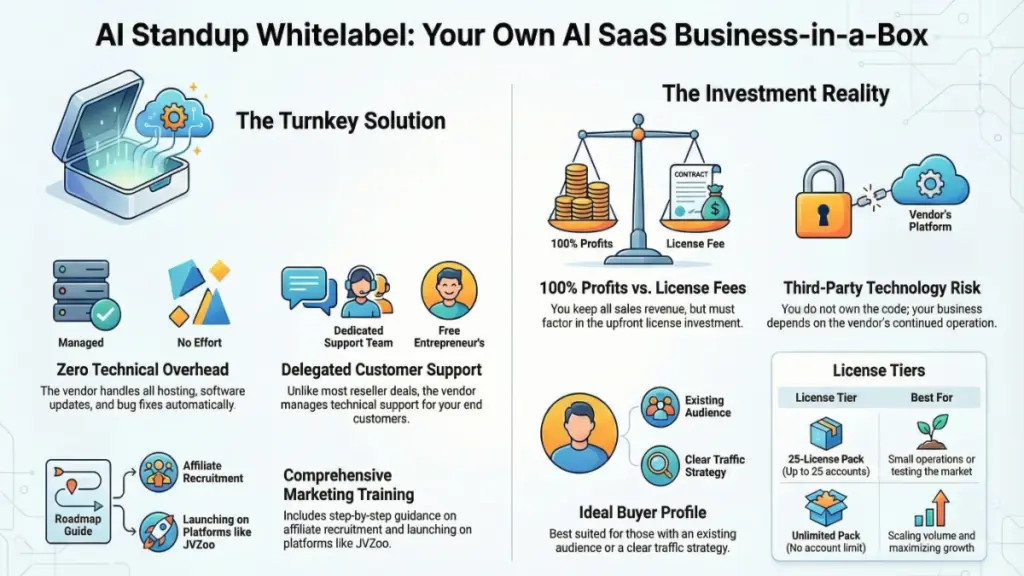
- Buy Your License: Pick between the 25-account starter pack or the unlimited accounts business tier
- Set Up Your Brand: The vendor sets up your custom domain, logo, and full visual identity
- Start Selling: You sell or give accounts to your clients under your own brand name
- Keep All Revenue: You collect 100% of the money from your sales
What makes this model different from basic reselling? Specifically, it’s the full infrastructure support. The vendor handles hosting, security updates, feature upgrades, and—most importantly—customer support for your users . As a result, you get a ready-to-run SaaS business instead of just a product license.
The Technology Behind the Platform
The core AI Standup platform uses artificial intelligence to serve a specific market need. First, you must check if this product solves real problems for your target customers. Meanwhile, the AI SaaS sector has grown fast. Indeed, AI-powered chat tools and automation software lead the 2025 market trends.
Full Feature List: What You Get in 2025
Technical Setup and Infrastructure
| Feature | What It Means | Why It Helps Your Business |
|---|---|---|
| Custom Branding | Professional logo design included | Instant brand trust with customers |
| Domain Setup | Full custom domain configuration | Better credibility and search ranking |
| Hosting Included | Vendor-managed cloud servers | No technical maintenance work |
| Software Updates | Automatic feature improvements | Product keeps getting better |
| Security Management | Business-grade protection | Less risk for your company |
Business Operations Tools
The Whitelabel Client Panel acts as your control center. Furthermore, it lets you create, manage, and delete client accounts with one click
. Consequently, this admin dashboard is key for growing your business without hiring more staff.
Payment Processing comes ready with PayPal built in. Therefore, you avoid the hassle of setting up merchant accounts. For new entrepreneurs, this speeds up your time to make money.
Marketing and Growth Training
AI Standup stands out through detailed training modules that go beyond basic how-to guides. For example, you get:
- Paid Traffic Mastery: Facebook Ads, Google Ads, and native ad strategies
- Free Traffic Methods: SEO, content marketing, and social media growth
- Affiliate Recruitment: Building promoter networks on JVZoo and WarriorPlus
- Launch Strategy: Product release plans for digital marketplaces
Moreover, this training fixes a major gap in many white label deals. To be specific, most rivals only give basic documents, leaving resellers to figure out customer acquisition alone.
Market Analysis: Where AI Standup Fits
Current Trends in White Label AI Software
The white label software market has changed a lot. Specifically, industry-specific solutions now lead the market, with AI features that were not possible just two years ago. Here are the key trends shaping this space:
1. Smart AI Agents By 2026, 80% of white-label AI platforms will offer smart agents that can handle multi-step tasks. Consequently, platforms building these features now will charge premium prices.
2. Multi-Model Systems Single-model platforms face pressure as clients want flexibility across GPT-4, Claude, Gemini, and other models. Indeed, flexible architectures are becoming standard.
3. Niche Specialization Generic AI platforms are losing ground to industry-specific tools—healthcare AI, legal AI, finance AI—each with special compliance features.
How AI Standup Compares to Competitors
AI Standup sits in the “fully managed” section of the white label market. In contrast, other options include:
- DIY Platforms: Need lots of technical setup and ongoing work
- API-First Solutions: Require developers for customization
- Hybrid Models: Offer branding but limited operational help
For pure ease of use, AI Standup’s vendor-managed approach stays competitive. On the other hand, entrepreneurs who want long-term business value may prefer platforms with deeper technology control.
Pros: Where AI Standup Delivers Real Value
1. No Technical Skills Needed
The biggest selling point is complete technical simplicity. You do not need to know server management, database tuning, or API connections. Instead, the vendor handles all technical complexity. Therefore, you can focus only on sales and marketing.
This helps especially:
- Non-technical entrepreneurs entering software markets
- Marketing agencies adding SaaS to their services
- Consultants looking for steady income streams
2. Customer Support Handled for You
Vendor-managed support is rare in white label SaaS. In fact, most reseller deals force you to run your own helpdesk, pulling you away from growth tasks. With AI Standup, your customers get technical help directly from platform experts. Meanwhile, you keep the client relationship.
3. Flexible Pricing Options
The license structure supports several ways to make money. For instance:
- One-Time Sales: High-price lifetime access licenses
- Monthly Subscriptions: Recurring billing for steady monthly revenue
- Tiered Packages: Basic, Professional, and Business level differentiation
- Usage-Based Pricing: Costs that scale with client usage
Therefore, you can optimize your revenue model based on what your audience prefers.
4. Ready for Marketplace Launches
For marketers who use JVZoo and WarriorPlus, the included training gives platform-specific tactics. These digital marketplaces still get heavy traffic for business software launches. Consequently, understanding their unique rules gives you a real edge.
Cons: Risks You Must Consider
1. You Don’t Own the Technology
You do not own the core intellectual property. This fact carries built-in risk. Specifically:
- If the vendor stops the product, your business ends
- Platform changes or feature removals happen without your input
- Pricing power stays with the technology owner
- Customization limits are set by the vendor’s plans
This risk exists in all reseller arrangements but needs clear acknowledgment. To reduce this risk, you can diversify across multiple white label products. Alternatively, you can build your own assets over time.
2. Market Saturation Challenges
Because AI Standup licenses to many resellers at once, you are not the only seller of this technology. Therefore, differentiation becomes crucial:
- Brand positioning must connect with specific audience groups
- Added services (consulting, setup help, training) create competitive advantages
- Niche focus reduces direct price competition
- Content marketing builds organic authority that generic resellers cannot copy
3. Real Cost Analysis
While “keep 100% of profits” sounds good, you must check the numbers. Specifically, consider:
- How long to recover your upfront license cost
- Customer acquisition cost versus lifetime customer value
- Churn rate impact on recurring revenue forecasts
- Marketing spend needs for meaningful traffic
The 30-day money-back guarantee reduces risk. Nevertheless, success requires money for sustained marketing.
4. Sales Pressure Tactics
The sales page uses scarcity tricks (countdown timers, price-increase warnings) common in digital product sales. These urgency triggers often reset. Consequently, they should not push your buying decision. Logical evaluation of fit matters more than fake time pressure.
Who Should Buy This? Clear Fit Assessment
Ideal Buyer Profile
This investment matches entrepreneurs who:
Have Existing Audiences: Email lists, social media followers, or professional networks ready to buy
Know Digital Marketplaces: Previous experience with JVZoo, WarriorPlus, or ClickBank launches
Want Speed Over Ownership: Value fast market entry above long-term technology control
Accept Reseller Economics: Comfortable with margin-based models rather than owning unique assets
Have Marketing Budget: Have money set aside for customer acquisition beyond the license purchase
Who Should Skip This?
Think twice if you:
Want Passive Income: SaaS businesses need active customer acquisition and retention work
Lack Traffic Sources: No existing audience or budget for paid ads creates impossible cold-start problems
Seek Technology Control: Want to modify core features or own the source code
Need Market Exclusivity: Require monopoly rights on the software functionality
Have Limited Funds: Cannot sustain marketing investment during the 3-6 month startup period
Implementation Guide: Maximizing Your Return
Phase 1: Pre-Launch Prep (Weeks 1-2)
- Audience Research: Survey your contacts to confirm demand for AI productivity tools
- Competitor Analysis: Study how other AI Standup resellers position themselves (find gaps)
- Pricing Design: Create tiered packages (Basic/Pro/Business) with clear value steps
- Brand Story: Build a compelling brand narrative beyond the vendor-provided logo
Phase 2: Technical Setup (Week 3)
- Domain Configuration: Set up custom domain with proper security and DNS settings
- Payment Testing: Verify PayPal integration and test purchase flows
- Panel Training: Master account creation, suspension, and analytics features
- Support Setup: Establish clear communication paths with vendor support
Phase 3: Market Entry (Weeks 4-8)
- Soft Launch: Release to warm audience (email list, social followers) for feedback
- Case Studies: Document early client results for social proof
- Content Marketing: Publish SEO-optimized articles targeting “AI productivity tools” keywords
- Affiliate Recruitment: Activate JVZoo/WarriorPlus training to build promoter networks
Phase 4: Scale and Optimize (Months 3-6)
- Paid Traffic Tests: Small-budget Facebook/Google Ads experiments
- Conversion Optimization: A/B test pricing pages and checkout flows
- Retention Programs: Build onboarding sequences to reduce early cancellations
- Expansion Planning: Evaluate unlimited license upgrade based on sales numbers
Alternatives: Market Comparison
Other White Label AI Platforms
| Platform | Model | Best For | Key Difference |
|---|---|---|---|
| SalesMind AI | LinkedIn automation + AI personalization | B2B agencies | 42% average reply rate, full API access |
| Reviewly.ai | AI review management | Local SEO agencies | Automated Google review generation |
| GoHighLevel | All-in-one CRM/marketing | Marketing agencies | Comprehensive funnel building |
| CustomGPT.ai | AI chatbot builder | Customer service agencies | No-code conversation design |
| Insighto.ai | Voice + chatbot solutions | Enterprise communication | Multi-channel deployment |
Strategic Positioning
AI Standup competes mainly on operational simplicity rather than feature depth. For entrepreneurs who prioritize speed-to-market over customization, this positioning works well. However, agencies needing deep integration or industry-specific compliance may find specialized solutions better.
Financial Scenarios: Profit Projections
Scenario A: Conservative Start (25-License Pack)
Assumptions:
- License cost: ~$997 (typical JVZoo pricing)
- Average sale price: $97 one-time
- Conversion rate: 2% of warm audience
- Audience size: 1,000 engaged contacts
Projections:
- 20 sales = $1,940 revenue
- Profit after license: $943
- Break-even: Immediate license cost recovery
Scenario B: Subscription Model (Unlimited Pack)
Assumptions:
- License cost: ~$1,997 (unlimited tier)
- Pricing: $47/month subscription
- Customer acquisition cost: $30
- Monthly churn: 5%
- New customers/month: 15
Projections:
- Month 6: 77 active customers = $3,619 monthly recurring revenue
- Month 12: 134 active customers = $6,298 monthly recurring revenue
- Annual recurring revenue at Year 1: ~$75,576
Risk Factors to Watch
- Churn spikes if product-market fit is weak
- Rising acquisition costs as warm audience exhausts
- Platform dependency if vendor changes terms
Final Verdict: The Recommendation
The Bottom Line
AI Standup’s Whitelabel License offers a legitimate, well-built entry point into SaaS business for the right buyer. Indeed, the infrastructure support, training resources, and operational help create real value. This is especially true for marketers with existing audiences who want fast diversification into software revenue.
However, this is fundamentally a reseller business, not a tech company. Consequently, success depends completely on your marketing execution, audience quality, and ability to stand out in a multi-licensee market.
Final Decision Framework
Buy if:
- You have 1,000+ engaged email subscribers or social followers
- You understand JVZoo/WarriorPlus marketplace dynamics
- You can allocate $500+/month for traffic acquisition
- You accept the vendor dependency risk
Skip if:
- You expect revenue without active marketing
- You seek proprietary technology ownership
- You have no audience and limited ad budget
- You require exclusive market rights
Next Steps
- Research your audience before buying—confirm interest in AI productivity tools
- Map your numbers—calculate break-even based on your actual audience size
- Review the refund policy—confirm 30-day guarantee terms
- Study competitor positioning—find differentiation opportunities
- Start with 25-license tier—validate the model before unlimited commitment
The white label AI SaaS opportunity is real and growing. In fact, the global market trend supports continued demand. Your success with AI Standup depends not just on software quality, but on your strategic preparation and marketing execution. Therefore, enter with clear expectations, realistic forecasts, and committed marketing investment. If you do this, the platform can speed up your SaaS business launch significantly.
Frequently Asked Questions
Is the AI Standup Whitelabel license a one-time payment? Based on the sales page, the license appears to be a one-time purchase. However, you should confirm whether there are any ongoing hosting or renewal fees before completing your order.
Can I really sell unlimited licenses with the higher-tier package? Yes—the unlimited accounts pack removes the 25-license cap and allows you to create as many client accounts as you need. This makes it the better option if you plan to scale significantly.
Do I need technical skills to run this white label business? No. The vendor handles hosting, setup, updates, and support. Your main focus will be sales, marketing, and client acquisition—none of which require coding knowledge.
What platforms can I sell AI Standup on? The training covers JVZoo, WarriorPlus, and general online selling. Additionally, you can sell directly through your own website or to clients you reach through paid or organic traffic.
Is there a refund policy? The vendor advertises a 30-day money-back guarantee. As with any digital product purchase, review the refund terms carefully and keep a record of your purchase confirmation.