


I’ll be honest—when I first started reviewing AI tools back in 2016, I thought they were mostly gimmicks. Fast forward to today, and I’m using AI software daily for everything from content creation to data analysis. But here’s the thing: after testing hundreds of AI-powered platforms over the past nine years, I’ve learned that these tools are neither the miracle solution vendors promise nor the job-killing monsters some fear. The truth? AI tools are incredibly powerful when used correctly, but they come with legitimate drawbacks that nobody talks about enough.
In this article, I’m breaking down the real pros and cons of AI tools based on hands-on experience, not marketing hype. Whether you’re considering your first AI subscription or already knee-deep in automation, you’ll discover what actually works, what doesn’t, and how to make smarter decisions about which tools deserve your money and attention.
The Genuine Advantages of AI Tools (From Real-World Use)
They Dramatically Accelerate Repetitive Tasks
One of the most transformative benefits I’ve witnessed is how AI tools handle repetitive work that used to consume hours. I’m talking about tasks like data entry, email sorting, basic image editing, or generating first drafts of standard documents.
Take my experience with AI-powered email management tools. I used to spend 45-60 minutes each morning sorting through emails, categorizing them, and flagging priorities. Now? An AI assistant does this in under 5 minutes with about 85-90% accuracy. That’s roughly 200 hours saved per year—time I’ve redirected toward strategic planning and client relationships.
The key here is understanding which tasks are truly repetitive. AI excels at:
- Transcribing audio and video content
- Organizing and tagging large file systems
- Scheduling meetings across time zones
- Generating multiple variations of ad copy or social media posts
- Analyzing spreadsheet data for patterns and anomalies
- Creating basic design templates from text descriptions
What I’ve found is that the ROI becomes obvious when you’re dealing with high-volume, low-complexity work. If you’re doing the same type of task more than 10 times per week, there’s probably an AI tool that can handle 70-80% of it.
They Lower the Barrier to Entry for Specialized Skills
This advantage doesn’t get enough attention, but it’s genuinely democratizing. AI tools are making specialized skills accessible to people who previously couldn’t afford expensive software or years of training.
I’ve watched small business owners with zero design experience create professional-looking logos using AI design tools. I’ve seen marketers with no coding background build functional landing pages with AI website builders. One of my clients—a solopreneur running a consulting business—now produces podcast-quality audio content despite having no audio engineering knowledge, thanks to AI voice enhancement and editing tools.
Here’s what’s actually possible now:
- Graphic design: Tools like Canva’s AI features or Midjourney let non-designers create compelling visuals
- Copywriting: AI writing assistants help people who struggle with writing produce clear, professional content
- Video editing: AI-powered editors can handle cuts, transitions, and basic effects automatically
- Data analysis: Business intelligence tools with AI can identify trends without requiring SQL or Python knowledge
- Translation: Real-time translation tools are making multilingual communication genuinely accessible
The caveat? While AI lowers the entry barrier, it doesn’t make you an expert overnight. You still need to understand the basics to evaluate whether the AI’s output is any good. But for getting 80% of the way there without 4 years of training, the value is undeniable.
They Provide 24/7 Availability and Instant Responses
Unlike human team members, AI tools don’t sleep, take vacations, or call in sick. This constant availability has practical implications that go beyond the obvious.
I’ve integrated AI chatbots for customer service on several client websites, and the impact on response times has been remarkable. Instead of customers waiting 4-8 hours for a reply (or until Monday morning if they reach out Friday evening), they get immediate answers to common questions. This doesn’t just improve satisfaction—it directly impacts conversion rates. One e-commerce client saw a 23% increase in completed purchases after implementing an AI chat assistant that could answer product questions instantly.
The always-on nature of AI tools becomes especially valuable when you’re:
- Running a global business across multiple time zones
- Managing social media accounts that need consistent engagement
- Monitoring systems or data streams for anomalies
- Providing customer support outside traditional business hours
- Generating content on tight deadlines or odd hours
That said, this advantage comes with an important qualifier I’ll cover in the cons section—availability doesn’t equal quality in every situation.
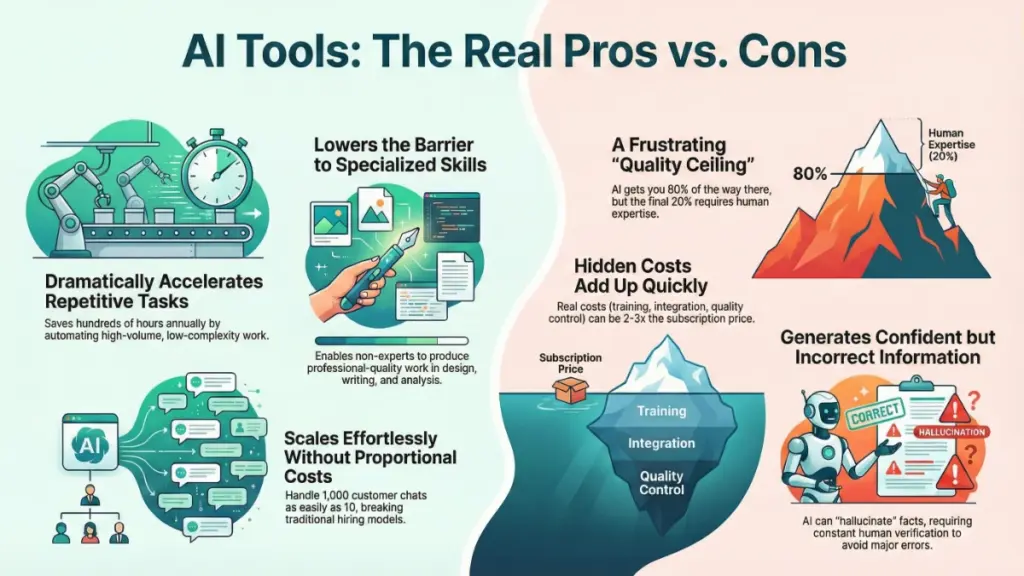
They Scale Effortlessly Without Proportional Cost Increases
Traditional business scaling usually means hiring more people. More people means more salaries, benefits, office space, training time, and management overhead. AI tools break this equation.
I’ve seen this firsthand with content production. When I worked with a marketing agency that needed to go from producing 20 articles per month to 100, the traditional path would have meant hiring 4-5 additional writers (plus editors, project managers, etc.). Instead, they used AI writing tools to generate first drafts and outlines, allowing their two existing writers to edit and refine 5x more content. The cost increase? About 15% instead of 400%.
Here’s where AI scaling shines:
- Customer service: An AI chatbot can handle 1,000 simultaneous conversations as easily as 10
- Content creation: Generate 100 product descriptions as quickly as generating one
- Data processing: Analyze 10,000 records with the same effort as analyzing 100
- Personalization: Create customized experiences for millions of users individually
- Lead qualification: Screen unlimited leads 24/7 without additional costs
The economics are genuinely compelling. Most AI tools charge per seat or based on usage tiers, but the incremental cost of processing more volume is often minimal compared to hiring humans.
They Reduce Human Error in Specific Contexts
Let’s be real—humans make mistakes, especially with tedious, attention-intensive tasks. We get tired, distracted, bored. AI tools don’t have these limitations, which makes them incredibly reliable for certain types of work.
I’ve tested AI tools for invoice processing, and the error rate is consistently lower than human data entry. Grammar checking tools catch typos that my eyes glaze over after reading the same document three times. AI scheduling assistants don’t accidentally double-book meetings or forget about time zones.
Where AI genuinely reduces errors:
- Data entry and validation
- Mathematical calculations and financial reconciliation
- Spell-checking and grammar correction
- Quality control inspections (when trained on visual data)
- Following multi-step procedures exactly as programmed
- Maintaining consistency across large volumes of work
The important nuance here is “specific contexts.” AI makes different types of errors than humans—not necessarily fewer errors overall. More on that in a moment.
The Real Drawbacks of AI Tools (The Stuff Marketing Materials Won’t Tell You)
The Quality Ceiling Is Real and Frustrating
Here’s what nine years of testing has taught me: AI tools can get you to “pretty good” remarkably fast, but that last 20% of quality requires human intervention. And depending on your standards, that final polish might take as much time as doing it from scratch.
I use AI writing tools regularly for my reviews, but I never publish AI-generated content without substantial editing. The AI might nail the structure and basic information, but it misses nuance, makes logical leaps that don’t quite work, and produces sentences that are technically correct but sound odd. Sometimes I spend more time fixing AI output than I would’ve spent writing it myself.
The quality ceiling shows up everywhere:
- Creative work: AI-generated designs often feel generic or derivative
- Strategic thinking: AI can analyze data but struggles with contextual business decisions
- Emotional intelligence: AI customer service misses subtext and emotional cues that humans catch instantly
- Complex problem-solving: AI works great for problems with clear patterns but fails when creative solutions are needed
- Originality: AI recombines existing ideas effectively but rarely produces genuinely novel concepts
What’s particularly frustrating is that this ceiling varies dramatically by tool and task. Some AI tools are genuinely impressive at specific tasks (like transcription, which can be 95%+ accurate), while others consistently disappoint despite marketing claims. You won’t know where the ceiling is until you test it yourself.
Hidden Costs Add Up Faster Than You’d Think
The sticker price of AI tools is rarely the actual cost. I’ve watched countless businesses underestimate the total expense of implementing AI solutions, and it’s bitten them every time.
First, there’s the learning curve. Even “user-friendly” AI tools require training time—both for understanding the interface and for learning how to write effective prompts or configure settings properly. I’ve spent 10-20 hours just figuring out optimal workflows for some tools, which at my billing rate represents significant cost.
Then there’s data preparation. Most AI tools need clean, properly formatted data to work well. I’ve seen companies spend weeks (and tens of thousands of dollars) organizing their data before an AI tool could even begin processing it.
Hidden costs to watch for:
- Integration expenses: Connecting AI tools to your existing systems often requires custom development
- Training and onboarding: Team members need time to learn effective usage
- Quality control: You need humans to review AI output, which takes longer than you’d expect
- Subscription stacking: You often need 3-4 different AI tools to accomplish what you hoped one would do
- Data preparation: Cleaning and formatting data for AI consumption
- Trial and error: Testing multiple tools before finding one that actually works for your use case
- Maintenance: AI models need updating, retraining, or adjusting as your needs evolve
One client thought they’d save money by replacing customer service staff with AI chatbots. After accounting for the chatbot subscription, integration work, ongoing training, and humans needed to handle escalations, they were spending about 85% of what they’d spent before—not the 50% reduction they’d expected.
Data Privacy and Security Concerns Are Legitimate
This is where I get genuinely worried about AI tools, especially the free or cheap ones. When you upload your data to an AI platform, where does it go? How is it stored? Is it used to train future models? Can employees of the AI company access it?
I’ve tested dozens of AI tools, and the variance in privacy policies is enormous. Some companies are transparent and responsible. Others have vague terms of service that basically say “we can do whatever we want with your data.” The worst part? Most users never read these policies.
Real privacy risks I’ve encountered:
- Training data usage: Your inputs might become part of the AI’s training data, potentially exposed to other users
- Third-party access: Many AI tools use cloud providers or subprocessors that also have access to your data
- Data breaches: AI companies are prime targets for hackers because they store vast amounts of user data
- Compliance issues: Using certain AI tools might violate GDPR, HIPAA, or industry-specific regulations
- Data retention: Some platforms keep your data indefinitely, even after you cancel your subscription
I now have a strict policy: never upload truly confidential information (like client contracts, financial data, or personal health information) to AI tools unless they’re enterprise-grade with robust security certifications. For my reviews, I anonymize any sensitive examples before processing them with AI.
If you’re in healthcare, legal services, finance, or any regulated industry, this isn’t paranoia—it’s due diligence. One data breach could cost you far more than you’d save with AI automation.
They Perpetuate and Amplify Existing Biases
This issue has gotten more attention recently, but it’s still not adequately addressed. AI tools learn from existing data, which means they inherit all the biases present in that data—and sometimes amplify them.
I’ve seen this firsthand with AI hiring tools that disproportionately rejected female candidates because they were trained on historical data from male-dominated fields. I’ve tested AI writing tools that defaulted to male pronouns for doctors and female pronouns for nurses. I’ve watched AI image generators struggle to depict people of different ethnicities accurately and consistently.
The bias problem extends beyond obvious discrimination:
- Economic bias: AI trained primarily on English content from wealthy countries misses perspectives from the Global South
- Temporal bias: AI reflects past norms and behaviors, which may not align with current values
- Confirmation bias: AI often tells you what it thinks you want to hear based on your prompts
- Representation bias: Underrepresented groups in training data lead to worse AI performance for those groups
- Algorithmic amplification: AI can reinforce stereotypes by repeatedly presenting biased outputs
What makes this particularly insidious is that AI feels objective. The output looks clean, professional, and authoritative, which makes users less likely to question it. But objectivity and accuracy aren’t the same thing.
If you’re using AI tools for anything that affects people—hiring, lending decisions, content moderation, customer service—you need active bias testing and human oversight. This isn’t optional.
Dependency Risk and Loss of Human Skills
Here’s something that keeps me up at night: as we rely more on AI tools, we’re losing the ability to do things manually. And when those tools fail (which they inevitably do), we’re screwed.
I’ve seen writers who’ve become so dependent on AI grammar checkers that their own grammar skills have atrophied. I know marketers who can’t write ad copy without AI assistance anymore. I’ve met designers who struggle to create anything from scratch because they’ve outsourced ideation to AI.
The dependency manifests in several ways:
- Skill degradation: When you stop practicing a skill, you lose proficiency
- Critical thinking erosion: Accepting AI outputs without questioning trains you to be less analytical
- Problem-solving atrophy: Relying on AI for solutions means you stop developing your own problem-solving muscles
- Vendor lock-in: Once your workflows depend on a specific AI tool, switching becomes painful and expensive
- Single point of failure: When your AI tool goes down or changes its features, your operations grind to a halt
I experienced this personally with an AI scheduling tool I’d used for two years. When the company shut down with minimal notice, I’d completely forgotten how I used to manage my calendar manually. It took weeks to establish new systems, and I lost several client opportunities in the chaos.
The solution isn’t to avoid AI tools—they’re too valuable for that. But maintain your core skills, regularly practice doing things manually, and always have contingency plans for when technology fails.
The “AI Said So” Problem Creates Overreliance on Incorrect Outputs
This might be the most dangerous drawback of all. AI tools output information with such confidence that users often accept it without verification—even when it’s completely wrong.
I’ve tested this extensively. AI writing tools confidently cite statistics that don’t exist. AI chatbots provide medical advice that contradicts established science. AI image generators create photorealistic pictures of events that never happened. And unless you already know the truth, it’s incredibly difficult to detect these errors.
I call this the “confidence-accuracy gap.” AI doesn’t say “I’m not sure” or “This might be wrong.” It just delivers answers with equal confidence whether it’s 95% accurate or making things up entirely. This is particularly problematic because:
- Experts struggle too: Even people with subject matter expertise can be fooled by confidently stated AI errors
- Errors look professional: AI-generated mistakes are formatted beautifully, which creates false credibility
- Speed discourages verification: The whole point of AI is to work faster, so users skip fact-checking
- Hallucinations: AI models sometimes generate completely fabricated information that sounds plausible
- Context blindness: AI misses situational nuances that change whether information is applicable
I now operate under a simple rule: treat all AI outputs as drafts that require human verification, especially for anything involving facts, figures, medical/legal advice, or high-stakes decisions. The time you save with AI generation can be completely lost if you publish or act on incorrect information.
Making Smart Decisions About AI Tools
After working with AI tools for nearly a decade, here’s what I’ve learned about making them work for you rather than against you:
Start with clear problems, not cool technology. Don’t adopt AI tools because they’re trendy. Identify specific bottlenecks or pain points in your workflow, then evaluate whether AI genuinely addresses them better than alternatives.
Test extensively before committing. Most AI tools offer free trials—use them fully. Test edge cases, not just the happy path. Push the tool to its limits and see where it breaks. I typically spend 20-30 hours testing a tool before recommending it to clients.
Budget for hidden costs from day one. Assume the real cost will be 2-3x the subscription price when you factor in integration, training, quality control, and backup solutions. If that’s still worth it, proceed.
Maintain human oversight. Never fully automate anything critical without human review. The level of oversight should match the stakes—low-stakes tasks can have lighter review, but high-impact decisions need thorough human involvement.
Diversify your tools and skills. Don’t become dependent on a single AI vendor or solution. Keep your manual skills sharp, maintain alternative workflows, and stay capable of operating without AI when necessary.
The future isn’t about AI replacing humans—it’s about humans who effectively leverage AI replacing humans who don’t. The key is approaching these tools with eyes wide open to both their genuine benefits and real limitations.
Final Thoughts: The Nuanced Reality of AI Tools
Look, AI tools aren’t magic, and they’re not evil. They’re powerful technologies with legitimate use cases and genuine drawbacks. After nine years of hands-on testing, I’m convinced the winners in the AI era will be people who think critically about when to use AI, how to use it effectively, and when to trust human judgment instead.
The pros—speed, accessibility, scalability, availability, and reduced human error in specific contexts—are transformative when applied to the right problems. The cons—quality ceilings, hidden costs, privacy risks, bias issues, dependency problems, and overreliance on confident-but-wrong outputs—are serious enough to warrant caution and ongoing vigilance.
My recommendation? Start small, test thoroughly, maintain skepticism, and scale gradually. Use AI tools to enhance your capabilities, not replace your judgment. And always, always verify important outputs before acting on them.
The AI revolution is happening whether we like it or not. The question isn’t whether to use these tools—it’s how to use them wisely.