

I still remember the first time I generated an image with DALL-E 2 back in 2022. I typed in something ridiculous like “a cat wearing a business suit giving a presentation to dogs” and waited. Thirty seconds later, I had four surprisingly decent images. I was hooked.
Fast forward to today, and I’ve probably generated thousands of images across both Midjourney and DALL-E. I’ve used them for client projects, social media content, blog headers, and honestly, just for fun when I’m bored on a Tuesday night. Here’s what nobody tells you upfront: these tools are fantastic, but they’re built for completely different types of users—and picking the wrong one will cost you time and money.
In this comparison, I’m going to break down everything I’ve learned from actually using both platforms day-to-day. We’re talking real pricing breakdowns, quality comparisons with actual examples, learning curves, and most importantly—which one makes sense for your specific situation. No fluff, no corporate marketing speak. Just straight talk from someone who’s been in the trenches with both tools.
The Quick Version: Key Differences That Actually Matter
Before we dive deep, here’s what you need to know right away. Midjourney and DALL-E take fundamentally different approaches to AI image generation, and understanding these core differences will save you a lot of headaches.
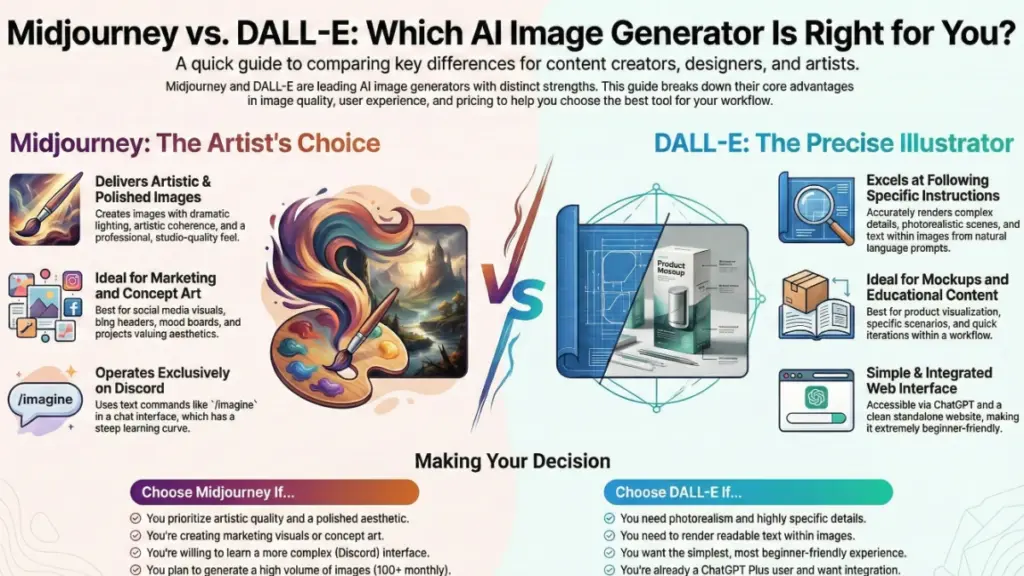
Midjourney lives entirely in Discord, uses a credit-based subscription model, and consistently produces images with an artistic, almost painterly quality that looks polished right out of the gate. It’s beloved by artists, designers, and anyone creating content where aesthetics matter more than pixel-perfect accuracy.
DALL-E (specifically DALL-E 3, which is what we’re talking about here) is integrated into ChatGPT and as a standalone tool, uses a simpler interface, and excels at understanding complex text prompts with specific details. It’s better at following instructions precisely and tends to produce more photorealistic results when you ask for them.
The pricing structure is night and day different. Midjourney charges $10-$120 monthly depending on your plan. DALL-E operates on a per-image credit system through ChatGPT Plus ($20/month gets you integrated access) or you can buy credits separately.
In my experience, Midjourney is the better choice if you’re creating marketing visuals, concept art, or anything where artistic style matters. DALL-E wins when you need specific details rendered accurately, text within images, or you’re already living in the ChatGPT ecosystem.
But let’s get into the specifics, because the devil—as they say—is in the details.
Image Quality: Where Each Tool Actually Shines
Here’s where things get interesting, and where I’ve changed my opinion over the past year. When Midjourney first dominated the scene in late 2022, it was the clear winner for pure aesthetic quality. DALL-E 2 images often looked a bit… off. Uncanny valley territory.
Then DALL-E 3 launched in late 2023, and the gap narrowed significantly.
Midjourney’s Strength: Artistic Coherence
Midjourney V6 (the current version as of this writing) produces images with incredible artistic consistency. When I generate a series of images for a client’s brand identity, Midjourney maintains a cohesive style that feels intentional. The lighting is dramatic, the compositions follow classical art principles, and there’s this polish that makes everything look like it came from a professional studio.
Last month, I was creating header images for a luxury travel blog. I used Midjourney with prompts like “elegant woman in flowing dress on santorini cliffside, golden hour, cinematic –ar 16:9 –v 6”. The results were stunning—looked like something straight out of a high-end travel magazine. The skin tones were natural, the fabric physics made sense, and the overall mood was exactly what I needed.
The downside? Midjourney can be stubborn about certain details. Try to get it to render specific text on a sign or a particular brand logo, and you’ll pull your hair out. It’s also prone to adding its own “artistic interpretation” even when you don’t want it. I’ve had projects where I needed something straightforward and simple, and Midjourney kept giving me dramatic lighting and complex compositions.
DALL-E’s Strength: Instruction Following and Realism
DALL-E 3 is remarkably good at understanding what you’re actually asking for. This is where OpenAI’s language model expertise really shows. You can write a detailed paragraph describing exactly what you want, and DALL-E will try its hardest to give you that specific thing.
I was helping a client create educational content about historical events, and we needed an image showing “a 1920s newspaper office with three journalists at typewriters, one woman and two men, art deco interior, warm lighting from desk lamps, papers scattered on desks”. DALL-E nailed it on the second try. The composition matched the description almost perfectly, and the historical accuracy was impressive.
DALL-E is also significantly better with text rendering. Not perfect—AI-generated text is still wonky about 40% of the time—but it’s leagues ahead of Midjourney. When you need a mock-up of a book cover or a poster with readable text, DALL-E is your better bet.
The photorealism in DALL-E 3 is exceptional when you specifically ask for it. Product photography, realistic portraits, architectural visualization—these are areas where DALL-E consistently delivers results that look like they came from a camera rather than a paintbrush.
However, DALL-E images can sometimes feel a bit… sterile? They lack the artistic “wow factor” that Midjourney brings. When I generate the same prompt in both tools, Midjourney’s version usually looks more interesting, even if DALL-E’s is more accurate.
User Experience: Discord vs. Web Interface
This is honestly where many people make their decision, and I completely get it. The platform experience is wildly different.
Midjourney’s Discord Setup: Love It or Hate It
Midjourney requires Discord, which feels bizarre if you’ve never used Discord before. You’re essentially generating images in a chat server alongside thousands of other users. When I first started, I found this absolutely chaotic. Public channels scroll by with hundreds of other people’s generations, making it hard to find your own work.
Here’s what I’ve learned: you need to use Direct Messages with the Midjourney bot. This creates a private space where only your generations appear. But even this has a learning curve. You type commands like /imagine prompt: your description here and then add parameters like --ar 16:9 for aspect ratio or --v 6 for version selection.
The upside? Once you get comfortable with it (took me about two weeks of regular use), the Discord interface is actually quite powerful. You can easily upscale images, create variations, use images as references for style, and the community aspect can be inspiring. I’ve gotten great ideas just by browsing what others are creating.
The downside is obvious: it’s clunky for non-technical users. I’ve recommended Midjourney to creative friends who gave up after 20 minutes because the Discord barrier was too high. It’s also harder to integrate into existing workflows. Want to generate an image and immediately use it in your design software? You’re downloading from Discord, which adds extra steps.
DALL-E’s Streamlined Experience
DALL-E through ChatGPT is beautifully simple. You’re already in a conversation, you describe what you want, and images appear. No special commands to memorize, no separate platform to learn. For someone just dipping their toes into AI image generation, this is dramatically more approachable.
The standalone DALL-E interface (labs.openai.com) is clean and minimalist. You type your prompt, hit generate, and wait. You can edit images, create variations, and download—all in a straightforward web interface that feels like any other modern web app.
What I appreciate most is the integration with ChatGPT. I can have a conversation about what I’m trying to create, refine the concept, and generate images without switching contexts. Last week, I was working on a presentation and needed three specific images. I described the overall theme to ChatGPT, it helped me refine the visual style, and then generated all three images in the same conversation. That workflow is genuinely convenient.
The limitation? Less control over advanced parameters. Midjourney lets you fine-tune dozens of settings. DALL-E is more of a “describe what you want and trust the AI” experience. For quick projects, this is perfect. For detailed artistic work where you want precise control, it can feel limiting.
Pricing Reality: What You’ll Actually Spend
Let me be completely transparent about costs, because this is where a lot of people get surprised.
Midjourney Subscription Tiers
Midjourney has four plans:
- Basic ($10/month): ~200 image generations in fast mode
- Standard ($30/month): ~900 generations, plus 15 hours of “relaxed” unlimited mode
- Pro ($60/month): ~1800 generations, 30 hours relaxed mode, stealth mode (hide your images)
- Mega ($120/month): ~3600 generations, 60 hours relaxed mode
Here’s what this actually means in practice. Fast mode gives you images in 30-90 seconds. Relaxed mode is “unlimited” but you’re in a queue and might wait 5-10 minutes per image. I find relaxed mode frustrating when I’m actively working on a project.
I’m on the Standard plan ($30/month), and I hit my limits about once every two months when I have multiple client projects. For most content creators posting to social media regularly, the Basic plan at $10 is probably enough. For agencies or designers doing this professionally, you’ll want Pro or Mega.
One thing that burned me early: there’s no refund on unused generations. They don’t roll over month-to-month. If you pay for 900 generations and use 300, those 600 are gone. I learned to time my subscription around busy project periods.
DALL-E Credit System
DALL-E 3 pricing is… complicated. If you have ChatGPT Plus ($20/month), you get DALL-E 3 integrated with some usage limits. I’ve found I can generate maybe 40-50 images before hitting daily limits, though OpenAI isn’t super transparent about the exact numbers.
You can also buy credits separately for the standalone DALL-E tool. Pricing is around $15 for 115 credits, where each image generation costs 1 credit (standard quality) or more for HD quality. This works out to roughly $0.13-$0.27 per image.
For casual users, the ChatGPT Plus inclusion is the better deal. You’re paying $20 anyway for ChatGPT, and the image generation is a bonus. For heavy users, the costs can stack up quickly compared to Midjourney’s unlimited relaxed mode.
Real Cost Comparison
Let me give you a concrete example from my own usage. Last month, I generated approximately 150 images across both platforms:
- Midjourney: $30 subscription (would have stayed within Standard plan limits)
- DALL-E: Would have cost $20-$40 depending on quality settings
For professional use with 500+ images monthly, Midjourney becomes significantly cheaper. For occasional use (20-30 images per month), DALL-E through ChatGPT Plus makes more financial sense, especially if you’re already using ChatGPT for writing tasks.
Prompt Engineering: How Hard Is It Really?
This is where experience matters, and where I’ve seen the biggest difference between beginners and advanced users.
Midjourney Prompting: Art Direction Language
Midjourney rewards you for thinking like an art director. You’ll get better results by including style references, artistic movements, technical photography terms, and specific artistic attributes.
A basic prompt like “a dog in a park” gives you okay results. But a refined prompt like “golden retriever in central park, autumn morning, soft diffused light, shot on 85mm lens, shallow depth of field, warm color grading, national geographic style –ar 3:2 –v 6” gives you dramatically better results.
I keep a swipe file of effective Midjourney terms: “volumetric lighting,” “bokeh,” “rule of thirds,” “complementary colors,” “cinematic composition.” These aren’t just buzzwords—they genuinely improve output quality. It took me probably 3-4 months of regular use to build a vocabulary that consistently produced great results.
The parameter system adds complexity. --ar controls aspect ratio, --stylize affects how much artistic interpretation to apply, --chaos introduces variation. You’ll need to learn these, but they’re powerful once you do.
DALL-E Prompting: Natural Language
DALL-E is more forgiving for beginners. You can literally describe what you want in plain English, and it makes a solid attempt. The underlying GPT-4 model helps interpret your intent even when your prompt isn’t perfectly structured.
I can type “create a cozy coffee shop interior with plants hanging from the ceiling, warm lighting, someone reading a book by the window, rainy day outside” and get something pretty close to what I imagined. No technical jargon required.
However, DALL-E still benefits from detailed prompts. Being specific about colors, mood, composition, and style helps. The difference is that you’re not penalized as much for casual language.
One advantage: you can have a back-and-forth conversation with ChatGPT to refine your prompt before generating. I often start with “I want to create an image of X for Y purpose, what details should I include in my prompt?” ChatGPT helps me think through the description, and then we generate. This collaborative approach significantly improves results.
Real-World Use Cases: Which Tool For What?
After two years with both platforms, here’s my honest breakdown of when I reach for each tool.
When I Use Midjourney:
- Marketing visuals for social media (Instagram posts, Pinterest pins)
- Blog header images where aesthetic quality matters most
- Concept art and creative exploration
- Brand identity work and mood boards
- Any project where “artistic” and “polished” are priorities
- Creating a series of images with consistent style
When I Use DALL-E:
- Product mockups and visualization
- Educational content with specific details
- Quick iterations during brainstorming sessions
- Anything requiring text within the image
- Photorealistic scenarios
- When I’m already working in ChatGPT and need an image without switching platforms
Where Both Struggle:
- Hands and complex human anatomy (both still mess this up regularly)
- Precise brand logos or existing characters
- Complex scenes with many specific objects
- Anything requiring legal precision or trademark accuracy
Honestly, I use both in my workflow. They complement each other. I’ll often generate concept art in Midjourney for client approval, then use DALL-E for more specific, detailed versions once we’ve locked in the direction.
The Learning Curve: What to Expect
Let me set realistic expectations based on my experience and watching others learn these tools.
Midjourney: Expect 2-3 weeks to feel comfortable, and 2-3 months to feel proficient. The Discord barrier is real, and learning the command syntax takes time. You’ll generate a lot of mediocre images before you start consistently getting good results. I’ve seen people give up after a week, and I’ve seen people master it in a month. It depends on how much time you invest.
The community resources help tremendously. The Midjourney Discord has channels full of prompt examples, and there are countless YouTube tutorials. I spent probably 10 hours just watching tutorials in my first month.
DALL-E: You can be productive on day one. Seriously. The learning curve is minimal for basic use. Mastering it to get consistently excellent results takes maybe 2-4 weeks of regular use. The natural language interface means you can start getting decent results immediately, then refine your approach over time.
Integration and Workflow Considerations
This is practical stuff that matters if you’re using these tools professionally.
Midjourney Export and Usage: All images are downloadable in high resolution. Commercial usage is included in all paid plans (Basic and up), but you need to understand the licensing. Images aren’t exclusive—others could theoretically generate something similar. For client work, I always disclose that we’re using AI-generated imagery.
The biggest workflow pain point is getting images out of Discord. It’s workable but adds friction. I’ve built a system where I immediately download images to a project-specific folder, but it requires discipline.
DALL-E Integration: Images download easily from both ChatGPT and the standalone interface. The ChatGPT integration is genuinely valuable if you’re already using it for writing—you can go from article draft to custom header image without leaving the platform.
Commercial use is explicitly allowed under OpenAI’s terms. Same caveat about exclusivity applies.
Common Frustrations and How to Handle Them
Let me save you some headaches by sharing issues I’ve encountered and how to work around them.
Midjourney Frustrations:
- Inconsistent results: Even with identical prompts, you get different outputs. Use the seed parameter (
--seed 12345) when you want variations on a specific result - Discord overwhelm: Set up your Direct Messages immediately, ignore public channels
- Generation limits: Plan your usage, don’t generate aimlessly
- Customer support: Essentially non-existent. The community is your support system
DALL-E Frustrations:
- Daily limits: Hit them faster than you expect, especially with ChatGPT Plus integration
- Content policy blocks: DALL-E is more restrictive about what it won’t generate
- Less control: Can’t fine-tune as many parameters
- Occasional overload errors: The service gets busy, especially during peak hours
Universal AI Image Issues: Both tools sometimes refuse reasonable requests due to content policies. Both occasionally produce nonsensical results. Both require multiple generations to get exactly what you want. Set your expectations accordingly—plan for 3-5 generations per concept, not one perfect shot.
Making Your Decision: The Framework I Use
When someone asks me “which should I choose?”, I walk them through these questions:
Choose Midjourney if:
- You prioritize artistic quality and aesthetics
- You’re creating content for visual platforms (Instagram, Pinterest, portfolios)
- You’ll generate 100+ images monthly
- You’re willing to invest time learning a more complex tool
- You don’t mind using Discord
- You want consistent artistic style across multiple images
Choose DALL-E if:
- You need photorealistic or highly specific results
- You’re already using ChatGPT and want integration
- You generate fewer than 50 images monthly
- You want the simplest possible learning curve
- You need text rendered within images
- You value workflow convenience over ultimate quality
Consider using both if:
- You’re doing professional creative work
- Budget allows for $40-50/month across both platforms
- You want the best tool for each specific use case
- You’re producing diverse content types
I’m in the “both” camp. Midjourney is my primary tool for social media content and marketing visuals. DALL-E is my go-to for quick iterations, specific requests, and anything I’m generating while already working in ChatGPT.
My Honest Take After Two Years
Look, both of these tools are genuinely impressive pieces of technology. We’re living in a wild time where I can describe an image in text and get something usable in under a minute. That’s incredible.
But here’s the reality nobody wants to say outright: neither tool is perfect for everything, and you’ll still need human creative judgment. AI image generation is a tool, not a replacement for creative thinking. The people getting the best results are those who understand design principles, composition, and visual storytelling—and use AI to execute their vision faster.
Midjourney remains my favorite for pure image quality and artistic expression. When I want something that looks good, I go to Midjourney first. The Discord friction is annoying but manageable once you’re past the initial learning curve.
DALL-E has grown on me significantly over the past year. DALL-E 3 closed the quality gap enough that I now recommend it to beginners without hesitation. The ChatGPT integration is genuinely useful in my daily workflow.
If you forced me to choose only one? For professional creative work, I’d choose Midjourney. For casual use or if I’m on a tight budget, DALL-E through ChatGPT Plus. For optimal results, honestly, use both strategically.
The landscape is also evolving rapidly. New versions launch constantly, and features change. What’s true today might shift in six months. Stay flexible, keep experimenting, and remember that the tool is just the tool—your creative vision is what actually matters.
Frequently Asked Questions
Can I use images from Midjourney and DALL-E commercially? Yes, both platforms allow commercial use on paid plans. Midjourney requires Basic subscription or higher. DALL-E allows commercial use of generated images. However, always review current terms of service as policies can change.
Which is better for beginners? DALL-E is significantly more beginner-friendly due to its natural language interface and simple web-based access. Midjourney’s Discord requirement and command syntax create a steeper learning curve.
How much does it really cost per month? Midjourney ranges from $10-$120/month for subscriptions. DALL-E costs $20/month through ChatGPT Plus for integrated access, or roughly $15 for 115 credits (about $0.13-$0.27 per image) when buying separately.
Can these tools create images of real people? Both have restrictions on generating images of real public figures or identifiable people. DALL-E is generally more restrictive about faces and people overall due to content policy considerations.
What’s the image resolution and quality? Both generate high-quality images suitable for web use and print. Midjourney defaults to around 1024×1024 or higher depending on aspect ratio. DALL-E generates 1024×1024 standard or 1792×1024 HD. Both are sufficient for most professional uses.