


I’ll be honest with you—starting a SaaS product reviews blog in 2026 isn’t the easiest path to online income. I’ve been reviewing marketing and AI tools for the past four years, and the landscape has changed dramatically since I published my first clunky comparison post back in 2021. But here’s what surprised me: despite the competition and the challenges, a well-executed SaaS reviews blog can still be incredibly valuable (and profitable) if you approach it the right way.
In this guide, I’m going to walk you through everything I’ve learned from building my own reviews site, testing over 150+ tools, and yes—making plenty of mistakes along the way. Whether you’re a marketer looking to build authority, a developer who wants to monetize your product knowledge, or just someone who’s genuinely passionate about helping others find the right software, this article will give you the practical roadmap you need.
Why SaaS Product Reviews Blogs Still Work (Despite What You’ve Heard)
Look, I get it. You’ve probably heard that affiliate marketing is saturated, that AI is going to automate everything, or that nobody trusts reviews anymore. And there’s some truth to all of that. But here’s the reality I’ve seen firsthand: people are more overwhelmed by software choices than ever before.
Last month alone, I helped three different clients choose between project management tools. Each of them had spent hours researching, reading generic “Top 10” listicles that all recommended the same five tools, and they were more confused than when they started. What they actually needed was someone who’d used these tools in real work scenarios and could explain the nuanced differences that matter.
That’s the opportunity. The SaaS market is projected to hit $232 billion in 2024, with over 30,000 SaaS companies operating globally. Every single one of those companies has potential customers who are trying to figure out if the tool is right for them. Your job isn’t to convince them to buy—it’s to give them the information they actually need to make a smart decision.
Here’s what makes SaaS reviews particularly attractive:
- High-value affiliate commissions: Many B2B SaaS tools offer 20-30% recurring commissions, not just one-time payments
- Long decision cycles: People spend weeks researching before buying, which means they’ll read multiple articles (yours included)
- Evergreen content potential: A well-written review can generate traffic and income for years
- Authority building: Become known as the go-to expert in your niche
- Multiple monetization options: Affiliates, sponsorships, consulting, your own products
But—and this is important—you can’t just spin up generic AI-written reviews and expect to succeed. Google’s helpful content updates have decimated low-quality review sites. The ones that survive (and thrive) demonstrate real experience and provide genuine value.
Choosing Your Niche: Why “SaaS Reviews” Is Way Too Broad
This is where most people mess up, and honestly, it’s where I messed up too. My first attempt at a reviews blog tried to cover “all marketing tools.” Six months in, I was exhausted, my traffic was mediocre, and I had no real authority in any specific area.
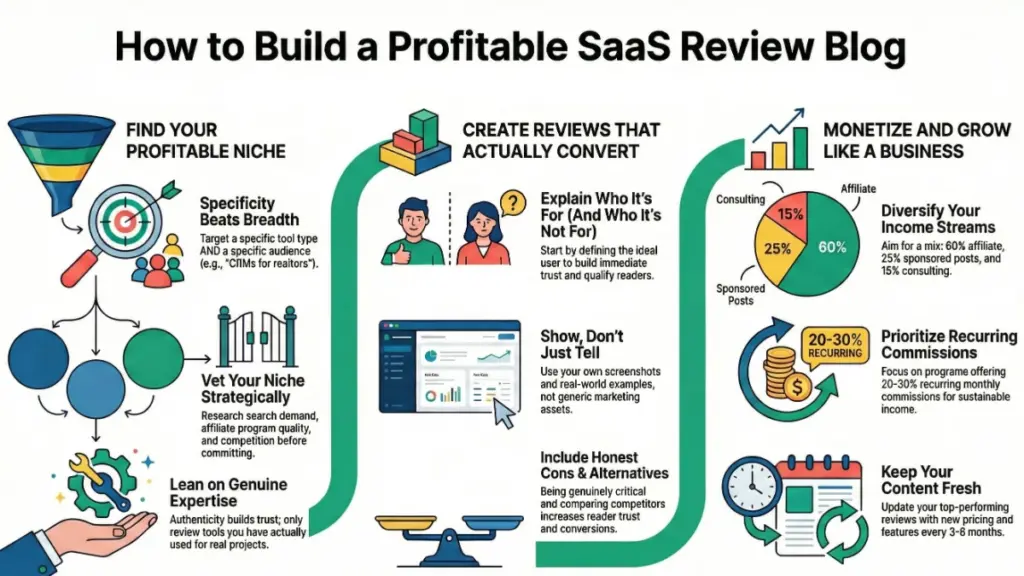
Here’s what I learned: specificity beats breadth every single time.
Instead of “SaaS product reviews,” you need to narrow down to something like:
- AI writing tools for content marketers
- CRM systems for real estate agencies
- Project management software for creative agencies
- Email marketing platforms for e-commerce stores
- Accounting software for freelancers and solopreneurs
Notice how each of these targets a specific type of tool AND a specific audience? That’s the sweet spot. When I relaunched my blog focusing specifically on AI tools for digital marketers, everything changed. My content ranked faster, my audience was more engaged, and brands actually started reaching out to me.
How to choose your niche strategically:
- Match your genuine expertise: What tools have you actually used extensively? What industry do you understand? Authenticity shows through in your writing, and readers can spot a faker from a mile away.
- Research commercial intent: Use tools like Ahrefs or Semrush to check if people are actually searching for “[tool name] review” or “[tool type] comparison.” If nobody’s searching, nobody’s buying.
- Check affiliate program quality: Not all SaaS companies have affiliate programs, and not all programs are worth your time. I’ve promoted tools with 5% one-time commissions and tools with 30% recurring commissions—the math isn’t even close.
- Evaluate competition realistically: Can you compete with established sites? Look at who’s ranking on page one. If it’s all huge review sites with Domain Authority 70+, you might need a more specific angle.
- Consider your growth path: Can you expand within this niche? My AI tools niche lets me branch into related categories without losing focus.
A quick reality check: you won’t rank for “best CRM software” in your first year unless you have a massive SEO budget. But “best CRM for insurance agents” or “ActiveCampaign vs HubSpot for consultants”? Those are absolutely achievable.
Setting Up Your Reviews Blog: The Technical Foundation
I’m not going to bore you with basic WordPress tutorials—there are thousands of those. But I will share the specific technical decisions that matter for a SaaS reviews blog.
Platform choice: I use WordPress with the Kadence theme, and here’s why. WordPress gives you complete control, excellent SEO plugins (I use Rank Math), and the flexibility to add comparison tables, review schemas, and affiliate link management. Yes, platforms like Webflow look prettier, but WordPress is battle-tested for this exact use case.
Essential plugins for reviews blogs:
- Rank Math or Yoast SEO: For basic on-page optimization (I prefer Rank Math’s interface)
- Pretty Links: To manage and cloak affiliate links cleanly
- TablePress: For creating comparison tables that readers actually use
- Schema Pro: To add proper review schema markup (helps with rich snippets)
- WP Rocket: Because page speed matters, especially on content-heavy review posts
Here’s something I wish someone had told me early: invest in proper hosting from day one. I started with a $5/month shared hosting plan, and my site was so slow that my bounce rate was ridiculous. When I moved to WP Engine (about $30/month), my rankings actually improved because page speed is a ranking factor. If that’s too pricey, Cloudways or SiteGround’s business plan are solid middle-ground options.
Design considerations specific to reviews:
- Clean, scannable layouts with plenty of white space
- Prominent but not obnoxious affiliate buttons (I use a subtle color scheme that stands out without screaming “BUY NOW”)
- Sticky sidebar with a quick comparison table or key takeaways
- Mobile-first design (over 60% of my traffic is mobile)
- Fast-loading images (I compress everything with ShortPixel)
One thing that’s worked surprisingly well for me: I have a standardized review template that includes the same sections for every tool. This creates consistency, makes writing faster, and helps readers navigate my content. They know exactly where to find pricing information or pros/cons lists.
Creating Reviews That Actually Help (And Rank)
This is where the rubber meets the road. I’ve written probably 100+ tool reviews at this point, and I can tell you exactly what separates a helpful review from generic SEO fluff.
The anatomy of a great SaaS review:
1. Who it’s for (and who it’s NOT for) – Start here. Not every tool works for everyone, and being upfront about this builds trust immediately. I typically open with something like: “If you’re a solo content creator on a tight budget, this might not be your best option. But if you’re running a team of 5+ writers and need consistent brand voice across all content, keep reading.”
2. Real-world use cases with specific examples – Don’t just say “great for content marketing.” Tell them exactly how you used it: “Last month, I used this to generate 25 blog outlines for a client in the SaaS space. The process took about 2 hours instead of the usual 6-8 hours I’d spend brainstorming manually.”
3. Honest pros AND cons – Here’s where most affiliate reviews fail. They list 10 pros and maybe 2 minor cons that don’t really matter. Be genuinely critical. I’ve pointed out clunky interfaces, missing features, and frustrating limitations in tools I actively promote. Guess what? My conversion rates went UP because readers trust that I’m being straight with them.
4. Pricing breakdown with context – Don’t just copy the pricing page. Explain what you actually get at each tier and who each tier makes sense for. I include screenshots of the pricing page and break down the math: “At $99/month, you’re paying about $3.30 per day. If it saves you even one hour per week, that’s a no-brainer ROI.”
5. Comparison with alternatives – Nobody evaluates tools in a vacuum. I always include a section comparing the tool to 2-3 main competitors. This is where you can naturally link to your other reviews and create a content web that keeps people on your site.
6. Setup and onboarding experience – How easy is it to actually get started? I walk through the signup process, initial configuration, and any gotchas I encountered. This is practical information that readers genuinely need.
7. Screenshots and screen recordings – Words only go so far. I include 5-10 annotated screenshots in every review showing actual features, the interface, and specific workflows. Take your own screenshots—don’t just use the company’s marketing images.
8. Final verdict with specific recommendations – End with crystal-clear guidance. I use a format like: “Buy if you [specific scenario]. Skip if you [specific scenario]. Consider [alternative] instead if [specific condition].”
What makes your review different from AI-generated content:
I’ve experimented with AI-written reviews (of course I have—I review AI tools). Here’s the thing: AI can create a decent outline and even okay first drafts, but it can’t replicate genuine experience. The reviews that perform best for me include:
- Specific metrics from my own use (“increased my content output by roughly 40%”)
- Unexpected discoveries (“what surprised me most was how much better the Chrome extension was than the main app”)
- Honest frustrations (“the first time I tried to set up automation, I spent 30 minutes confused before finding the hidden settings menu”)
- Workarounds and tips (“here’s a trick I discovered: if you [specific action], you can [specific benefit]”)
- Personal preferences explained (“I prefer this over [competitor] because [specific reason], but that’s subjective”)
These human touches can’t be automated, and they’re exactly what readers are looking for in a sea of generic content.
The SEO Strategy That Works for Reviews in 2026
Let me share something that changed everything for me: stop chasing high-volume keywords and start targeting high-intent, specific queries.
When I was trying to rank for “best email marketing software,” I was competing with every major marketing blog on the internet. My article sat on page 4 for months. But when I wrote “ConvertKit vs Mailchimp for course creators” and “ActiveCampaign automation for ecommerce stores,” those articles hit page 1 within weeks.
The keyword strategy I use now:
- Tool name + review – “Jasper AI review,” “Copy.ai review” (these can be competitive but are worth targeting)
- Tool name + alternative – “Jasper AI alternative,” “cheaper alternative to Copy.ai” (often less competitive, high buyer intent)
- Tool vs Tool comparisons – “Jasper vs Copy.ai,” “ChatGPT vs Claude for marketing” (these convert incredibly well)
- Use case specific searches – “best AI writing tool for blog posts,” “AI content generator for SEO articles”
- Feature-specific queries – “AI tools with plagiarism checker,” “content generators with SEO optimization”
- Problem-solution keywords – “how to write faster with AI,” “automate content creation for marketing”
I use a mix of Ahrefs for keyword research and actual Google searches to see what real people are asking. The “People Also Ask” boxes and related searches at the bottom of Google SERPs are goldmines for content ideas.
Internal linking strategy: This is huge and often overlooked. Every review should link to:
- Related tool comparisons
- Alternative tool reviews
- Broader category guides
- Specific how-to articles about using those tools
I have a spreadsheet tracking my internal links to make sure I’m building topical authority around each tool category.
Content update schedule: Google loves fresh content. I update my top-performing reviews every 3-6 months with:
- New pricing information
- Recently added features
- Updated screenshots
- Fresh examples and use cases
- New comparison data
I literally have a calendar reminder for this. Takes me about 30-45 minutes per article, and I’ve seen rankings jump simply from updating publish dates and adding new information.
Monetization: Beyond Basic Affiliate Links
Here’s where things get interesting. Most people start a SaaS reviews blog thinking “I’ll just add affiliate links and make passive income.” That works, but you’re leaving money on the table if that’s your only strategy.
My current revenue breakdown (I’m sharing this to give you realistic expectations):
- Affiliate commissions: About 60% of income
- Sponsored reviews: About 25% of income
- Consulting and services: About 10% of income
- Ad revenue: About 5% (I use Mediavine, but ad revenue is honestly not great for B2B niches)
Affiliate programs I actually use:
I’m picky about affiliate programs now after promoting some tools with terrible tracking and low conversion rates. Here are the programs that actually perform well:
- Impact – Aggregates lots of SaaS affiliate programs in one place
- PartnerStack – Similar to Impact, lots of B2B SaaS companies
- Direct affiliate programs – Tools like Jasper, Copy.ai, Surfer SEO all have their own programs
- AppSumo – Lower commissions but high conversion rates because of the deals
Commission structures to prioritize:
- Recurring monthly commissions (20-30% every month the customer stays subscribed)
- Annual upfront commissions (sometimes 100%+ of first year value)
- Tiered commissions (higher rates as you drive more sales)
Avoid: One-time 10% commissions on low-priced products. The math just doesn’t work unless you’re driving massive volume.
Sponsored review strategy: Once I hit about 10K monthly visitors, SaaS companies started reaching out about sponsored reviews. Here’s my approach:
- I only review tools I’d actually recommend (I’ve turned down probably 30% of offers)
- I clearly disclose sponsorships (both for FTC compliance and reader trust)
- I still include honest cons and limitations (non-negotiable)
- I charge $500-2,000 per sponsored review depending on my traffic to that category
- I include the sponsored review in my regular content calendar and promote it like any other article
The key is maintaining editorial integrity. I’ve had companies push back on criticism, and I’ve refused to remove it. One company actually asked me to take down a review because I called out a significant limitation. I didn’t, and you know what? Readers appreciated the honesty and my affiliate conversions for competing tools actually increased.
Building Authority and Growing Your Audience
Traffic doesn’t magically appear just because you published great content. I learned this the painful way after spending months writing articles that got maybe 20 visits each.
Distribution strategies that actually work:
1. Strategic guest posting: I write for larger marketing blogs and always include a relevant link back to one of my detailed reviews. This builds backlinks AND brings targeted traffic. In the past year, about 15 guest posts have driven thousands of visitors to my site.
2. Tool comparison databases: I submitted my comparison articles to sites like AlternativeTo, Capterra, and G2. Some allow you to link back to your content, and they rank well on their own, driving referral traffic.
3. Social media (but strategically): I’m not trying to go viral on Twitter. Instead, I:
- Share practical tips and insights on LinkedIn where decision-makers actually are
- Join specific Facebook groups and Slack communities where my target audience hangs out
- Answer questions on Reddit authentically (without spamming links)
- Create short-form video content on YouTube showing actual tool interfaces and workflows
4. Email list building: This took me way too long to implement. Now I have a simple lead magnet: “The Ultimate SaaS Tool Comparison Checklist” that I offer throughout my site. My list of 2,500 subscribers drives about 15-20% of my monthly traffic through newsletters featuring updated reviews and new comparisons.
5. Relationship building with SaaS companies: I reached out to marketing teams at tools I review, shared my articles with them (even critical ones), and built genuine relationships. Some have featured my reviews in their newsletters, sent my content to prospects, and even helped me get early access to new features for exclusive reviews.
The authority-building content mix I aim for:
- 60% – In-depth individual tool reviews
- 20% – Head-to-head comparisons
- 10% – Broader “best of” category guides
- 10% – How-to guides and tutorials for using these tools
This mix helps me rank for various keyword types while establishing genuine expertise.
Common Mistakes to Avoid (I’ve Made Most of These)
Let me save you some pain by sharing what didn’t work for me:
1. Reviewing tools I’ve never actually used: Early on, I wrote a few reviews based on free trials and demos. Readers could tell. My engagement metrics were terrible, and I felt like a fraud. Now I only review tools I’ve used for real projects over at least 2-4 weeks.
2. Accepting every affiliate offer: I promoted some truly mediocre tools just because they had good commission rates. This hurt my credibility more than the commissions were worth. Now I’m ruthlessly selective.
3. Ignoring mobile optimization: When I finally looked at my mobile experience, I was horrified. Comparison tables were unreadable, images were slow to load, and my affiliate buttons were tiny. Fixing this increased my mobile conversion rate by about 35%.
4. Not diversifying traffic sources: I relied almost entirely on Google for traffic. When one of my top articles dropped from position 2 to position 8 after an algorithm update, my income dropped 40% that month. Now I’m much more focused on building email lists and other traffic sources.
5. Writing for SEO instead of readers: My early articles were keyword-stuffed disasters. They ranked okay but nobody actually enjoyed reading them (high bounce rates told that story). When I started writing naturally and just ensuring keywords were present, everything improved.
6. Not tracking what actually converts: For months, I had no idea which articles were driving affiliate sales. When I finally set up proper tracking, I discovered that three articles were responsible for 70% of my affiliate income. Guess which articles I updated first and promoted most?
The Timeline: What to Actually Expect
I want to set realistic expectations because most content about starting blogs wildly oversells the timeline.
Month 1-3: You’re building foundation. Writing your first 15-20 articles, figuring out your voice, setting up technical infrastructure. Expect maybe 100-500 visits per month. Maybe $0-50 in affiliate commissions if you’re lucky.
Month 4-6: Your content is starting to rank for less competitive keywords. You might hit 1,000-2,000 visits per month. Affiliate income could be $100-300/month if you’re targeting the right keywords. This is where most people quit because the results don’t match the effort yet.
Month 7-12: This is where things start clicking. Some articles hit page one, you’re getting consistent organic traffic (3,000-8,000 visits per month if you’ve been consistent). Affiliate income might reach $500-1,500/month. You’re starting to get inbound sponsorship requests.
Year 2+: Compound growth kicks in. Your older articles are ranking better, you’ve built authority, and you’re known in your niche. Traffic can reach 10,000-30,000+ monthly visits depending on your niche. Affiliate income can hit $2,000-10,000+/month. Sponsorships and other opportunities become regular.
My site took about 8 months before I made more than $500 in a month. Frustrating? Absolutely. But I kept at it because I genuinely enjoyed the work and believed in the value I was providing.
The Real Talk: Is This Worth It?
Starting a SaaS product reviews blog in 2026 is not a get-rich-quick scheme. It’s also not as saturated as some people claim, especially if you pick the right niche and provide genuine value.
Here’s my honest assessment after four years doing this:
You should start a SaaS reviews blog if:
- You genuinely use and understand software tools in a specific category
- You enjoy detailed research and testing
- You’re willing to commit to at least 12-18 months of consistent content creation before seeing significant income
- You can handle algorithm updates and traffic fluctuations without panicking
- You’re comfortable with the technical side of running a website or willing to learn
Skip this if:
- You’re looking for passive income with minimal effort (doesn’t exist)
- You don’t actually use the tools you’d be reviewing (readers can tell)
- You’re not willing to invest in learning SEO and content marketing
- You need income in the next 3-6 months to pay bills (this is not that)
For me, building my SaaS reviews blog has been one of the most rewarding projects I’ve taken on. It generates consistent income, has opened doors to consulting opportunities, and has positioned me as an authority in my niche. The income isn’t quite “quit your day job” level yet (though it’s getting close), but combined with my consulting work, it’s created real financial freedom and flexibility.
The key is approaching it with the right expectations and a genuine desire to help people make better software decisions. If you can do that consistently for a year or two, you’ll build something valuable—both for your audience and for yourself.