


I’ve been diving into Reddit threads about AI software for the past four years, and honestly? It’s become one of my go-to research methods before recommending any tool to clients. There’s something raw and unfiltered about Reddit discussions that you just don’t get from polished review sites or carefully managed testimonials. But here’s the thing—navigating Reddit for AI software reviews requires knowing where to look and how to separate genuine insights from noise.
Let me walk you through exactly how I use Reddit to research AI tools, which communities actually provide valuable feedback, and what red flags to watch for. Whether you’re evaluating ChatGPT alternatives, looking into AI writing assistants, or trying to figure out if that shiny new AI tool is worth the investment, this guide will help you make smarter decisions based on real user experiences.
Why Reddit Has Become Essential for AI Software Research
In my experience testing over 150 marketing and AI tools, I’ve learned that official reviews often miss critical details. A tool might look perfect in a demo video, but then you discover it crashes when processing large files—something three Redditors mentioned in a thread six months ago.
Reddit discussions reveal what companies don’t advertise: the friction points, the hidden costs, the features that sound great but barely work in practice. Last month, I was evaluating an AI content tool that had glowing reviews on G2 and Capterra. Ten minutes on Reddit showed me that their API had been unreliable for weeks and customer support was ghosting people. That saved me and my client about $3,000 in wasted subscription fees.
What makes Reddit valuable for AI software reviews:
- Unfiltered opinions: People share frustrations they’d never post on LinkedIn or company review sites
- Real-world use cases: You’ll find detailed breakdowns of how tools perform in actual workflows, not controlled demos
- Active communities: Many subreddits discuss AI tools daily, so information is current
- Comparison discussions: Redditors love debating “Tool A vs Tool B,” which gives you multiple perspectives quickly
- Technical depth: You’ll often find developers and power users who understand the underlying technology and limitations
The challenge isn’t finding opinions on Reddit—it’s finding good ones. Not every comment is equally valuable, and some threads devolve into arguments or outdated information. That’s where knowing the right communities and evaluation methods becomes crucial.
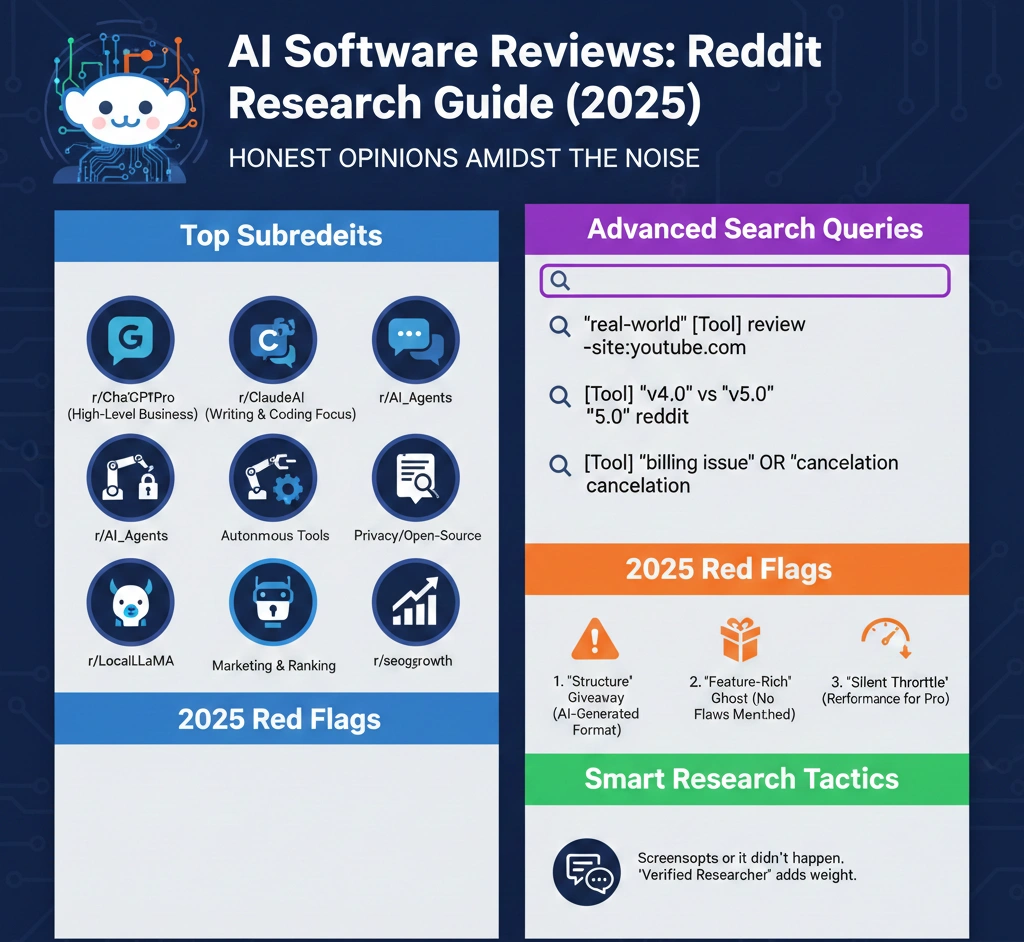
The Best Reddit Communities for AI Software Reviews
After years of monitoring AI discussions across Reddit, I’ve identified the communities that consistently provide substantive, honest feedback. Here’s where I spend most of my research time:
r/artificial (585K+ members)
This is my starting point for broad AI technology discussions. The community skews technical, which means you’ll find thoughtful analysis about how AI models actually work, not just surface-level impressions. When a new AI tool launches, someone here usually breaks down what’s genuinely innovative versus marketing hype.
Best for: Understanding AI capabilities, model comparisons, discussions about GPT-4 vs Claude vs open-source alternatives
Watch out for: Sometimes gets too academic; practical business use cases might be limited
r/ChatGPT (4.5M+ members)
Obviously essential if you’re researching ChatGPT, but this community also discusses AI writing tools, productivity apps, and plugins extensively. I’ve found detailed threads comparing ChatGPT Plus versus free tier, discussions about prompt engineering, and honest takes on what ChatGPT does well (and poorly).
Best for: ChatGPT-specific features, plugin reviews, prompt strategies, alternatives to ChatGPT
Watch out for: High volume means quality varies; sort by “top” and look for detailed posts, not quick reactions
r/ClaudeAI (86K+ members)
This community has exploded as Claude has become more popular. The discussions here tend to be more focused on practical applications—content creation, coding assistance, research tasks. I particularly appreciate the comparison threads between Claude and ChatGPT, which have helped me understand when to recommend one over the other to clients.
Best for: Claude-specific features, Anthropic product updates, writing quality comparisons
Watch out for: Smaller community means fewer niche use cases discussed; still growing
r/SaaS (206K+ members)
Not exclusively AI-focused, but invaluable for honest reviews of AI-powered SaaS tools. Founders and operators here share real numbers, integration experiences, and whether tools actually delivered ROI. I found a thread here that completely changed my perspective on AI customer support tools—turned out most were overpromising and underdelivering on automation.
Best for: Business software reviews, pricing discussions, ROI analysis, vendor comparisons
Watch out for: Some promotional content from SaaS founders; check post history
r/LocalLLaMA (186K+ members)
If you’re interested in running AI models locally or exploring open-source alternatives, this is the place. The community discusses Llama models, Mistral, and other alternatives to commercial APIs. I don’t recommend local models to most clients, but understanding what’s possible helps me make better recommendations about when commercial tools are worth the cost.
Best for: Open-source AI models, self-hosting options, technical comparisons, privacy-focused alternatives
Watch out for: Very technical; requires some AI/ML knowledge to follow discussions
r/ArtificialIntelligence (1.4M+ members)
Broader than software reviews, but excellent for understanding AI trends, ethical discussions, and long-term implications. When I need context about where AI technology is heading or want perspective on a tool’s sustainability, I check here.
Best for: Big-picture AI trends, ethical considerations, industry analysis
Watch out for: More philosophical than practical; not always focused on specific tools
r/MachineLearning (2.9M+ members)
Highly technical community focused on ML research and implementation. This isn’t where I go for user-friendly software reviews, but it’s invaluable for understanding what’s actually innovative versus repackaged existing technology. When an AI tool claims breakthrough performance, someone here has probably tested those claims.
Best for: Technical validation, understanding model capabilities, research paper discussions
Watch out for: Very technical; practical software reviews are rare

How I Actually Use Reddit for AI Software Research
Let me walk you through my actual process, which I’ve refined over hundreds of tool evaluations:
Step 1: Search strategically
I don’t just search for the tool name. I use specific query patterns that surface the most useful threads:
- “[Tool name] vs [competitor]” – Gets comparison discussions
- “[Tool name] worth it” – Finds ROI and value discussions
- “[Tool name] alternatives” – Surfaces options I might not have considered
- “[Tool name] disappointed” or “frustrated” – Reveals common pain points
- “[Tool name] use case” – Shows real applications
Step 2: Sort and filter intelligently
When I find a relevant thread, I always sort comments by “best” first, then switch to “top” to see what got the most initial traction. For time-sensitive information (like current pricing or recent feature updates), I filter posts by “past month” or “past year.”
Step 3: Evaluate comment quality
Not all Reddit comments are created equal. Here’s what I look for:
- Specificity: “The export feature doesn’t work” is less useful than “When I tried exporting 500 contacts to CSV, the file was corrupted and missing 30% of fields”
- Context: Does the commenter explain their use case? Their experience level?
- Balanced perspective: Comments that mention both strengths and weaknesses tend to be more reliable
- Recency: AI tools update frequently; a complaint from 18 months ago might no longer be relevant
- Follow-up engagement: Did the person respond to questions? That suggests genuine experience
Step 4: Check user history (sometimes)
If a comment seems suspiciously positive or negative, I’ll glance at the user’s history. Are they genuinely active in the community, or did they create an account just to promote (or trash) a tool? Five minutes of checking can reveal astroturfing or competitors bashing each other.
Step 5: Look for patterns, not individual opinions
One person saying “This tool is terrible” doesn’t mean much. Ten people independently mentioning the same issue? That’s a real problem. I mentally tally common themes: pricing concerns, feature requests, integration issues, customer support experiences.
Step 6: Cross-reference with other sources
Reddit is one data point. I’ll compare what I find there with G2 reviews, Product Hunt comments, Twitter discussions, and my own testing. If Reddit users love a tool but it performs poorly in my hands-on testing, I trust my experience. If Reddit criticism aligns with my own observations, that confirms the issue is widespread.
Red Flags to Watch For in Reddit AI Software Reviews
After reading thousands of AI tool discussions on Reddit, I’ve learned to spot warning signs that a comment might not be trustworthy:
Overly promotional language: If someone sounds like they’re reading from a marketing script—”This revolutionary AI-powered solution transformed my business overnight!”—I’m skeptical. Real users are more nuanced.
Account age and karma: A three-day-old account with no other activity posting glowing reviews? Probably astroturfing. Check if the account has genuine engagement in other communities.
Affiliate disclosures (or lack thereof): Some Redditors share referral links without disclosing they’re affiliates. Not necessarily bad, but it biases the recommendation.
Vague criticisms: “This tool sucks” tells me nothing. Why does it suck? What were you trying to do? What went wrong?
Outdated information: AI tools update constantly. A complaint about ChatGPT’s coding ability from 2022 isn’t relevant today. Always check post dates.
Comparing apples to oranges: Someone saying “Tool X is terrible compared to ChatGPT” might be using completely different use cases. Context matters.
Competitor shilling: Sometimes you’ll find users who consistently bash one tool while promoting an alternative across multiple threads. Check their comment history.
What Real Reddit Reviews Actually Look Like
Let me show you the difference between helpful and unhelpful Reddit feedback by sharing real patterns I’ve noticed:
Helpful review (paraphrased from r/ChatGPT):
“Been using ChatGPT Plus for six months for content outlines and research. Honestly, it’s worth it for my use case—I create 20+ blog outlines weekly, and the faster response times save me probably 3-4 hours a month. That said, the search feature (Browse with Bing) is super inconsistent. Sometimes it works great, other times it just fails to load sources. Also, if you’re just doing basic queries a few times a week, the free tier is probably fine. I upgraded because I hit rate limits constantly.”
What makes this helpful: Specific use case, timeframe, quantified benefits, honest drawbacks, clear recommendation based on context.
Unhelpful review:
“ChatGPT Plus is a scam. Total waste of money. Just use Claude instead.”
What’s wrong: No context, no explanation, no specific issues, just opinion without substance.
The best Reddit reviews tell a story. They explain what the person was trying to accomplish, what worked, what didn’t, and whether the tool is worth the investment for similar use cases. That’s the kind of feedback I actively seek out.
Using Reddit Reviews to Make Smarter AI Tool Decisions
Here’s how I translate Reddit research into actual purchasing decisions for myself and clients:
For individual users: If you’re a solo creator or professional, Reddit discussions often reveal whether a tool’s features match real workflows. When I was evaluating Jasper versus Copy.ai last year, Reddit threads showed me that Jasper had better long-form content capabilities, but Copy.ai was more affordable for shorter copy. That helped me recommend the right fit based on content needs and budget.
For teams: Reddit discussions about collaboration features, user management, and API reliability are gold. I discovered through r/SaaS that a popular AI writing tool had terrible team features—no version control, confusing permission settings, and slow collaboration. Saved my client from investing in something that wouldn’t scale.
For technical implementation: Developer perspectives on Reddit have warned me about API rate limits, integration challenges, and documentation quality before I committed to complex implementations.
For long-term viability: Reddit discussions sometimes surface concerning patterns—declining feature updates, unresponsive customer support, users jumping ship. These are early warning signs that a tool might not be a safe long-term bet.
My Honest Take on Reddit’s Limitations
Look, Reddit is incredibly valuable, but it’s not perfect. Here are the real limitations I’ve encountered:
Negativity bias: People are more likely to post when they’re frustrated than when everything works fine. A tool might have 10,000 happy users, but you’ll mostly read about the 50 who had problems.
Technical skill variation: Someone saying “This tool is too complicated” might just mean they’re not the target user. Context about technical skill level matters.
Different use cases: A tool that’s terrible for academic research might be perfect for marketing copy. Make sure the Reddit reviewer’s use case aligns with yours.
Outdated information: AI tools evolve fast. That pricing complaint from eight months ago? The company might have completely revamped their plans since then.
Echo chambers: Sometimes Reddit communities develop strong preferences. R/LocalLLaMA heavily favors open-source solutions, while r/ChatGPT users might overvalue OpenAI products. Recognize the bias.
Limited enterprise perspective: Most Reddit users are individuals or small teams. If you need enterprise-level features, you might not find relevant feedback.
Key Takeaways: Making Reddit Work for Your AI Tool Research
After years of using Reddit to research AI software, here’s what I’ve learned works best:
Start with the right communities—r/artificial, r/ChatGPT, r/ClaudeAI, and r/SaaS are my core research hubs. Each has different strengths, so choose based on what you need to learn.
Use strategic search queries that go beyond just the tool name. Look for comparisons, frustrations, use cases, and alternatives to get a complete picture.
Evaluate comment quality by looking for specificity, balance, context, and recency. One detailed comment from an experienced user beats ten vague hot takes.
Watch for red flags like promotional language, brand-new accounts, vague criticisms, and outdated information. Not every opinion is equally trustworthy.
Cross-reference Reddit feedback with your own testing, official reviews, and other community discussions. Reddit is one valuable data point, not the only one.
Recognize Reddit’s limitations—negativity bias, varying skill levels, and niche preferences can skew discussions. Factor these in when making decisions.
Your Next Step: Start Your Own Reddit Research
Here’s what I’d recommend doing right now: Pick an AI tool you’re currently evaluating (or considering), open Reddit, and search for “[tool name] vs” to find comparison threads. Spend 20 minutes reading through the top 5-10 most detailed comments. Pay attention to what experienced users say about real-world performance, not just feature lists.
You’ll probably discover something you didn’t know—a limitation the company doesn’t advertise, a workaround that makes the tool more valuable, or an alternative you hadn’t considered. That’s the power of Reddit: unfiltered insight from people who’ve actually used these tools in the trenches.
What AI tool are you researching right now? What’s your biggest question about it? Drop a comment below—I’d love to hear what you’re working on and might be able to point you toward specific Reddit threads or communities that could help.